
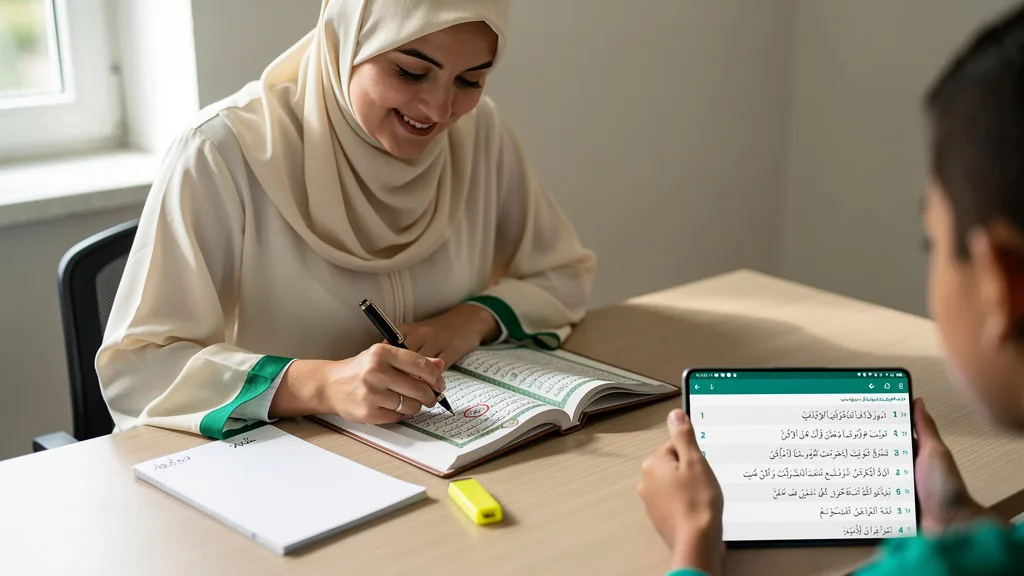
Are you ready to transform your recitation from correct to captivating? Moving beyond the basics of Tajweed is a profound step in your relationship with the Quran, and receiving guidance from an expert can illuminate the path. These tips are designed to help you refine the subtle details that distinguish a good reciter from a truly excellent one.
The most effective advanced Tajweed tips from a female Hafiza teacher focus on mastering the intricate attributes of each letter (Sifaat), perfecting difficult articulation points (Makharij), and understanding the art of pausing and starting (Waqf and Ibtida). This level of study moves beyond foundational rules to instill a deep, intuitive fluency that beautifies your recitation and honors the sacred text. It requires personalized feedback and consistent practice under the guidance of a qualified instructor.
What Are Advanced Tajweed Tips and Why Do They Matter?
Advanced Tajweed tips are specialized techniques that go beyond the foundational rules of recitation you learn in a beginner course like Noorani Qaida. While basic Tajweed covers essential rules like Noon Saakin and Tanween, advanced study delves into the very essence of each letter, its unique characteristics (Sifaat), and its relationship with neighboring letters. It also involves a sophisticated understanding of when and how to pause to preserve the intended meaning of the verses.
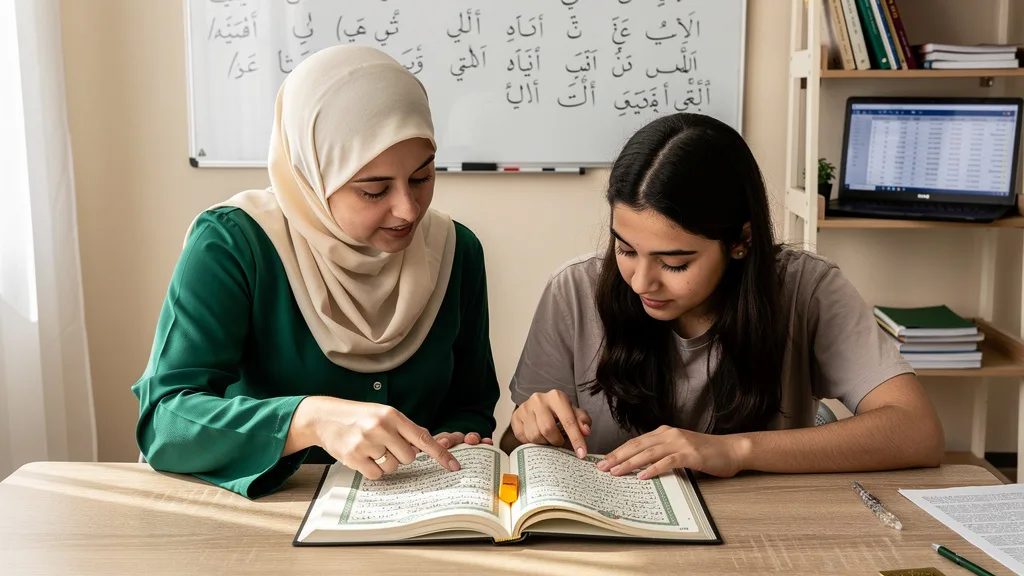
These advanced principles matter because they are the key to reciting the Quran as it was revealed to Prophet Muhammad (peace be upon him). Applying them correctly protects the reciter from both major and minor mistakes, some of which can inadvertently alter the meaning of the words. For sisters seeking to perfect their recitation in a comfortable environment, these advanced Tajweed tips from a female Hafiza teacher provide a clear and structured path toward achieving a beautiful, moving, and technically flawless connection with the words of Allah.
Refining Your Foundation: Key Rules for Flawless Recitation
Before diving into the complexities of advanced topics, you must ensure your foundation is rock-solid. True mastery in Tajweed is built upon the flawless application of its core principles. Without this, advanced techniques will lack the proper base to be effective. Revisit and perfect your understanding of the foundational rules until their application becomes second nature, like breathing while you recite.

Take time to review these essential areas. A qualified teacher can listen to your recitation and pinpoint subtle inconsistencies you may not notice yourself. This process of refinement is not a step back, it is the reinforcement needed to build higher. Many students find that dedicating time to perfecting these basics with an expert tutor significantly accelerates their progress when they later tackle more advanced concepts. This is a crucial step in preparing for an advanced tajweed program.
Mastering Advanced Articulation Points and Attributes (Makharij & Sifaat)
The heart of advanced Tajweed lies in the precise science of Makharij (articulation points) and Sifaat (attributes of the letters). While beginners learn where a letter originates, advanced students learn *how* it sounds and behaves in every context. This deep dive into the phonetics of the Arabic language is what creates the melodic and powerful recitation that touches the heart.

Mastering these concepts requires dedicated practice, a keen ear, and often, direct correction from a teacher who can demonstrate the sounds correctly. It involves training your mouth, tongue, and throat to produce sounds that may not exist in your native language. This is where one-on-one coaching becomes invaluable, especially for perfecting the nuances of difficult letters and their unique attributes.
Deepening Your Understanding of Sifaat al-Huruf (Letter Attributes)
Every Arabic letter has a set of attributes, or Sifaat, that define its unique sound. Advanced study goes beyond the primary attributes with opposites (like Hams/Jahr or Shiddah/Rakhawah) and focuses on the non-opposed attributes. These are the special characteristics that give certain letters their distinct flavor.
Key non-opposed attributes to master include:
- Al-Qalqalah: The 'bouncing' or 'echoing' sound on the five letters of (ق ط ب ج د) when they are saakin. Advanced study involves mastering the different levels of Qalqalah.
- As-Safeer: The 'whistling' sound associated with the letters (ص س ز).
- Al-Leen: The 'soft' sound of the diphthongs 'aw' and 'ay' when the waw or yaa are saakin and preceded by a fatha.
- At-Takrir: The 'trilling' of the tongue for the letter Ra (ر). The goal is to learn how to produce a single, precise trill, not an exaggerated roll.
- At-Tafash'shi: The 'spreading' of air in the mouth for the letter Sheen (ش).
- Al-Istitalah: The 'elongation' of the makhraj for the letter Dhad (ض), one of the most difficult letters to perfect.
Perfecting the Nuances of Difficult Makharij (Articulation Points)
Many students, even at an intermediate level, struggle with a few key articulation points. Perfecting these difficult Makharij is a hallmark of an advanced reciter. This requires focused effort to distinguish between similar-sounding letters and to produce them from their correct origin in the throat and mouth. For many sisters, getting this right requires the patient guidance of a female Tajweed teacher online who can provide a comfortable learning space.
Letters that require special attention include the 'Ayn (ع) and Ha (ح) from the throat, distinguishing them from the Hamza (ء) and ha (ه). Another common challenge is the letter Dhad (ض), which involves pressing the side of the tongue against the upper molars. Similarly, mastering the difference between similar-sounding pairs like Ta (ت) and Taa (ط), or Dhal (ذ) and Dhaa (ظ), is a critical aspect of advanced practice. This detailed work on articulation points is fundamental to authentic recitation.
Applying the Rules of Tafkheem and Tarqeeq (Heaviness and Lightness)
Tafkheem (heaviness) and Tarqeeq (lightness) refer to the quality of a letter's sound, specifically whether it is pronounced with a 'full mouth' or an 'empty mouth'. While some letters are always heavy (the seven letters of Isti'laa: خ ص ض غ ط ق ظ) and most are always light, some letters change based on their context. Mastering these conditional rules is a sign of an advanced student.
The primary letters with conditional rules are the letter Ra (ر), the Lam (ل) in the name of Allah (الله), and the Alif (ا) of elongation. For example, the letter Ra can be heavy or light depending on its vowel and the vowels of the letters surrounding it. Understanding these intricate rules ensures that the recitation has the correct resonance and texture, bringing the words to life exactly as intended.
| Condition of the Letter Ra (ر) | Rule | Example |
|---|---|---|
| Ra with a Fatha or Dammah | Tafkheem (Heavy) | رَحْمٰنِ , رُزِقْنَا |
| Ra is Saakin, preceded by a Fatha or Dammah | Tafkheem (Heavy) | مَرْيَمَ , الْقُرْآنُ |
| Ra is Saakin, preceded by a kasrah, followed by a heavy letter in the same word | Tafkheem (Heavy) | قِرْطَاسٍ , مِرْصَادًا |
| Ra is at the end of a word (waqf), preceded by a Saakin letter (not yaa), which is preceded by a fatha or dammah | Tafkheem (Heavy) | وَالْعَصْرْ , خُسْرْ |
Achieving Quranic Fluency: The Art of Pausing and Connecting
Quranic fluency is not just about speed; it's about flow, rhythm, and meaning. A significant part of this is mastering the art of Waqf (stopping) and Ibtida (starting). Knowing precisely where you can and cannot stop reciting is an advanced skill that has a profound impact on the listener's understanding. An incorrect pause can break the flow of the message or, in some cases, even corrupt the meaning.
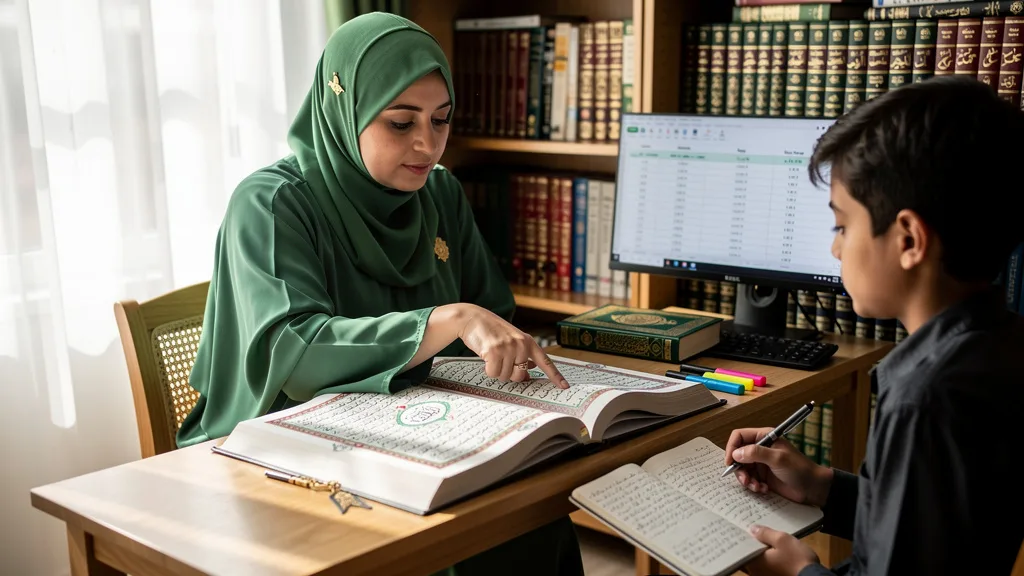
This skill moves beyond simply recognizing the stop signs written in the Mushaf. It involves a contextual understanding of the Arabic grammar and sentence structure within the verses. An advanced student learns to identify complete thoughts and grammatical breaks, allowing them to pause gracefully and resume recitation from a point that makes sense, thus preserving the integrity of the divine message.
Advanced Rules of Waqf and Ibtida (Stopping and Starting)
The science of Waqf and Ibtida classifies stops into several categories based on their grammatical and contextual appropriateness. While every reciter knows the mandatory stop (Waqf Lazim) and the forbidden stop, an advanced student learns to navigate the more nuanced stops to enhance their recitation. These are often taught in a structured tajweed program online with expert tutors.
The main types of stops to master are:
- Waqf at-Taam (The Complete Stop): Stopping at the end of a verse where the meaning is complete and has no grammatical connection to what follows. Starting with the next phrase is perfect.
- Waqf al-Kaafi (The Sufficient Stop): Stopping on a word where the meaning is complete, but the following phrase is grammatically related. It is permissible to stop and to start from the next word.
- Waqf al-Hasan (The Good Stop): Stopping on a word that completes the meaning, but is grammatically dependent on what follows. It is permissible to stop here, but it is better to start again from the word you stopped on or before it.
- Waqf al-Qabeeh (The Ugly Stop): Stopping at a place that gives an incomplete or incorrect meaning. This must be avoided, and if done by mistake, the reciter must go back and connect the words properly.
Understanding and Applying Sakt, Qat', and Waqf Lazim
Beyond the general categories of stops, there are specific types of pauses that have precise rules. Understanding these is a clear indicator of advanced Tajweed knowledge. They are not optional stylistic choices but are fixed rules of recitation in the narration of Hafs 'an 'Asim.
The three key terms to know are Sakt, Qat', and Waqf Lazim. A Sakt is a brief pause held for a moment without taking a breath, occurring in four specific places in the Quran. Qat' refers to cutting off the recitation with the intention of stopping completely, for example, at the end of a prayer or study session. Finally, Waqf Lazim (marked with a 'م') is a compulsory stop, where continuing to the next word would severely corrupt the meaning. Mastering these ensures your recitation is not only beautiful but also technically correct.
Common Mistakes to Avoid on Your Path to Mastery
As you progress to an advanced level, the mistakes you make become more subtle. It's no longer about mispronouncing entire letters but about fine-tuning the details. Being aware of these common pitfalls can help you focus your practice and seek specific feedback from your teacher. Many of these errors are simply old habits that were never fully corrected at the beginner stage.
Some of the most frequent mistakes seen in advanced students include inconsistent application of Madd (lengthening), where a 4-count Madd sometimes becomes 3 or 5. Another is the incomplete application of Ghunnah (nasalization) on the letters Noon and Meem. Students also struggle with maintaining Tafkheem (heaviness) on a heavy letter when it is next to a light letter, and vice versa. Recognizing these patterns is the first step, but correcting them often requires the trained ear of a guide who can identify the root of the error. You can learn more about avoiding common errors by reading about mistakes when learning Quran with a female teacher.
How to Find an Expert Female Teacher for Advanced Tajweed
Finding the right teacher is the single most important factor in your journey to mastering advanced Tajweed. You need more than just a native Arabic speaker; you need a qualified Hafiza or scholar who has an Ijazah (a license to teach) in Tajweed, connecting her back to the Prophet (peace be upon him). Such a teacher possesses a deep knowledge of these intricate rules and has the experience to diagnose and correct subtle errors.
For many sisters, learning with a female teacher provides a more comfortable and focused environment. Online platforms have made it easier than ever to connect with highly qualified female tutors from around the world. When searching, look for an academy that offers one-on-one classes, as personalized feedback is essential at this level. A trial session is also a great way to assess the teacher's style and ensure she is a good fit for your learning goals. Finding the right female Quran teacher online can make all the difference in your progress.
"Finding a qualified female Hafiza teacher who understands the nuances of advanced Tajweed is the single most important step in perfecting your recitation. Personalized feedback is something you can't get from a video or an app; it requires a human connection and expert knowledge."
Key Takeaways
Perfecting your recitation is a beautiful and rewarding journey. As you move into advanced Tajweed, remember these key principles to guide your study and practice. Focusing on these areas will help you develop the fluency and precision of a truly accomplished reciter.
- Mastery Requires a Strong Foundation: Before tackling advanced concepts, ensure your knowledge of basic Tajweed rules is flawless.
- Focus on Sifaat and Makharij: The essence of advanced Tajweed lies in the subtle attributes (Sifaat) and precise articulation points (Makharij) of each letter.
- The Art of Pausing is Critical: Proper use of Waqf (stopping) and Ibtida (starting) preserves the meaning of the Quran and is a hallmark of an expert reciter.
- Avoid Subtle, Common Mistakes: Be vigilant about inconsistencies in Madd, Ghunnah, and the qualities of Tafkheem/Tarqeeq.
- A Qualified Teacher is Non-Negotiable: You cannot master advanced Tajweed alone. Seek out a certified female teacher who can provide one-on-one, personalized feedback.
Frequently Asked Questions
What are the 7 essential rules of Tajweed?
While Tajweed has many rules, a core set often considered essential for beginners includes: the rules of Noon Saakinah and Tanween (Izhar, Idgham, Iqlab, Ikhfa), the rules of Meem Saakinah (Ikhfa Shafawi, Idgham Shafawi, Izhar Shafawi), the rules of Madd (lengthening), the rules of Qalqalah (vibration), Tafkheem and Tarqeeq (heaviness and lightness), the articulation points (Makharij), and the attributes of the letters (Sifaat). Mastering these forms a solid foundation.
What is the 3/10 hifz method for memorization?
The 3/10 hifz method is a popular strategy for Quran memorization (Hifz). It involves memorizing three new lines of the Quran each day and then revising the ten previous lines you memorized. This creates a balanced system of learning new material while consistently strengthening your recall of recent lessons. This structured approach helps build long-term retention and prevents you from forgetting what you've already worked hard to learn, making it a sustainable practice for a long journey.
How can you become a hafiz in 2 years?
Becoming a Hafiz (one who has memorized the entire Quran) in two years is an ambitious but achievable goal that requires immense dedication. A typical plan involves memorizing one page per day, five days a week, with two days for revision. This requires consistency, a distraction-free environment, and a strong relationship with a qualified teacher for correction and motivation. Seeking advice from others who have completed this journey, like in discussions about any advice from hafiza sisters, can also provide valuable insight and support.
Where can I find an advanced Tajweed course online?
You can find an advanced Tajweed course online through specialized Islamic educational platforms. Academies like Hidayah Quran Academy offer private, one-on-one classes with qualified female Hafiza teachers who are experts in advanced Tajweed. These courses are conducted via platforms like Zoom or WhatsApp, providing personalized feedback and a flexible schedule for students worldwide. Look for programs that offer a free trial to ensure the teaching style meets your specific learning needs for advanced study.
Conclusion
Embarking on the path of advanced Tajweed is a testament to your love for the Quran and your desire to connect with it on the deepest level. The journey from basic recitation to masterful fluency is built on understanding the intricate details of every letter, the rhythm of every pause, and the profound impact these subtleties have on meaning. The advanced Tajweed tips shared here are your starting point for this beautiful and rewarding endeavor.
Remember that the most crucial element in this journey is not a book or an app, but the living tradition passed down through a qualified teacher. Personalized feedback is essential to unlearn small habits and perfect the nuances that your own ear might miss. A female Hafiza teacher can provide not only expert knowledge but also a supportive and comfortable environment for sisters to truly flourish in their recitation.
Ready to take your recitation to the next level with expert, one-on-one guidance? At Hidayah Quran Academy, our certified female teachers specialize in helping sisters and children master the art of Tajweed. We invite you to experience our approach with a complimentary 30-minute trial class. Let us help you beautify your connection with the Quran. Book Free Trial today and begin your journey toward recitation mastery.