
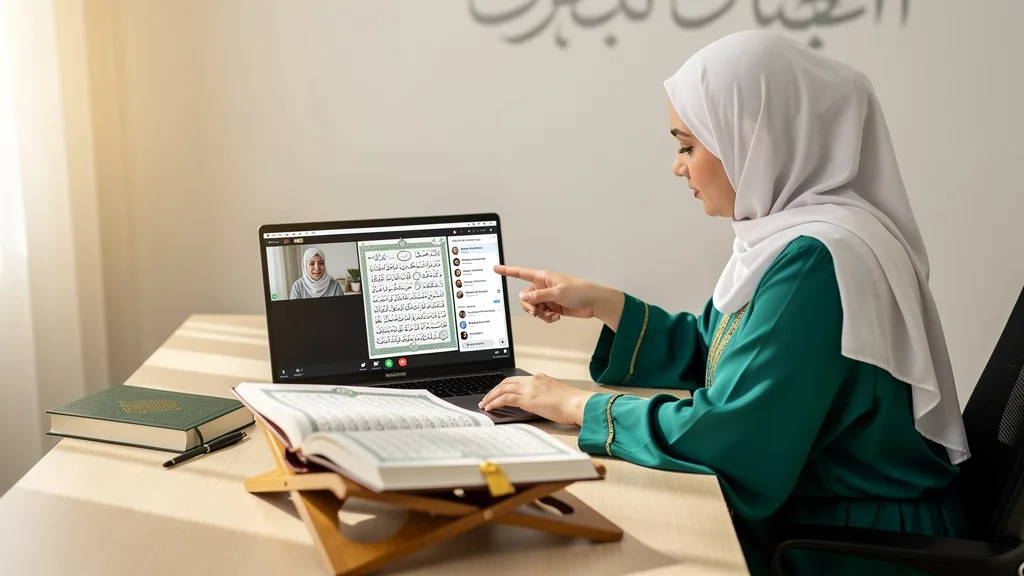
Are you considering learning Arabic but feel unsure where to start? The path to understanding this rich language can seem complex, especially when faced with terms like Quranic Arabic and Modern Standard Arabic. Choosing the right one depends entirely on your goals: do you wish to connect with the divine text of the Quran on a deeper level, or do you want to communicate with people across the Arab world today? Understanding the distinction is the first step in your learning journey.
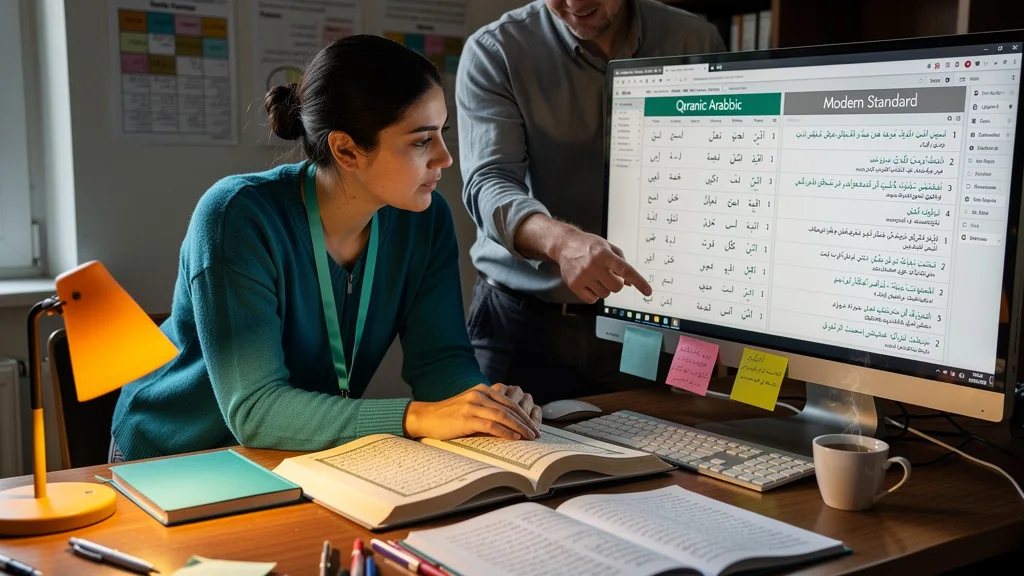
The core difference between Quranic Arabic and Modern Standard Arabic (MSA) is their purpose and era. Quranic Arabic, also known as Classical Arabic, is the language of the Quran and classical Islamic literature, characterized by its complex grammar and ancient vocabulary. In contrast, Modern Standard Arabic is the contemporary, standardized form used in books, news media, and formal situations across the Arab world, adapted with modern terminology.
Understanding Quranic Arabic: The Language of Revelation
Quranic Arabic is the form of the Arabic language found in the Quran, the holy book of Islam. Muslims believe it to be the direct word of Allah, revealed to the Prophet Muhammad (peace be upon him) in the 7th century. This form is revered for its eloquence, depth, and spiritual significance. It serves as the foundation of Islamic theology, law, and literature, and its mastery is essential for anyone seeking a profound understanding of these subjects.
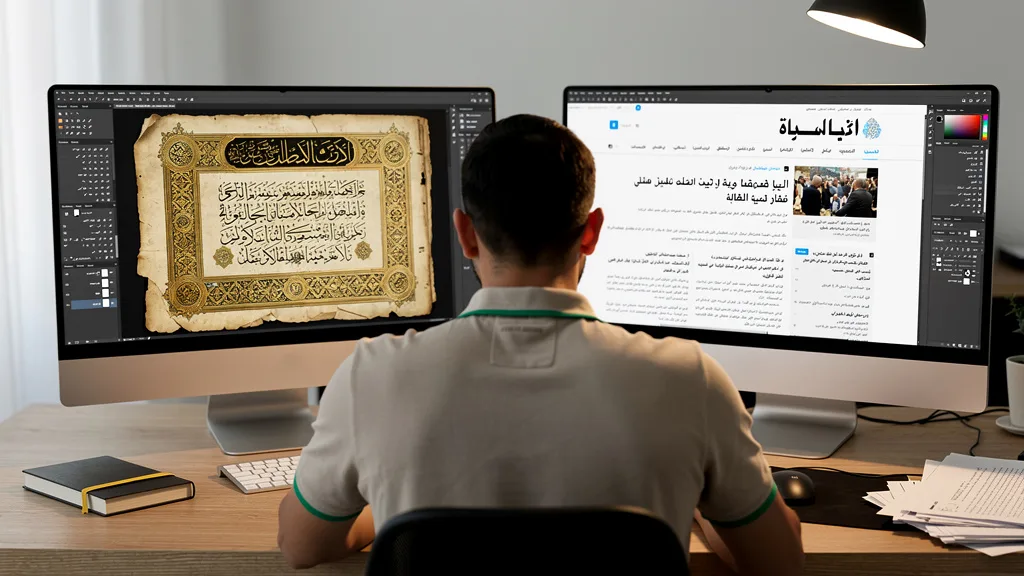
The language itself is known for its intricate grammatical system, known as ʾIʿrāb (case endings), which adds layers of meaning that can be lost in translation. Every word and grammatical structure in the Quran is considered perfect and divinely chosen, making its study an act of worship for believers. Learning Quranic Arabic allows you to engage directly with the sacred text, appreciating its literary beauty and unlocking its deeper spiritual messages without relying on intermediaries.
Its Connection to Classical Arabic
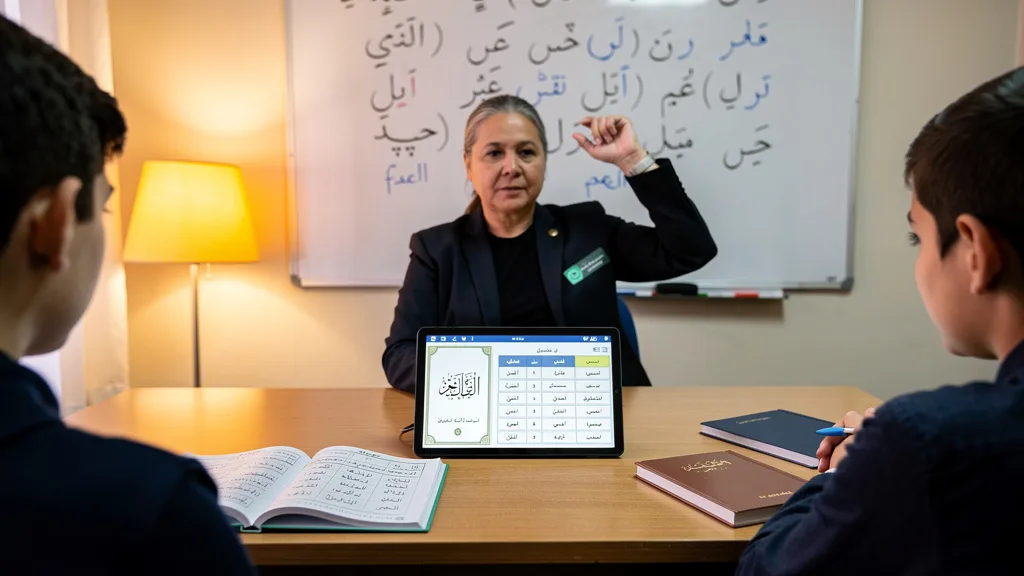
The terms Quranic Arabic and Classical Arabic are often used interchangeably, and for good reason. Quranic Arabic is the most prominent and preserved example of Classical Arabic. The Quran set the definitive standard for Arabic grammar and rhetoric, a standard that Arab poets and scholars of the classical period emulated. Therefore, all Quranic Arabic is Classical Arabic, but the term Classical Arabic can also encompass other literature from that era, such as pre-Islamic poetry and early scholarly works.
Essentially, the Quran represents the pinnacle of Classical Arabic, providing the ultimate reference for its grammatical rules and stylistic features. When you study Quranic Arabic, you are learning the purest form of Classical Arabic. This is the language that has been meticulously preserved for over 1400 years through the continuous recitation and study of the Quran by Muslims worldwide, making it a stable and unchanging linguistic form.
Defining Modern Standard Arabic (MSA): The Lingua Franca
Modern Standard Arabic, often abbreviated as MSA, is the contemporary iteration of the Arabic language used in formal contexts throughout the Arabic-speaking world. It evolved from Classical Arabic during the 19th century to accommodate the needs of the modern era. Think of it as the universal formal language that a Moroccan can use to understand a news broadcast from Egypt or read a newspaper from Saudi Arabia.
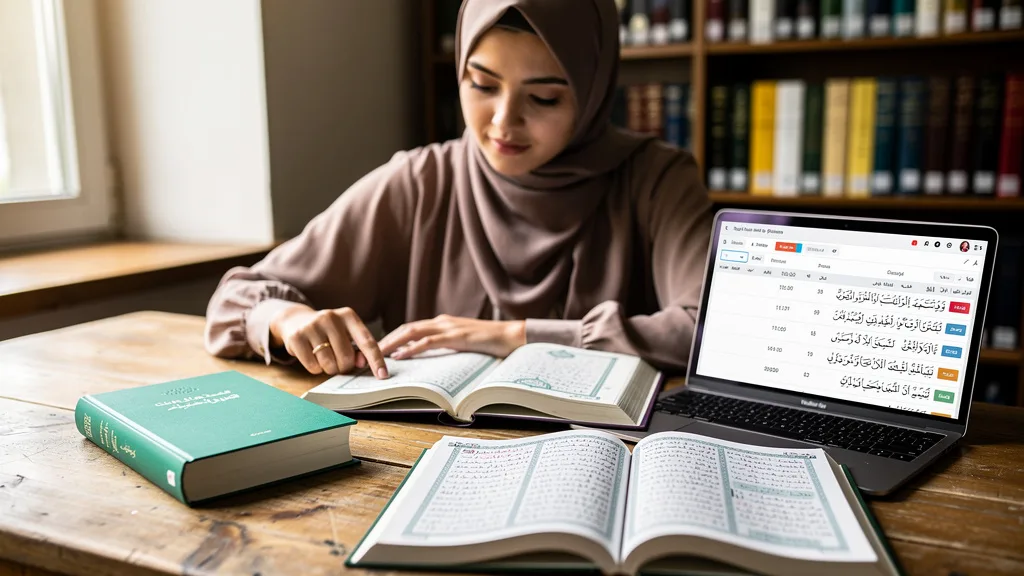
MSA is the language of education, literature, media, and politics. It's what you will hear on news channels like Al Jazeera, read in modern novels and official documents, and be taught in universities as 'Arabic'. However, it is important to note that virtually no one speaks MSA in their daily, informal conversations. For everyday life, people use their local spoken dialects (Aammiyya), which can differ significantly from one country to another.
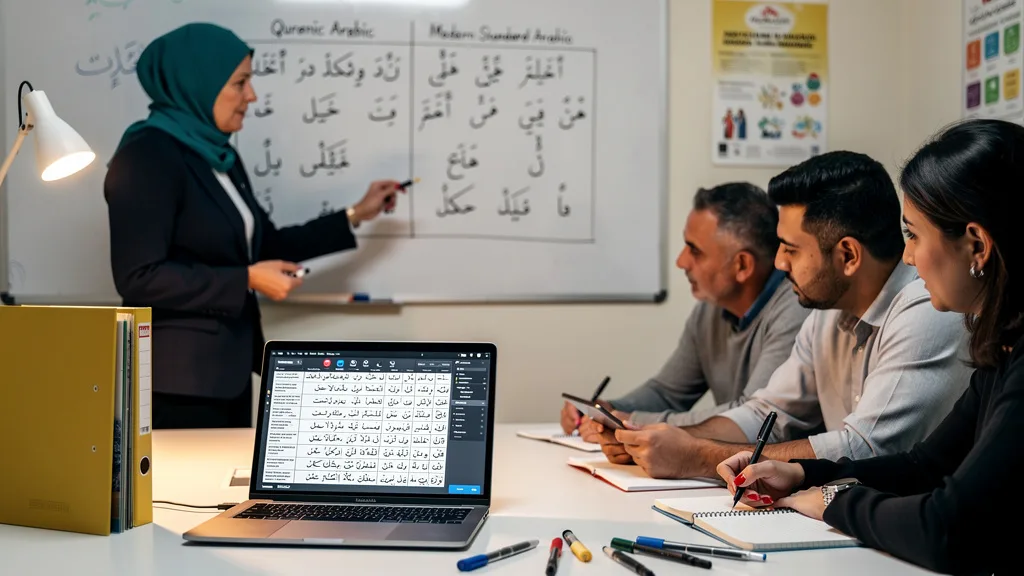
The Role of MSA in the Modern Arab World
In 2026, the role of MSA is more critical than ever as a unifying force in a region with diverse spoken dialects. It provides a shared linguistic platform for over 400 million Arabic speakers, facilitating communication in professional and academic spheres. If you plan to do business, work in diplomacy, or engage in academic research related to the Arab world, learning MSA is indispensable.
MSA bridges the gap between the various colloquial dialects. While an Iraqi and a Tunisian might struggle to understand each other's local dialect, they can switch to MSA for clear and formal communication. This makes MSA the practical choice for learners whose primary goal is to engage with the modern Arab world through its media, literature, and formal interactions. It is the key to accessing a vast amount of contemporary information and culture.
While MSA is a direct descendant of Classical Arabic, several key differences in vocabulary, grammar, and usage distinguish the two. Understanding the Quranic Arabic vs Modern Standard: Key Differences is crucial for aligning your learning strategy with your personal or professional objectives. The primary distinction lies in evolution; Quranic Arabic is preserved and unchanging, while MSA is dynamic and adapts to the modern world.
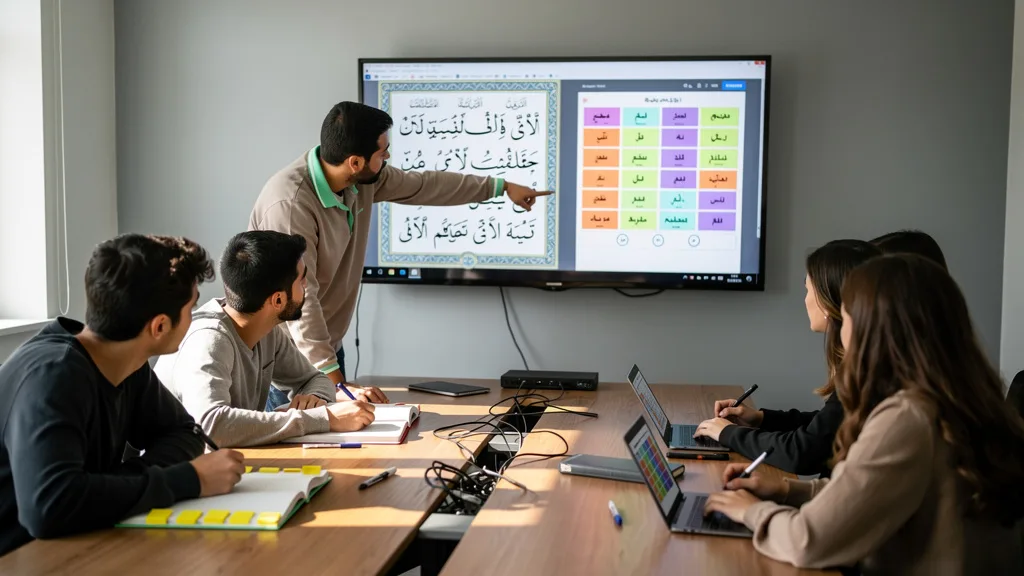
These distinctions are not merely academic. They have practical implications for comprehension and use. A student of MSA might read a newspaper with ease but find the Quran's text challenging, while a student of Quranic Arabic will connect deeply with religious texts but may not know the word for 'airport' or 'internet'. The following sections break down these differences in more detail.
To provide a clear overview, here is a table summarizing the primary distinctions:
| Feature | Quranic Arabic (Classical) | Modern Standard Arabic (MSA) |
|---|---|---|
| Vocabulary | Archaic, poetic, and specific to 7th-century context. Lacks modern terms. | Includes classical words plus loanwords and neologisms for modern concepts (e.g., كمبيوتر - computer). |
| Grammar | Complex and fully expressed case endings (ʾIʿrāb) are mandatory for meaning. | Grammar is simplified. Case endings are often unpronounced in speech, though written in formal texts. |
| Pronunciation | Governed by strict rules of Tajweed for precise and beautiful recitation. | Pronunciation is more relaxed and can be influenced by local dialects. |
| Primary Usage | Religious worship, prayer, Islamic scholarship, and classical literature. | Formal communication: news, books, politics, academia, and official documents. |
Vocabulary and Lexicon
One of the most noticeable differences is in the vocabulary. Quranic Arabic uses words and expressions that, while deeply meaningful, are now archaic and not part of everyday language. These words carry immense rhetorical and spiritual weight within the context of the Quran. For example, words describing specific theological concepts, ancient customs, or natural phenomena of the Arabian Peninsula are central to the Quranic text.
Conversely, MSA has evolved to describe the modern world. It has either created new words (neologisms) from classical roots or borrowed terms from other languages (loanwords) for concepts like technology, politics, and science. Words like 'internet' (إنترنت), 'democracy' (ديمقراطية), and 'television' (تلفزيون) are standard in MSA but are entirely absent from the classical lexicon. This lexical gap is a major reason why proficiency in one form does not guarantee fluency in the other.
Grammar and Sentence Structure
The grammatical structure of Quranic Arabic is significantly more complex than that of MSA. The most prominent feature is the rigorous application of ʾIʿrāb, the system of vowel markings at the end of nouns and verbs to denote their grammatical function in a sentence (e.g., subject, object). In Quranic recitation, these endings are fully pronounced and are critical for accurate meaning. For example, a slight change in a final vowel can change the entire meaning of a verse.
While MSA retains the rules of ʾIʿrāb in its written form, these case endings are almost always dropped in pronunciation, except in the most formal of speeches. This simplification makes spoken MSA feel less grammatically rigid. Furthermore, sentence structures in MSA tend to be more direct and aligned with modern prose, whereas Quranic Arabic often employs highly sophisticated and poetic structures that contribute to its inimitable nature.
Pronunciation and Phonetics
Pronunciation in Quranic Arabic is a science in itself, known as Tajweed. Tajweed provides a set of rules governing the exact articulation of every letter and sound to ensure the Quran is recited exactly as it was revealed to the Prophet Muhammad (peace be upon him). This includes precise rules for guttural sounds, the length of vowels, and assimilation of consonants. Mastering Tajweed is a spiritual discipline that preserves the phonetic integrity of the divine text.
In MSA, while clarity is important, the strict rules of Tajweed are not applied. The pronunciation is more standardized but can also be influenced by a speaker's native dialect. The focus is on intelligible communication rather than the perfect, melodic recitation required for the Quran. Learning the basics of pronunciation is key, and understanding the Arabic alphabet and its sounds is the foundational first step for either path.
Primary Usage and Context
The context in which each form is used is perhaps the most straightforward differentiator. Quranic Arabic is the language of worship. It is used in daily prayers (Salah), for reciting the Quran, and for studying classical Islamic texts. Its purpose is primarily spiritual and academic, connecting a Muslim directly to God and a 1400-year-old scholarly tradition. Its use is static and tied to religious practice.
Modern Standard Arabic, by contrast, is the language of modern life and formal communication. It is a practical tool for engaging with the contemporary Arab world. You would use MSA to read a novel by Naguib Mahfouz, watch a political debate, or write a formal email to a company in Dubai. Its context is public, professional, and intellectual, serving as the modern era's official linguistic standard.
Which Form of Arabic Should You Learn?
The decision of which form of Arabic to learn should be a direct reflection of your personal, spiritual, or professional goals. There is no single 'best' form of Arabic; there is only the best form for your specific needs. By honestly assessing your motivations, you can choose a path that is both fulfilling and effective, preventing you from investing time in a version of the language that doesn't align with your objectives.

Whether you dream of reading the Quran in its original form or navigating a business meeting in Riyadh, clarity of purpose is key. Both paths are rewarding and offer unique windows into the vast and diverse Arab-Islamic civilization. The following sections provide clear guidance based on these distinct goals.
"Choosing between Quranic Arabic and Modern Standard Arabic is the first and most important decision for any student. One path leads to the spiritual heart of Islam, and the other to the intellectual and professional heart of the modern Arab world. Your 'why' determines your 'what'."
Learning for Religious and Classical Studies
If your primary motivation is to understand the Quran, engage with the Hadith (sayings of the Prophet Muhammad ﷺ), and study classical Islamic jurisprudence (Fiqh) and theology, then you must learn Quranic Arabic. There is no substitute. Translations, while helpful, cannot capture the full depth, nuance, and beauty of the original text. Learning Quranic Arabic is an act of devotion that unlocks a direct and personal connection with the divine message.
This path is ideal for students of Islam, aspiring scholars, and any Muslim who wishes to deepen their faith and Salah (prayer). A structured approach focusing on classical grammar, Quranic vocabulary, and Tajweed is essential. Working with a tutor who specializes in this area, such as a dedicated female Quran teacher online, can provide the personalized guidance needed for this sacred journey.
Learning for Communication and Business in 2026
If your goal is to communicate with Arabic speakers, travel in the Middle East and North Africa, or pursue a career in business, journalism, diplomacy, or translation, then Modern Standard Arabic is the correct choice. MSA is the language of commerce and culture in the contemporary Arab world. It will enable you to read books and newspapers, understand news broadcasts, and interact in formal and professional settings across more than 20 countries.
While MSA won't help you converse with a shopkeeper in the market (that's where local dialects come in), it is the essential gateway to any formal interaction. It is the language taught in universities and foreign service institutes worldwide for this reason. Learning MSA provides a strong foundation that can also make it easier to pick up a specific spoken dialect later on.
Can You Understand the Quran if You Learn MSA?
A common question is whether learning Modern Standard Arabic will enable you to understand the Quran. The answer is partially, but not fully. An MSA learner will certainly have a significant advantage over someone with no Arabic knowledge. You will recognize a substantial amount of shared vocabulary and basic grammatical structures, allowing you to grasp the general meaning of many verses.
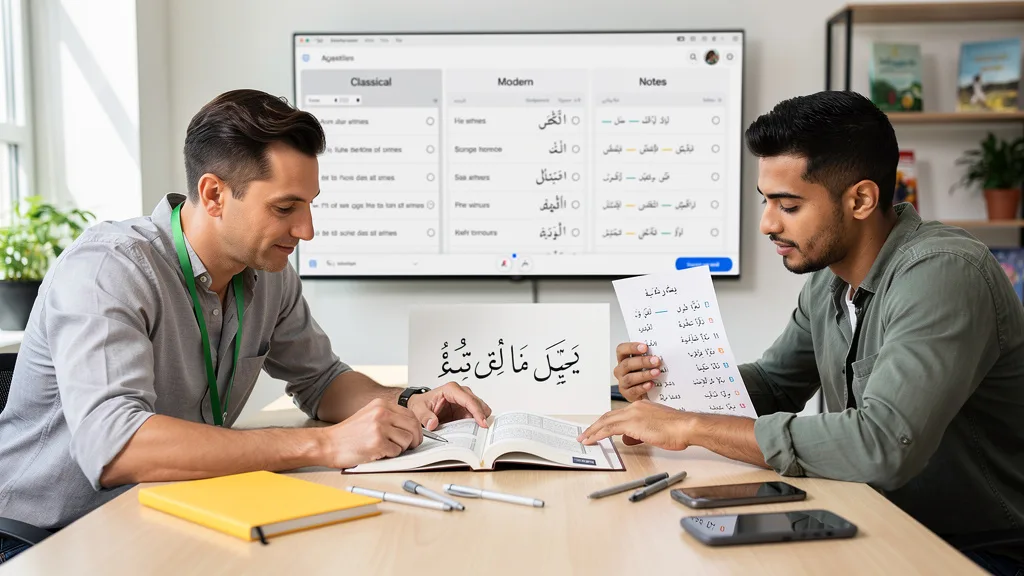
However, this understanding will be superficial. You will miss the profound rhetorical devices, the intricate grammatical nuances of ʾIʿrāb that alter meaning, and the specific context of archaic vocabulary. It is akin to a modern English speaker trying to read Shakespeare or Chaucer; you recognize the words, but the deep meaning, poetry, and cultural context are often lost. For a true, deep comprehension of the Quran, a dedicated study of its specific classical form is necessary.
Key Takeaways
Navigating the differences between Quranic and Modern Standard Arabic is the first step toward a successful learning journey. To simplify your decision, here are the essential points to remember:
- Purpose Defines the Path: Your primary goal determines which form to learn. For religious understanding, choose Quranic Arabic. For modern communication and business, choose Modern Standard Arabic (MSA).
- Vocabulary is a Key Differentiator: Quranic Arabic uses an ancient, poetic lexicon, while MSA incorporates modern terminology for concepts like technology and politics.
- Grammar Varies in Complexity: Quranic Arabic features a complex and fully utilized grammatical case system (ʾIʿrāb) that is essential for meaning, whereas MSA simplifies this in spoken practice.
- One Does Not Equal the Other: Fluency in MSA provides a helpful foundation but is not sufficient for a deep, nuanced understanding of the Quran. Dedicated study of the classical form is required for that purpose.
- Both are Gateways: Learning either form of Arabic opens a door to a rich and profound civilization, whether your interest is spiritual heritage or contemporary culture.
Frequently Asked Questions
Is Modern Standard Arabic worth learning?
Yes, Modern Standard Arabic is absolutely worth learning if your goal is to engage with the modern Arab world. It is the language of literature, news media, politics, and academia across more than 20 countries. Learning MSA allows you to read contemporary books, understand regional news, and communicate in any formal or professional setting, making it an invaluable skill for business, diplomacy, and travel.
Furthermore, MSA provides a strong linguistic base that can make it easier to understand or learn one of the many spoken Arabic dialects. It serves as the bridge connecting all forms of Arabic, making it a strategic and practical choice for most secular learners.
Is Classical Arabic the same as Quranic Arabic?
Classical Arabic and Quranic Arabic are very closely related, and the terms are often used interchangeably. However, there is a subtle distinction. Quranic Arabic refers specifically to the form of the language used in the Quran. Classical Arabic is a slightly broader term that includes the language of the Quran as well as other literature from the early Islamic era and pre-Islamic period, such as poetry and prose.
The Quran is considered the highest and most perfect example of Classical Arabic, and it single-handedly standardized the language's grammar and style. Therefore, when you study Quranic Arabic, you are studying the pinnacle and primary source of Classical Arabic.
How difficult is it to transition from MSA to Quranic Arabic?
The transition from MSA to Quranic Arabic is challenging but manageable, and your MSA knowledge provides a significant head start. You will already be familiar with the script, core vocabulary, and basic grammatical principles. The main difficulty lies in mastering the complex case ending system (ʾIʿrāb), learning archaic vocabulary, and understanding the sophisticated rhetorical structures unique to the Quran.
Think of it as advancing from an undergraduate to a postgraduate level of study. It requires dedicated effort and specialized instruction, but the foundation is already there. Working with the best online Quran tutor can make this transition smoother by focusing specifically on bridging these gaps.
Can native Arabic speakers today easily understand the Quran?
While native Arabic speakers who are educated in MSA can understand the basic meaning of many Quranic passages, they cannot easily grasp its full depth without specialized study. The linguistic gap is significant enough that many archaic words and complex grammatical structures are unfamiliar to the average speaker. They might understand the story but miss the theological and rhetorical brilliance.
Full and deep comprehension of the Quran requires knowledge of classical tafsir (exegesis), grammar (nahw), and rhetoric (balagha). This is why even in the Arab world, the Quran is a subject of deep and continuous study, not something that is passively understood just by being a native speaker.
Are there language schools that offer courses in both forms?
Yes, many institutions offer courses in both forms of Arabic. Universities with strong Middle Eastern studies departments often have separate tracks for Modern Standard Arabic and Classical or Quranic Arabic. Additionally, there are numerous specialized online platforms and language schools that cater to specific student goals.
For learners focused on religious studies, organizations like Hidayah Quran Academy offer dedicated programs in Quranic Arabic, Tajweed, and Hifz (memorization). These specialized courses provide the focused instruction necessary to engage directly with the sacred text in a private, supportive environment.
Conclusion
Choosing between Quranic Arabic and Modern Standard Arabic is a foundational decision that shapes your entire learning experience. As we've explored, the two forms serve distinct purposes. Quranic Arabic is the sacred, unchanging language of revelation, your key to a deeper spiritual connection and understanding of Islamic heritage. Modern Standard Arabic is the dynamic, practical language of contemporary life, your bridge to communicating and functioning in the formal spheres of the modern Arab world.
Your personal 'why' is the most important factor. If your heart is set on understanding the words of Allah in your prayers and reading the Quran without a translator, then the path of Quranic Arabic is your calling. If your career or travels require you to read Arabic news and communicate professionally, MSA is the necessary tool. Recognizing this distinction saves you time and sets you on a course for success.
Ultimately, both paths offer immense rewards. One provides a connection to a divine literary miracle and a 1,400-year-old tradition, while the other opens doors to a vibrant and diverse culture of over 400 million people. Whichever you choose, embarking on the journey to learn Arabic is a deeply enriching endeavor.
Ready to begin your journey with the language of the Quran? Our qualified female tutors provide private, one-on-one lessons for sisters and children, tailored to your goals. Start with a complimentary 30-minute trial to experience our approach. Book Free Trial.