
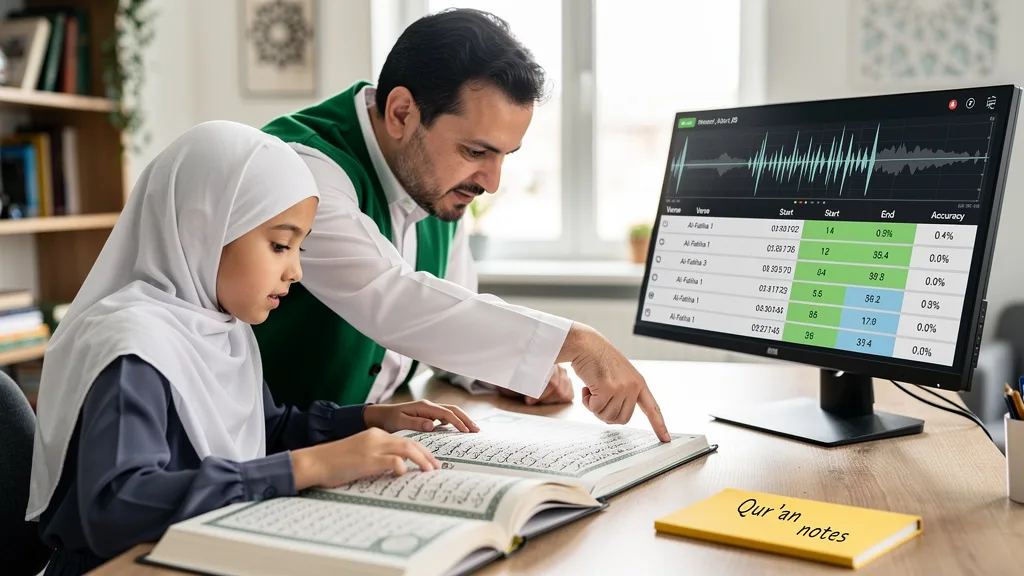
Have you ever listened to a beautiful Quran recitation and wished you could recite with the same clarity and precision? The journey to perfecting your pronunciation is a deeply rewarding spiritual and educational pursuit. It connects you more profoundly with the words of Allah (SWT) and ensures the message is conveyed as it was revealed.
To achieve an accurate accent in Quran recitation, you must learn and apply the rules of Tajweed, which govern pronunciation. This involves mastering the points of articulation (Makharij) and the attributes of each letter (Sifat). The most effective method is studying with a qualified teacher who can provide personalized feedback, supplemented by practice with modern learning apps. This combination ensures you build a correct and beautiful recitation style.
Why an Accurate Accent (Tajweed) Is Crucial for Recitation
Reciting the Quran with a proper accent, known as Tajweed, is not merely about aesthetics; it is fundamental to preserving the meaning of the divine text. The Arabic language is incredibly precise, and a small shift in pronunciation can drastically alter the meaning of a word, sometimes leading to unintentional error or even blasphemy. Therefore, learning Tajweed is a responsibility for every Muslim who wishes to recite the Quran correctly.

The primary goal of Tajweed is to recite the Quran in the same manner as the Prophet Muhammad (peace be upon him). This practice honors the sacredness of the text and deepens your connection to it. When you make a conscious effort to pronounce each letter correctly, you are engaging with the Quran on a much more intimate level, which enhances your focus, understanding, and spiritual reward during worship.
"Mastering Tajweed is like unlocking the true melody of the Quran. It transforms recitation from simple reading into a profound act of worship, ensuring every word is delivered with the weight and beauty it deserves. For anyone serious about their relationship with the Quran, learning how to achieve an accurate accent in Quran recitation is the essential next step."
Mastering the Core Components: Makharij and Sifat
To perfect your Quranic accent, you must focus on two foundational elements of Tajweed: Makharij (the points of articulation) and Sifat (the attributes of the letters). These two components work together to give each Arabic letter its unique sound and identity. Without a solid understanding of both, achieving a truly accurate recitation is impossible.
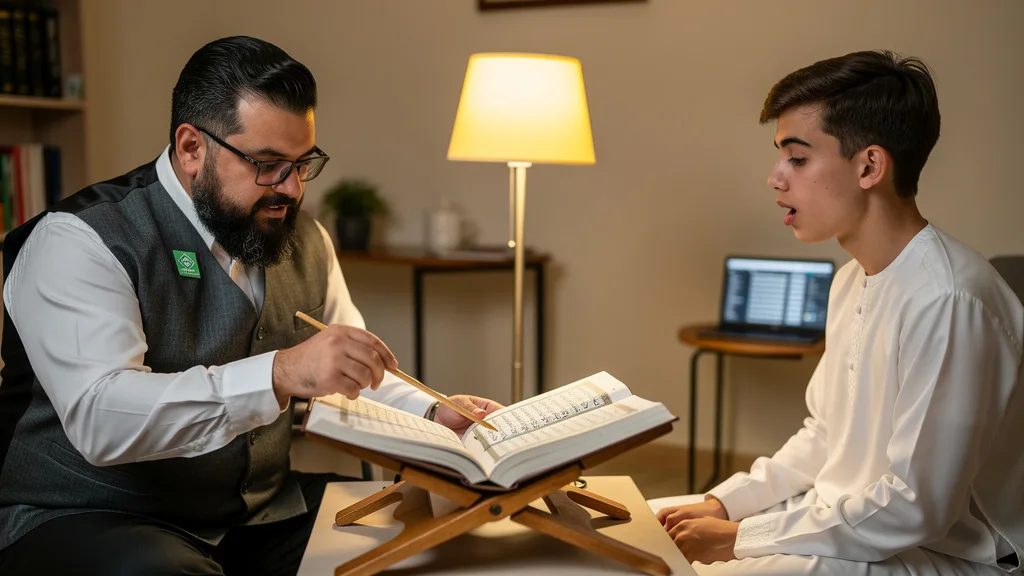
Think of Makharij as the birthplace of a letter and Sifat as its personality. Just as a person's origin and character define who they are, these two principles define how a letter sounds. Diligent study and practice of Makharij and Sifat under the guidance of a knowledgeable teacher are the building blocks for a beautiful and correct recitation that pleases Allah (SWT).
Understanding the Points of Articulation (Makharij)
Makharij refers to the specific points in the mouth and throat from which each Arabic letter originates. There are five main areas of articulation: the throat, the tongue, the lips, the nasal cavity, and the empty space in the mouth and throat. Within these areas, there are 17 distinct articulation points for the 29 letters of the Arabic alphabet.
Learning Makharij requires careful listening and imitation. A qualified teacher can demonstrate the exact placement of the tongue, the shape of the lips, and the use of the throat for each letter. For non-Arab speakers, this is often the most challenging part of learning Tajweed, as many Arabic sounds do not have equivalents in other languages. Consistent practice and correction are key to training your mouth to produce these sounds naturally and accurately.
Perfecting the Attributes of Letters (Sifat)
Once you know where a letter is produced (Makharij), you must learn how to produce it, which is governed by its Sifat, or attributes. Sifat are the characteristics that give each letter its distinct sound quality, such as heaviness (Tafkhim), lightness (Tarqiq), vibration (Qalqalah), or the continuation of breath (Hams). Each letter has a set of permanent attributes that must be applied every time it is recited.
For example, the letters ق (Qaf) and ك (Kaf) are produced from nearby points on the tongue, but their Sifat are very different. Qaf is a heavy letter pronounced from the back of the tongue, while Kaf is a light letter. Mastering these subtle but crucial differences is what separates a novice recitation from an advanced one. A good teacher will break down these attributes and provide exercises to help you perfect them.
How to Find a Qualified Qari for One-on-One Lessons
Finding a qualified Qari or Qaria (male or female teacher) is the most critical step in your journey to accurate recitation. A good teacher provides the personalized feedback, correction, and encouragement that self-study methods lack. Look for a teacher who is not only fluent in recitation but also has a formal certification, known as an Ijazah, which is a license that traces their knowledge back to the Prophet Muhammad (PBUH).
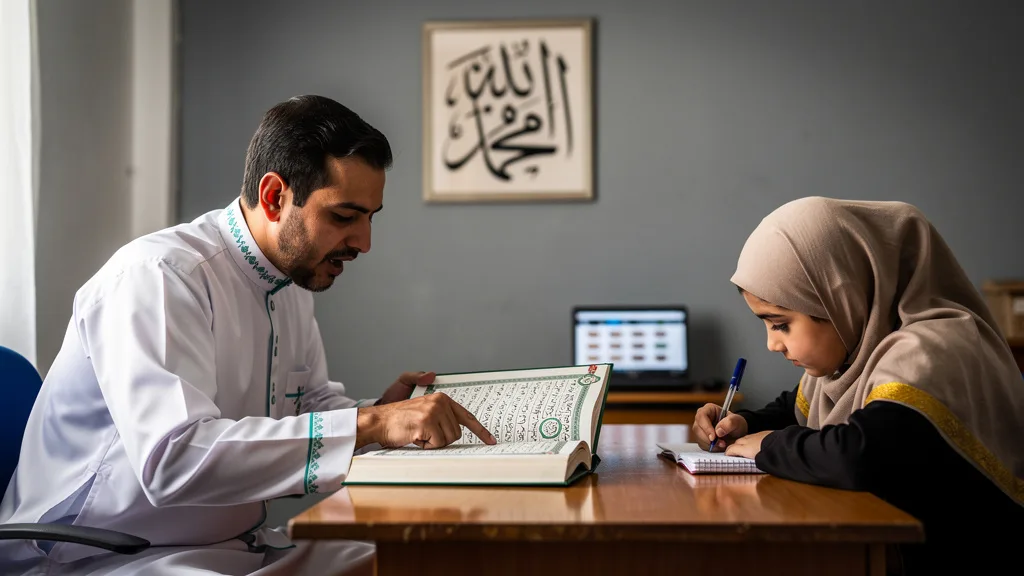
In 2026, online platforms have made it easier than ever to connect with certified instructors globally. When searching for an instructor, ask about their qualifications, teaching methodology, and experience with non-Arab students. Many organizations, like Hidayah Quran Academy, offer private, one-on-one sessions with qualified tutors, including dedicated female Tajweed teachers online for sisters and children who prefer a female instructor. Always take advantage of trial sessions to ensure the teacher's style is a good fit for your learning needs.
Live Teacher vs. Recitation App: Which Method Is Better?
When deciding how to improve your Quranic accent, you will likely encounter two main options: studying with a live teacher or using a recitation app. While both have their merits, they serve different purposes in your learning journey. A live teacher provides indispensable, nuanced feedback that an app cannot replicate, while an app offers convenience for reinforcement and practice.
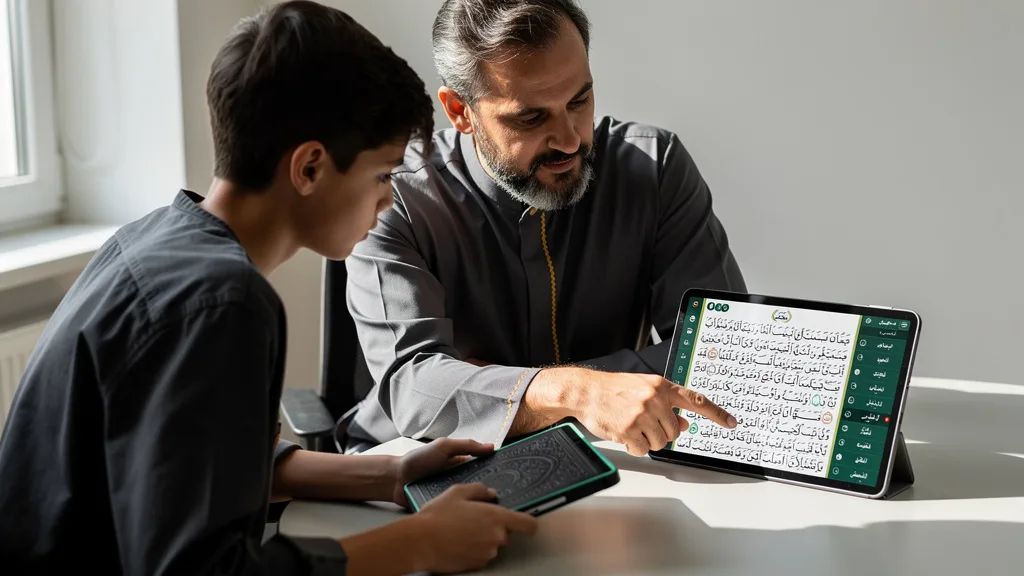
Ultimately, the best approach is often a hybrid one. Use one-on-one lessons with a qualified teacher as your primary method for learning the rules and receiving personalized correction. Then, supplement your studies by using a recitation app for daily practice, memorization, and reinforcing the concepts you learned with your teacher. This balanced strategy combines the best of both worlds for effective learning.
| Feature | Live Teacher (One-on-One) | Recitation App |
|---|---|---|
| Feedback | Personalized, immediate, and nuanced correction on Makharij and Sifat. | Often automated, based on AI, may miss subtle errors. |
| Personalization | Curriculum is tailored to your specific level, pace, and challenges. | Standardized lessons and exercises for a general audience. |
| Motivation | Provides encouragement, accountability, and a spiritual connection. | Relies entirely on self-discipline. |
| Flexibility | Scheduled sessions require commitment. | Practice anytime, anywhere. |
| Cost | Higher investment, typically charged per hour or month. | Often free, freemium, or a low-cost subscription. |
The Invaluable Feedback of a Live Teacher
The single most significant advantage of learning with a live teacher is the quality of feedback. An experienced Qari can hear the subtle inaccuracies in your pronunciation that even the most advanced AI might miss. They can identify if the issue stems from incorrect tongue placement (Makharij) or a misunderstanding of a letter's attribute (Sifat).
This human element is irreplaceable. A teacher can not only correct you but also explain the 'why' behind the correction and provide targeted exercises to fix the specific issue. This interactive process builds a strong foundation and prevents the fossilization of bad habits. For sisters and children, finding online Quran classes for females with a private teacher ensures a comfortable and focused learning environment where they can ask questions freely and receive dedicated attention.
The Convenience and Practice of Recitation Apps
Where recitation apps excel is in providing convenience and consistent practice opportunities. You can use an app on your phone to listen to renowned Qaris, repeat verses, and practice your memorization during your commute, on a lunch break, or anytime you have a few spare moments. This accessibility is a powerful tool for reinforcing what you learn in your lessons.
Many apps also include features like verse-by-verse translation, transliteration, and the ability to slow down the recitation, which are excellent aids for beginners. They serve as a fantastic supplementary tool to drill verses and become more familiar with the flow and rhythm of the Quran. However, they should not be your sole source of learning if your goal is a truly accurate accent.
Are AI-Powered Tajweed Correction Tools Accurate in 2026?
In 2026, AI-powered Tajweed correction tools, like those found in apps such as Tarteel AI, have become remarkably sophisticated. These applications use voice recognition to listen to your recitation and highlight potential errors in pronunciation, timing, and rules like Ghunnah (nasalization) or Madd (elongation). For many learners, they offer an accessible first step in identifying areas for improvement.
However, while their accuracy has improved significantly, they are not yet a substitute for a human teacher. AI can flag a sound that deviates from its pre-programmed model, but it often cannot diagnose the root cause of the error. For example, it might flag a mispronounced 'ع' (Ayn), but it can't explain that your throat isn't constricted correctly. Therefore, these tools are best used as a practice aid to supplement, not replace, guidance from a qualified instructor who can provide that essential, nuanced feedback.
Top-Rated Quran Learning Apps for Improving Your Accent
While not a replacement for a teacher, Quran learning apps are excellent for daily practice and listening. They allow you to immerse yourself in the sounds of the Quran and compare your recitation to that of master Qaris. The best apps offer high-quality audio, variable playback speeds, and features that aid in both memorization and pronunciation practice.
When choosing an app, look for one with clear audio from a Qari whose style you wish to emulate. Features like word-by-word playback and looping are particularly useful for focusing on difficult words or verses. Below are some highly-rated apps for both iOS and Android users that can support your journey to a more accurate accent.
Recommended Apps for iOS Users
For those on Apple devices, the App Store offers several high-quality applications designed to help with Quran recitation. These apps are known for their user-friendly interfaces, robust features, and reliable performance.
- Tarteel AI: Uses artificial intelligence to listen, recognize, and correct your recitation in real-time. It's an excellent tool for practice and identifying mistakes.
- Quranly: Focuses on making Quran reading a daily habit with goal-tracking features. It includes various reciters to listen to and learn from.
- Quran.com: A comprehensive and highly-respected app that offers a clean interface, multiple translations, and audio from numerous famous Qaris.
Android users also have access to a wide array of powerful Quran learning tools through the Google Play Store. These apps provide similar functionality to their iOS counterparts, helping you listen, repeat, and perfect your recitation.
- Quran for Android: A classic, free, and open-source app known for its simplicity and crystal-clear Madani Mushaf pages. It offers gapless audio playback with numerous reciters.
- Ayat: Al Quran: Developed by King Saud University, this app is rich with features, including tafsir, translations, and high-quality recitations from many Qaris.
- Muslim Pro: While known as an all-in-one app, its Quran section is robust, featuring color-coded Tajweed rules, multiple audio recitations, and phonetic transliteration.
Which Famous Qaris Are Best to Imitate for a Clear Accent?
Listening to and imitating master reciters (Qaris) is a time-honored method for improving your own accent. By repeatedly hearing the correct pronunciation, rhythm, and intonation, your ears become attuned to the nuances of Tajweed. Choosing a Qari with a clear, measured, and precise style is crucial for a student.
While personal preference plays a role, certain reciters are universally recommended for learners due to their exceptional clarity and perfect application of Tajweed rules. Listening to these masters will provide you with a benchmark for excellence. Some of the most recommended Qaris for students to imitate include:
- Sheikh Mahmud Khalil Al-Husary: Revered for his highly precise, clear, and almost clinical recitation style. His recordings are often used in educational settings because every rule of Tajweed is perfectly applied and easy to discern.
- Sheikh Muhammad Siddiq Al-Minshawi: Known for his beautiful, heartfelt, and deeply moving recitation that is also incredibly accurate. His style is both spiritually uplifting and technically flawless.
- Sheikh Mishary Rashid Alafasy: A contemporary reciter popular for his clear voice and beautiful tone. His recitation is accessible and very popular among learners worldwide.
Understanding the Cost of Private Quran Recitation Tutors
Investing in a private Quran tutor is an investment in your spiritual and educational development. The cost of one-on-one lessons can vary significantly based on several factors, including the teacher's qualifications, location, and the platform used. As of 2026, you can generally expect to pay between $10 to $30 per hour for a qualified online tutor.
Teachers with an Ijazah or those affiliated with renowned institutions like Al-Azhar University may charge at the higher end of this range, reflecting their expertise. Tutors based in Western countries may also have higher rates than those in countries like Egypt or Pakistan. When considering the price, remember the value of personalized instruction. Many academies offer package deals or monthly subscriptions that can make lessons more affordable. For a detailed breakdown, researching the cost of an online female Quran teacher can provide specific insights into market rates.
Key Takeaways
Improving your Quranic accent is a journey of dedication that brings immense spiritual rewards. The path to an Accurate Quran Recitation is built on a few core principles. By focusing on these key areas, you can systematically and effectively enhance your pronunciation and connect more deeply with the words of Allah (SWT).
- Master Tajweed Fundamentals: Your primary focus should be on learning the points of articulation (Makharij) and the attributes of the letters (Sifat). These are the non-negotiable building blocks of correct recitation.
- Find a Qualified Teacher: The feedback and personalized guidance from a certified Qari or Qaria are invaluable. This is the single most effective way to correct mistakes and build a proper foundation.
- Use Technology as a Supplement: Leverage Quran apps and AI tools for daily practice, listening, and reinforcement. They are excellent aids but should not replace a live teacher.
- Listen and Imitate: Regularly listen to master Qaris like Sheikh Al-Husary to train your ear and develop a sense for correct rhythm and pronunciation.
- Be Patient and Consistent: Perfecting your accent takes time and consistent effort. Celebrate small victories and remain steadfast in your practice.
Frequently Asked Questions
How long does it take to improve my Quranic accent?
The time it takes to improve your accent varies greatly depending on your starting point, natural ability, and the amount of time you dedicate to practice. With consistent daily practice and weekly lessons with a qualified teacher, most students see noticeable improvement within three to six months. Achieving mastery, however, is a lifelong journey.
The key is consistency over intensity. A little practice every day is more effective than one long session per week. Your progress also depends on the quality of your instruction. A good teacher can accelerate your learning by quickly identifying and correcting your specific mistakes.
Can I learn Tajweed effectively by myself?
While you can learn the theoretical rules of Tajweed from books and videos, learning the practical application by yourself is extremely difficult and not recommended. Tajweed is an oral and auditory science. You need a trained ear to listen to your recitation and correct the subtle mistakes that you cannot hear yourself.
Without a teacher, you risk ingraining incorrect pronunciations that become very difficult to unlearn later. A teacher provides the essential feedback loop required for genuine improvement. You can begin your journey with resources, but you should seek a teacher as soon as possible.
What is the first step to correcting my recitation?
The very first step is to find a qualified Quran teacher and have your recitation assessed. You cannot fix a problem until you know what it is. A teacher will listen to you recite a short passage, like Surah Al-Fatiha, and provide an honest evaluation of your current strengths and weaknesses.
From there, they will typically start with the basics: the correct pronunciation of each letter of the alphabet (Makharij). This ensures you have a solid foundation before moving on to more complex rules. Many academies, including Hidayah Quran, offer a free trial lesson which is the perfect first step.
Is it necessary to learn Arabic to have a perfect accent?
No, it is not necessary to become fluent in the Arabic language to have a perfect Quranic accent. Millions of non-Arab Muslims throughout history have become masters of recitation (Qaris). The study of Tajweed is a separate science from the study of Arabic grammar and vocabulary (nahw and sarf).
However, having a basic understanding of Arabic can certainly help you appreciate the meaning of what you are reciting, which can make the experience more profound. The primary focus for accurate recitation, though, remains on the science of Tajweed and correct pronunciation of the letters and words.
What are the best online Tajweed courses for non-Arab speakers in 2026?
The best online Tajweed courses for non-Arab speakers are those that offer live, one-on-one instruction with a certified teacher. This personalized approach is crucial for correcting pronunciation. Look for programs that have a structured curriculum, starting with Noorani Qaida or a similar foundational method, before progressing to the full Quran.
Platforms that offer dedicated teachers for different demographics, such as female teachers for sisters or instructors experienced with children, are highly beneficial. Hidayah Quran Academy specializes in this, providing private classes that cater to the specific needs of families, women, and beginners in the UK, USA, Australia, and beyond.
Conclusion
Achieving an accurate accent in Quran recitation is a beautiful and attainable goal for any dedicated student in 2026. By focusing on the fundamentals of Tajweed, seeking guidance from a qualified teacher, and leveraging modern tools for consistent practice, you can transform your connection to the Quran. Remember that this journey is an act of worship itself, and every effort you make is rewarded. The key is to start with a solid foundation and remain consistent, allowing the divine words to flow from you with the clarity and beauty they deserve.
Are you ready to take the first step toward a more beautiful and accurate recitation? Hidayah Quran Academy offers private, one-on-one classes with qualified female teachers for sisters, children, and adult beginners. Our supportive environment is designed to help you learn at your own pace. Book Free Trial
If you want help turning this into a concrete plan for your site or team, take the next step below to apply How to Achieve an Accurate Accent in Quran Recitation with confidence.
Ready to act on How to Achieve an Accurate Accent in Quran Recitation? Book Free Trial — tell us your goal, and we will help you pick the highest-leverage next step so you are not guessing alone.