
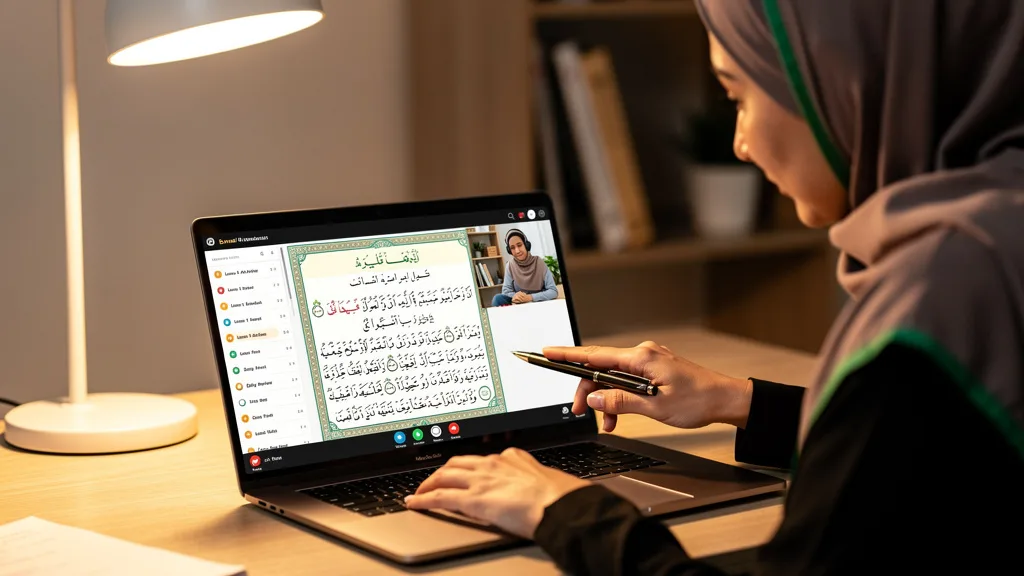
Do you wish to connect with the Quran on a deeper level but feel intimidated by the rules of recitation as a non-Arab speaker? Learning to recite the Quran with its proper rules, known as Tajweed, is a beautiful and rewarding journey that brings you closer to the words of Allah (SWT). It ensures that the divine message is pronounced as it was revealed, preserving its profound meaning and impact.
The Holy Quran recitation rules for non Arab speakers are a set of guidelines that govern pronunciation, articulation, and rhythm. Mastering them transforms your reading from simple utterance to a spiritually uplifting experience. This guide breaks down the foundational concepts, core rules, and practical steps you can take in 2026 to beautify your recitation, whether you are a beginner, a revert, or someone looking to refine your skills.
Why Correct Quran Recitation (Tajweed) Is Essential
Tajweed literally means "to make better" or "to improve." In the context of the Quran, it is the science of reciting the holy book as the Prophet Muhammad (peace be upon him) recited it. This is not merely about aesthetics; it is about precision and preservation of meaning. The Arabic language is incredibly nuanced, and a small mistake in pronunciation, such as changing a vowel or mispronouncing a letter, can drastically alter the meaning of a word, sometimes leading to unintentional blasphemy.
For a non-Arab speaker, engaging with Tajweed is an act of devotion. It demonstrates a sincere effort to honor the divine text. When you recite with correct Tajweed, you can feel the rhythm and flow of the verses, which enhances your focus in prayer (Salah) and deepens your personal connection during recitation. It transforms the act of reading into a conversation with Allah (SWT), allowing the beauty and power of His words to penetrate your heart more effectively.
Furthermore, learning Tajweed is fulfilling the right of the Quran. The scholars of Islam have emphasized its importance, considering it a collective obligation (Fard Kifayah) for the community and an individual recommendation for every Muslim who recites. By dedicating time to learn these rules, you are participating in the preservation of the Quran's oral tradition, a chain that goes back over 1400 years.
Foundational Concepts for Non-Arab Speakers
Before diving into complex rules, every beginner must master the building blocks of the Arabic language. These fundamentals form the bedrock upon which all Tajweed knowledge is built. For non-Arab speakers, spending adequate time on this stage is crucial for long-term success and clarity in recitation.
Understanding the Arabic Alphabet and Pronunciation
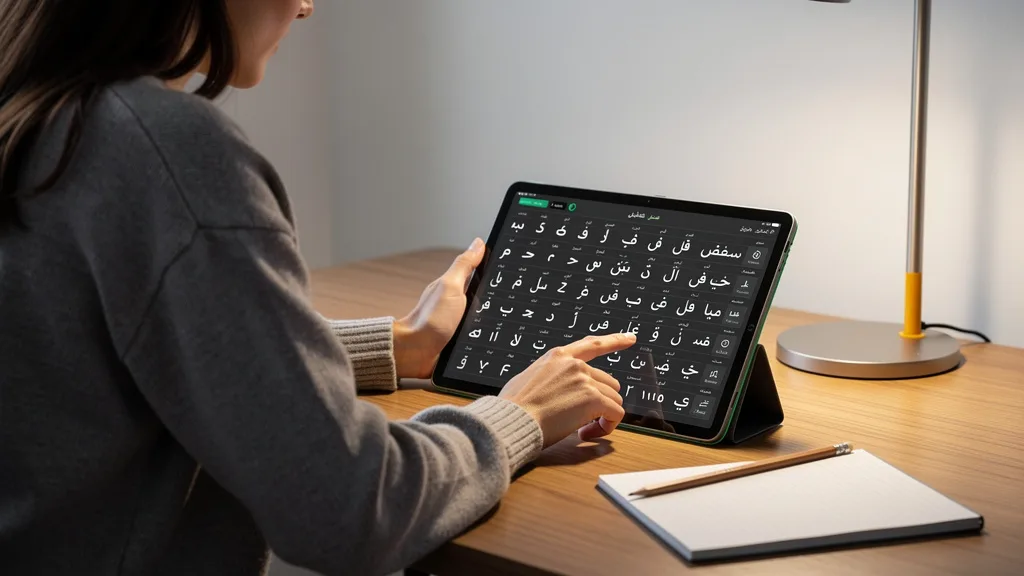
The Arabic alphabet consists of 29 letters, each with a unique sound and point of articulation (Makhraj). Unlike English, Arabic is written from right to left. The first step is to learn to recognize each letter and its distinct sound. Many letters may sound similar to an untrained ear, such as 'س' (Seen) and 'ص' (Saad), or 'ت' (Ta) and 'ط' (Toh). Differentiating between them from the very beginning is vital.
Focus on learning the name, shape, and sound of each letter. Pay close attention to how the shape of a letter changes depending on its position in a word: initial, medial, or final. Using flashcards and practicing writing the letters can significantly help in memorization. The goal is to be able to identify and pronounce each letter correctly and without hesitation before moving on to joining them to form words.
Mastering Short and Long Vowels (Harakat)
Vowels in Arabic, known as Harakat, are symbols written above or below a letter to indicate its sound. The three short vowels are Fatha (a short 'a' sound), Kasra (a short 'i' sound), and Dammah (a short 'u' sound). It is critical to pronounce these sounds with precision and for the correct duration, as elongating them changes them into long vowels, altering the word's meaning.
Long vowels are created by pairing a short vowel with one of the three Madd (elongation) letters: Alif (ا), Waw (و), and Ya (ي). For example, a Fatha followed by an Alif creates a long 'aa' sound. A Kasra followed by a Ya creates a long 'ee' sound, and a Dammah followed by a Waw creates a long 'oo' sound. Understanding the difference between short and long vowels is fundamental to proper rhythm and meaning in Quranic recitation.
Recognizing Key Symbols: Sukoon and Shaddah
Beyond vowels, two other symbols are essential for correct reading: Sukoon and Shaddah. The Sukoon (ـْـ) is a small circle placed above a letter to indicate that it has no vowel. It marks the end of a syllable. When you see a Sukoon, you pronounce the letter and then pause on it, joining it to the letter that came before it.
The Shaddah (ـّـ) is a small symbol that looks like the head of the letter 'seen' (س). When placed above a letter, it signifies that the letter should be doubled. The first instance of the letter has a Sukoon, and the second has a vowel. For example, the word رَبِّ (Rabbi) has a Shaddah on the 'ب' (Ba). You pronounce it by first joining the 'Ra' to a 'Ba' with a Sukoon (Rab-), then immediately pronouncing a second 'Ba' with a Kasra (-bi). Mastering these symbols is key to fluency.
Core Tajweed Rules for Recitation
Once you have a firm grasp of the alphabet and basic symbols, you can begin learning the core Tajweed rules. These rules govern how letters interact with each other, ensuring a smooth, clear, and accurate recitation. They are the heart of what makes Quranic recitation so melodious and precise.
The Rules of Noon Sakinah and Tanween
The rules of Noon Sakinah (نْ) and Tanween (the double vowels an, in, un) are among the most frequently encountered in the Quran. They describe how to pronounce the 'n' sound when it is followed by different letters. There are four main rules:
| Rule | Meaning | Pronunciation Effect | Letters |
|---|---|---|---|
| Izhar (إظهار) | To make clear | The 'n' sound is pronounced clearly without any nasalization (ghunnah). | ء, ه, ع, ح, غ, خ (the throat letters) |
| Idgham (إدغام) | To merge | The 'n' sound merges into the following letter. It can be with ghunnah (nasal sound) or without. | ي, ر, م, ل, و, ن (collected in the word يرملون) |
| Iqlab (إقلاب) | To convert | The 'n' sound is converted into a light 'm' sound with ghunnah. | ب |
| Ikhfa (إخفاء) | To hide | The 'n' sound is hidden, pronounced lightly from the nasal passage with ghunnah, in preparation for the next letter. | The remaining 15 letters of the alphabet. |
The Rules of Meem Sakinah
Similar to Noon Sakinah, Meem Sakinah (مْ) also has specific rules depending on the letter that follows it. These rules are generally considered simpler to master as there are only three of them. Correct application of these rules ensures a seamless flow between words and syllables.
The three rules are Ikhfa Shafawi (Hiding), where the 'm' sound is hidden with a light nasal sound (ghunnah) when followed by the letter 'ب' (Ba); Idgham Shafawi (Merging), where the Meem Sakinah merges into the following 'م' (Meem) with ghunnah; and Izhar Shafawi (Clarifying), where the 'm' is pronounced clearly when followed by any of the other 26 letters. Izhar Shafawi is the most common of the three.
Understanding Madd: The Rules of Elongation
Madd means to elongate or stretch the sound of the long vowels (Alif, Waw, Ya). There are two main categories: Natural Madd (Madd Tabee'i) and Secondary Madd (Madd Far'i). Natural Madd is the basic elongation of two counts that occurs naturally with long vowels. If this is not done, the meaning can change.
Secondary Madd occurs due to specific reasons, such as being followed by a Hamzah or a Sukoon. There are several types of secondary Madd, each with its own rule for the length of elongation (e.g., 4, 5, or 6 counts). While mastering all types of Madd takes time, beginners should focus on correctly applying the Natural Madd and gradually learn the secondary types as they advance.
Points of Articulation (Makharij al-Huruf)
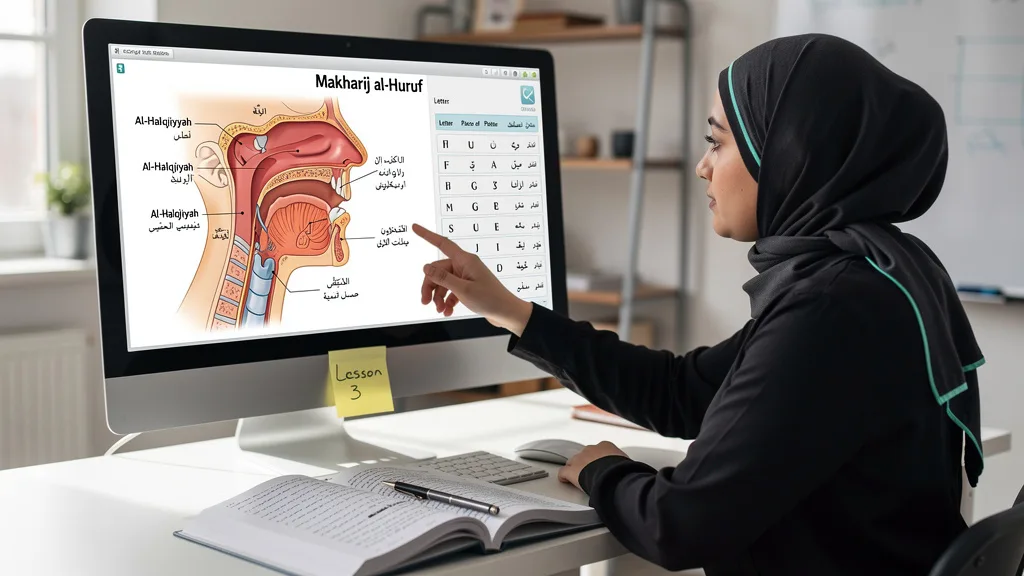
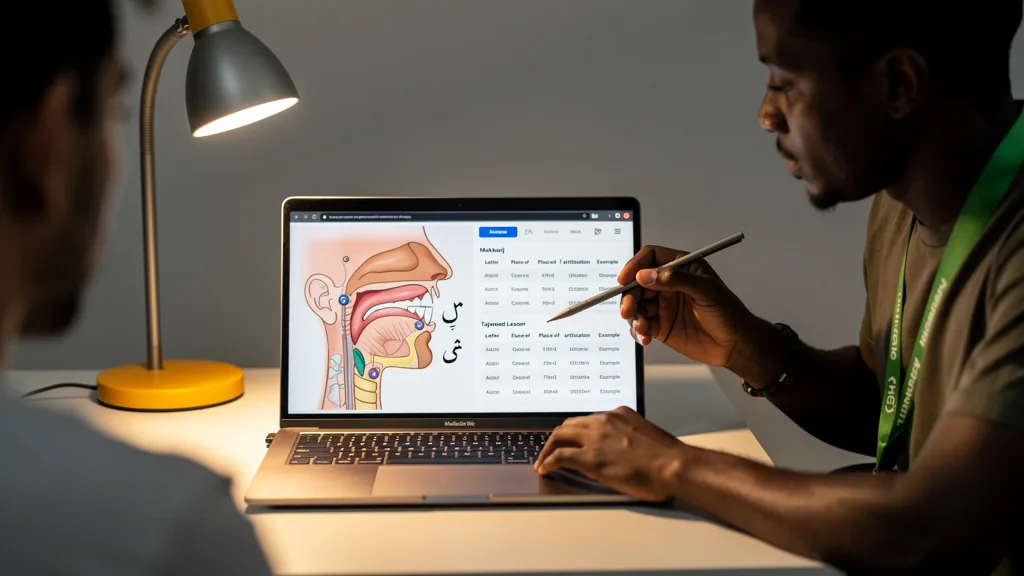
Makharij al-Huruf refers to the specific points in the mouth, throat, and nasal cavity from which each Arabic letter originates. There are five main areas of articulation: the throat, the tongue, the lips, the nasal cavity, and the empty space in the mouth and throat. Each of these areas is further subdivided to produce the 29 letters.
Studying Makharij is an advanced but essential part of Tajweed. It is the key to differentiating between letters that sound similar to non-Arabs, like 'ح' (Ha) and 'ه' (Haa). Perfecting your Makharij requires dedicated practice and often the guidance of a qualified teacher who can listen to your pronunciation and provide immediate correction. This is fundamental to achieving clear and authentic Holy Quran recitation rules for non Arab speakers.
Common Pronunciation Challenges and How to Fix Them
Non-Arab speakers often face a predictable set of challenges when learning to recite the Quran. Recognizing these common hurdles is the first step to overcoming them. With focused practice and the right techniques, you can correct these mistakes and significantly improve your recitation.
Differentiating Between Similar Sounding Letters
One of the biggest challenges is distinguishing between letters that sound alike to an English-speaking ear. For example:
- Ta (ت) vs. Toh (ط): 'Ta' is a light letter, while 'Toh' is a heavy letter, pronounced with the back of the tongue raised.
- Seen (س) vs. Saad (ص) vs. Tha (ث): 'Seen' is a sharp 's' sound. 'Saad' is a heavy 's' sound. 'Tha' is pronounced with the tip of the tongue between the front teeth, like the 'th' in 'three'.
- Dhal (ذ) vs. Za (ز) vs. Dhoh (ظ): 'Dhal' is like the 'th' in 'that'. 'Za' is a 'z' sound. 'Dhoh' is a heavy version of 'Dhal'.
To fix this, practice isolating these letters and saying them back-to-back while focusing on the different mouth and tongue positions. Listening to a qualified reciter and mimicking them is an excellent way to train your ear and tongue.
Pronouncing Heavy (Tafkheem) vs. Light (Tarqeeq) Letters
Arabic letters are categorized as either having Tafkheem (heaviness/thickness) or Tarqeeq (lightness/thinness). The seven heavy letters (خ, ص, ض, غ, ط, ق, ظ) are always pronounced with a full mouth, with the back of the tongue raised towards the palate. Most other letters are light.

A common mistake is making heavy letters light or vice versa, which alters the sound and can change the meaning. The letters 'Ra' (ر) and 'Lam' (ل) in the name of Allah (الله) can be either heavy or light depending on the vowels around them. Practice saying words that contain both heavy and light letters to master the transition between them smoothly.
Avoiding Common Mistakes in Vowel Length
Another frequent error is incorrect vowel timing. Non-Arab speakers might unintentionally shorten long vowels or lengthen short vowels, which is a significant mistake in Tajweed known as Lahn (error). For example, reciting the 'aa' in 'Alhamdulillah' for only one count instead of two changes the structure of the word.
To correct this, practice clapping or tapping out the counts for each vowel as you recite slowly. One count for a short vowel, two for a natural long vowel. This physical reinforcement helps internalize the rhythm of the recitation. Recording yourself and listening back can also help you identify where you are making mistakes in vowel length.
Practical Steps to Improve Your Recitation in 2026
Learning Tajweed is a journey, not a destination. Consistent effort and using the right resources are key to making steady progress. Here are some practical steps you can implement in 2026 to enhance your Quran recitation.
Find a Qualified Quran Tutor for Personalized Feedback
While self-study is valuable, there is no substitute for a qualified teacher. A tutor can provide immediate, personalized feedback that you cannot get from apps or recordings. They can pinpoint your specific mistakes in pronunciation and articulation and provide targeted exercises to correct them. A teacher also provides motivation and structure to your learning.
Look for a tutor who is fluent in your language and has a certification (Ijazah) in Quranic recitation. For sisters and children, finding a female Quran teacher online can provide a comfortable and private learning environment. One-on-one classes ensure you get the focused attention needed to build a strong foundation.
Utilize Modern Recitation Apps and Digital Tools
Technology offers a wealth of resources for Quran learners. Many apps provide the Quran with color-coded Tajweed rules, where each rule is highlighted in a different color. This visual aid can help you identify and apply rules as you read. Some apps also allow you to tap on a word to hear its correct pronunciation.
"In 2026, technology has made learning the Holy Quran recitation rules for non Arab speakers more accessible than ever. Use these tools to supplement your studies, but remember they are an aid, not a replacement for a qualified teacher's guidance."
Other digital tools include websites with detailed Tajweed lessons and YouTube channels dedicated to Quranic education. Use these resources to review concepts and listen to different recitation styles. They are excellent for reinforcing what you learn with your tutor.
Listen to and Imitate Renowned Qaris (Reciters)
One of the most effective ways to improve your recitation is through listening and imitation. Choose a Qari whose recitation is clear, slow, and precise, such as Sheikh Khalil Al-Husary or Sheikh Muhammad Al-Minshawi. Listen to a short verse or a few words repeatedly, paying close attention to their pronunciation, rhythm, and melody.
Try to mimic their recitation exactly. Record yourself reciting the same verse and compare it to the Qari's. This practice, known as shadowing, trains your ear to recognize correct Tajweed and helps your tongue adapt to the new sounds and articulations of the Arabic language.
Practice Consistently and Record Yourself
Consistency is more important than intensity. A short, focused practice session every day is far more effective than a long session once a week. Dedicate at least 15-20 minutes daily to practicing your recitation and reviewing Tajweed rules. This regular exposure builds muscle memory for your tongue and solidifies your knowledge.
Recording yourself is a powerful tool for self-assessment. We often don't hear our own mistakes as we recite. When you listen back to a recording, you can identify errors in pronunciation, vowel length, and application of rules more objectively. Share these recordings with your tutor for their feedback to accelerate your progress.
Key Takeaways
Embarking on the journey to perfect your Quran recitation is a noble and rewarding endeavor. As a non-Arab speaker, understanding the core principles can make the path clear and achievable. Here are the main points to remember:
- Tajweed is Essential: Correct recitation preserves the meaning of the Quran and deepens your spiritual connection.
- Start with Foundations: Master the Arabic alphabet, vowels (Harakat), and key symbols like Sukoon and Shaddah before tackling advanced rules.
- Learn Core Rules: Focus on understanding the rules of Noon Sakinah, Meem Sakinah, and Madd, as they appear frequently throughout the Quran.
- Focus on Articulation: Pay close attention to the points of articulation (Makharij) to differentiate between similar-sounding letters.
- Practice Smart: Find a qualified tutor for personalized feedback, use modern apps, listen to expert reciters, and practice consistently. Finding the best online Quran tutor for your needs is a critical step.
- Be Patient: Learning Tajweed is a gradual process. Celebrate small victories and trust that your sincere effort is rewarded by Allah (SWT).
Frequently Asked Questions
How long does it take to learn basic Tajweed as a non-Arab speaker?
The time it takes varies greatly depending on the individual's dedication, aptitude, and consistency. With regular practice (e.g., 3-4 sessions a week with a tutor), a motivated beginner can learn the foundational rules and read the Quran with a basic level of correctness within 6 to 12 months. Mastery, however, is a lifelong journey.
Your progress depends on the time you dedicate daily and the quality of your instruction. The key is to be patient with yourself and focus on understanding concepts thoroughly rather than rushing through them. Every step forward is a significant achievement in this beautiful spiritual practice.
Can I learn Quran recitation rules entirely on my own?
While you can learn the theoretical aspects of Tajweed from books and apps, it is nearly impossible to master the practical application without a qualified teacher. Pronunciation and articulation have nuances that can only be corrected by a trained ear. A teacher provides essential feedback to ensure you are not practicing mistakes.
Self-study is a great supplement, but a guide is crucial for authentic learning. This is especially true for non-Arab speakers who may not be able to hear their own errors. We offer online Quran classes for females that provide this necessary one-on-one guidance in a comfortable setting.
What is the most important rule of Tajweed for a beginner to focus on?
For a beginner, the most important area to focus on is the correct pronunciation of the letters from their points of articulation (Makharij al-Huruf) and the proper timing of short and long vowels. These are the absolute fundamentals. Without them, none of the other rules can be applied correctly.
Getting the letters and vowels right forms the foundation of your recitation. Once you have a strong grasp of these, you can move on to the rules of Noon Sakinah and Tanween, as they are the next most common rules you will encounter while reading the Quran.
Are there recommended books for learning Tajweed in English?
Yes, there are several excellent books written in English to help non-Arab speakers learn Tajweed. A popular choice is "Tajweed Rules of the Qur'an" by Kareema Czerepinski. Another widely recommended text is "A Course in Ilm al-Tajwid: The Science of Reciting the Qur'an" by Dr. Ayman Rushdi Swaid, although it is more advanced.
These books serve as great reference materials to supplement your lessons with a teacher. They often include diagrams and detailed explanations that you can review at your own pace. Always try to cross-reference what you read with the practical guidance of your tutor.
Is it a sin to make mistakes while trying to recite the Quran?
No, it is not a sin to make mistakes while you are sincerely trying to learn and improve. In fact, the effort is highly rewarded. The Prophet Muhammad (peace be upon him) said, "The one who is proficient in the recitation of the Qur'an will be with the honorable and obedient scribes (angels) and he who recites the Qur'an and finds it difficult to recite, doing his best to recite it in the best way possible, will have a double reward." (Sahih Al-Bukhari).
This hadith is a great source of encouragement for every learner. Allah (SWT) rewards your intention and your effort, not just your perfection. The key is to continue striving to the best of your ability and to seek knowledge to correct your mistakes over time. Your journey is a beautiful act of worship itself.
Conclusion
Learning the Holy Quran recitation rules as a non-Arab speaker is a profound act of faith that connects you directly to the divine message. While the path may seem challenging at first, breaking it down into manageable steps makes it an accessible and deeply fulfilling journey. By starting with the alphabet, mastering the vowels, and then gradually incorporating the core Tajweed rules, you build a solid foundation for a lifetime of beautiful recitation.
The key takeaways from this guide are to prioritize correct articulation (Makharij) and consistent practice. Differentiating between similar letters and understanding the rules of elongation and nasalization will transform your reading. Remember that every mistake made in the process of learning is a stepping stone, and your sincere effort is doubly rewarded by Allah (SWT). Don't let the fear of imperfection hold you back from this noble pursuit.
While digital tools and books are valuable aids, the guidance of a qualified teacher is irreplaceable for correcting subtle errors and ensuring your foundation is strong. A tutor provides the personalized feedback and encouragement needed to navigate the nuances of Tajweed effectively and confidently.
At Hidayah Quran Academy, our qualified female teachers specialize in guiding sisters and children through this rewarding process in a supportive, one-on-one environment. If you are ready to take the next step and beautify your connection with the Quran, we invite you to see how personalized instruction can make a difference. Book Free Trial today and begin your journey with confidence.