
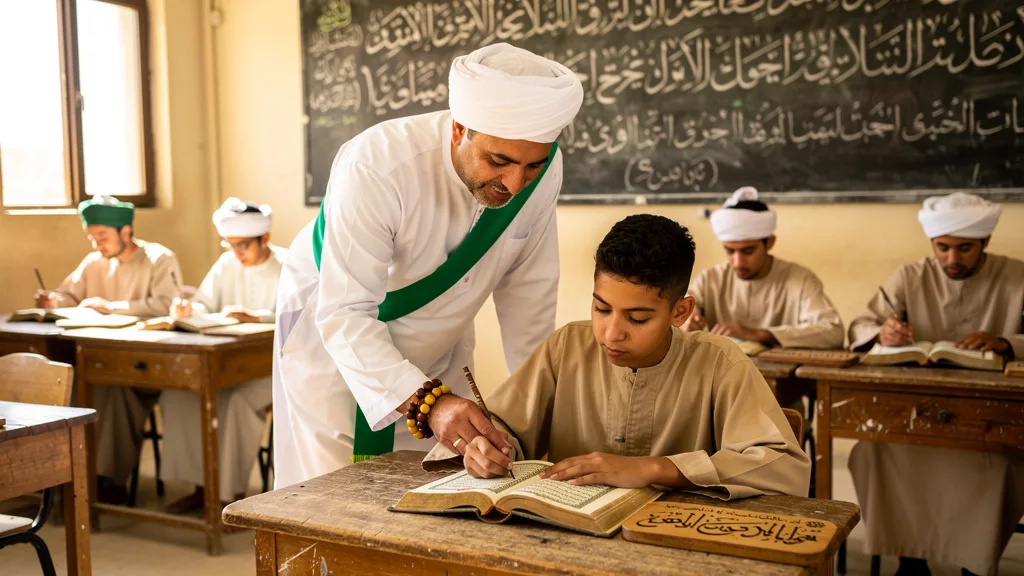
Have you ever wondered what makes a Quran teacher truly exceptional? For over a millennium, one institution has stood as the global standard for Islamic scholarship, producing some of the world's most respected scholars and educators. This guide explores how Al Azhar University in Egypt prepares Quran teachers, detailing the rigorous and comprehensive journey from student to certified instructor.
Al-Azhar University prepares future Quran teachers through an immersive, multi-year program that combines deep Quranic knowledge with pedagogical training. Students master Tajwid (recitation), Tafsir (exegesis), and classical Arabic, alongside core Islamic sciences. This academic rigor is paired with practical training on how to effectively impart this knowledge to others, culminating in an Ijazah (a license to teach) that is recognized and respected worldwide.
The Enduring Legacy of Al-Azhar in Islamic Scholarship
Founded in 970 CE in Cairo, Al-Azhar is one of the oldest degree-granting universities in the world. It has long been revered as a primary center for Sunni Islamic learning, attracting students and scholars from every corner of the globe. Its legacy is built on a tradition of preserving and transmitting authentic Islamic knowledge through an unbroken chain of scholarship that stretches back centuries. When you learn from an Al-Azhar graduate, you are connecting with this profound history.
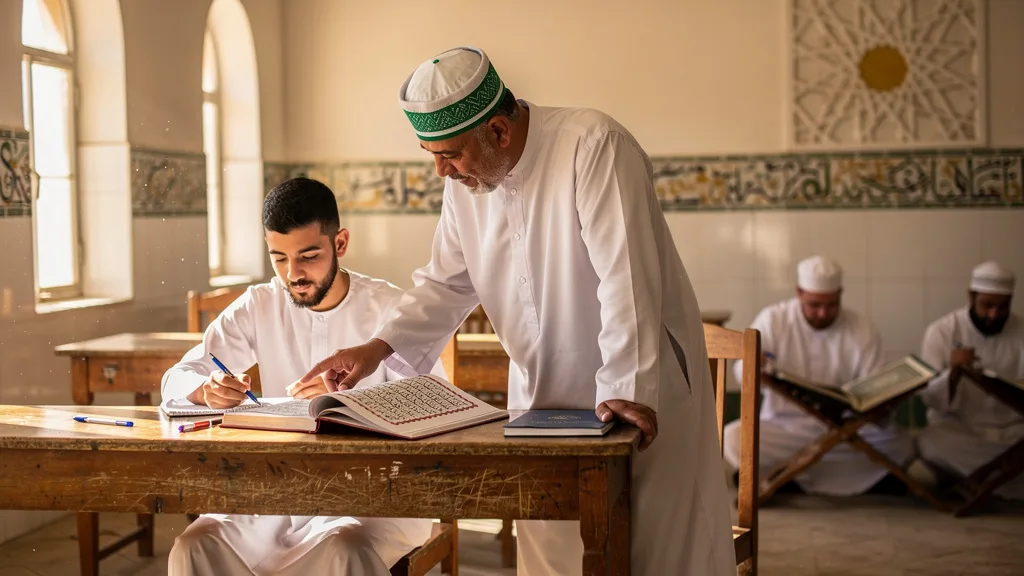
The university's influence extends far beyond its campus walls. Its graduates serve as imams, judges, scholars, and educators, shaping Muslim communities worldwide. The institution's commitment to a balanced, moderate understanding of Islam has made it a crucial voice in the contemporary Muslim world. For aspiring Quran teachers, studying at Al-Azhar is not just an academic pursuit; it is an immersion into the very heart of Islamic tradition and intellectual heritage.
Core Curriculum for Aspiring Quran Teachers at Al-Azhar
The curriculum at Al-Azhar is designed to produce not just knowledgeable individuals, but wise and effective teachers. The program is holistic, ensuring that every graduate has a complete and contextualized understanding of the Quran. This approach is a key part of the Al-Azhar method of teaching Quran and Islamic studies, which emphasizes depth and authenticity.
Mastery of Tajwid and Qira'at (The Art of Recitation)
The foundation of teaching the Quran is reciting it correctly. Students at Al-Azhar dedicate years to mastering Tajwid, the science of proper Quranic pronunciation and articulation. This involves learning the precise points of articulation (makharij al-huruf) and the characteristics (sifat al-huruf) of each letter, ensuring the words of Allah are recited exactly as they were revealed to the Prophet Muhammad (peace be upon him).
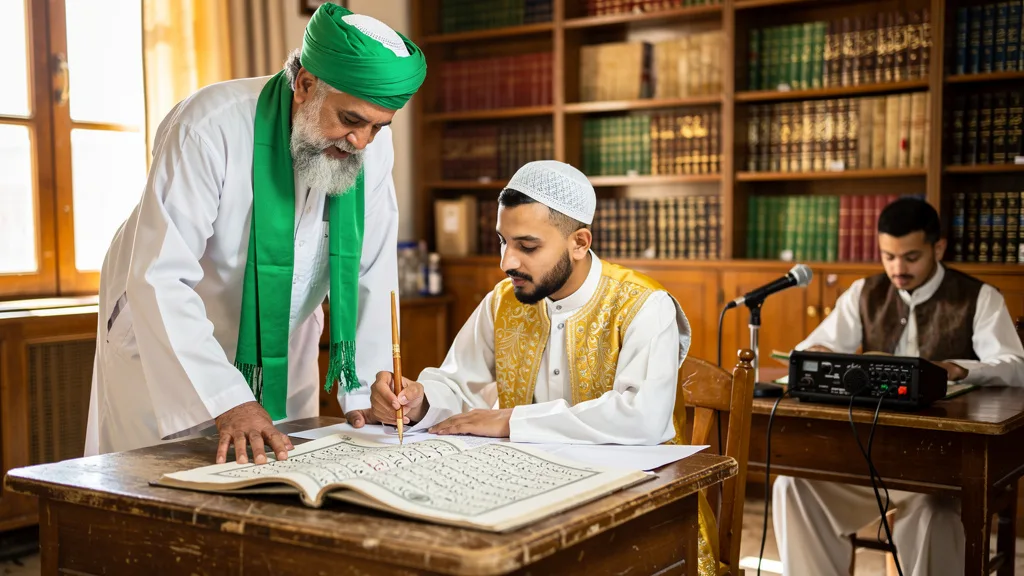
Beyond basic Tajwid, students delve into the Qira'at, the various canonical methods of Quranic recitation. This advanced study provides a deeper appreciation for the richness of the Quranic text and equips teachers to address the nuances of recitation with their own students. This mastery is a hallmark of an Al-Azhar-trained teacher and is essential for preserving the oral tradition of the Quran.
In-Depth Study of Tafsir and Quranic Sciences
A Quran teacher must understand not only the words of the Quran but also their meanings. The study of Tafsir, or Quranic exegesis, is a cornerstone of the Al-Azhar curriculum. Students learn to analyze the Quranic text by studying the works of classical and contemporary commentators, understanding the historical context of revelation (Asbab al-Nuzul), and exploring the linguistic and theological dimensions of the verses.
This is supplemented by a range of Quranic sciences ('Ulum al-Quran), including the study of abrogated verses (Nasikh wa Mansukh), the classification of Meccan and Medinan surahs, and the literary miracle of the Quran. This comprehensive knowledge allows a teacher to answer student questions with depth and accuracy, moving beyond a surface-level reading of the text.
Foundations in Classical Arabic Language and Grammar
The Quran was revealed in classical Arabic, and a deep, authentic understanding of its message is impossible without mastering this language. Students at Al-Azhar undertake an intensive study of classical Arabic, focusing on Nahw (grammar), Sarf (morphology), and Balaghah (rhetoric). This is far more advanced than learning conversational Arabic; it is about grasping the intricate linguistic structure that makes the Quran inimitable.
This linguistic training enables teachers to explain the subtle nuances of meaning in the Quranic verses. They can clarify why a particular word was chosen, how sentence structure impacts the message, and how the rhetorical devices used in the Quran create a powerful effect on the listener. This expertise is crucial for conveying the full beauty and depth of the Quran to students.
Understanding Core Islamic Disciplines like Fiqh and Hadith
Teaching the Quran effectively requires a holistic understanding of the Islamic tradition. At Al-Azhar, the study of the Quran is integrated with other core disciplines, primarily Hadith (Prophetic traditions) and Fiqh (Islamic jurisprudence). Studying Hadith provides the context for many Quranic verses and demonstrates how the Prophet Muhammad (peace be upon him) implemented the Quran in his own life.
The study of Fiqh, such as the principles of Hanafi fiqh amid challenges faced by a modern student, equips teachers to explain the legal and ethical rulings derived from the Quran. This knowledge is essential for guiding students on how to apply Quranic teachings to their daily lives. This interdisciplinary approach ensures that graduates are not just reciters, but well-rounded scholars who can present Islam as a complete and coherent way of life.
The Admission Process for International Students
Gaining admission to Al-Azhar as an international student is a competitive process that requires dedication and preparation. Prospective students must typically have completed high school and demonstrate a foundational knowledge of Islam and Arabic. Most non-native Arabic speakers are required to enroll in Al-Azhar's intensive Arabic language program for one to two years before they can begin their formal degree studies.
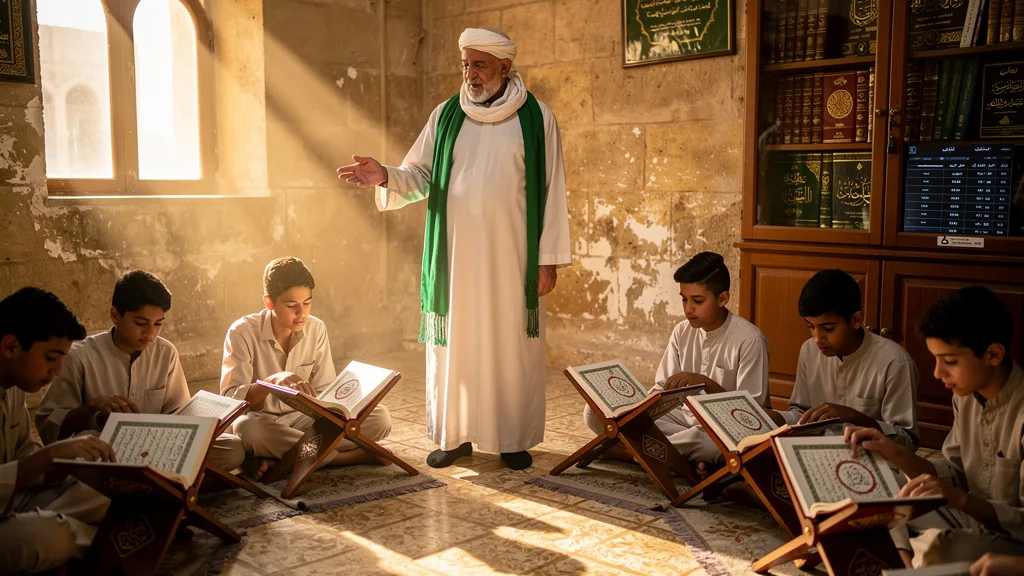
The journey can be particularly challenging for a foreign student, especially those from Western backgrounds. For example, stories of students like Ustadha Chloe Idris, who is originally from New Zealand pursued Islamic scholarship at Al Azhar University after converting, highlight the determination required. These students often navigate cultural adjustments and the immense academic workload as a mother and foreign student, showing incredible resolve to achieve their goal of deep Islamic learning.
Pedagogical Training: Learning How to Effectively Teach the Quran
Knowledge alone does not make a great teacher. Recognizing this, Al-Azhar incorporates pedagogical training into its curriculum. Students learn the art and science of teaching (tarbiyah), focusing on methods to effectively convey complex concepts to learners of different ages and abilities. This training covers classroom management, student psychology, and curriculum development.
This focus ensures that graduates know how to structure lessons, engage students, and create a supportive and encouraging learning environment. They learn to be patient, empathetic, and adaptable, which are crucial qualities for a successful Quran teacher. This training is a key reason why Al-Azhar teachers make Quran learning effective, whether in a traditional classroom or in a modern online setting.
"An Al-Azhar education teaches you not just what the Quran says, but how to transmit its light to another person's heart. The focus on pedagogy is what transforms a scholar into a teacher, making the knowledge accessible and transformative for the student."
What Qualifications and Certifications Do Graduates Receive?
Upon successful completion of their studies, graduates from Al-Azhar receive qualifications that are among the most respected in the Muslim world. The specific certification depends on the course of study, but they all signify a high level of expertise. It's important to understand the difference when comparing Al-Azhar vs. other Quran certifications.
The most significant qualification for a Quran teacher is the Ijazah. An Ijazah is a license or certificate that grants the holder the authority to teach and transmit a specific Islamic text or science. For Quran teachers, the most common types are:
- Ijazah in Tajwid: Certifies mastery of the rules of recitation.
- Ijazah in Qira'ah: A more advanced certification in one of the ten canonical recitations, with a sanad (an unbroken chain of transmission) going back to the Prophet Muhammad (peace be upon him).
- Academic Degrees: In addition to the traditional Ijazah, students can earn formal academic degrees such as a Bachelor of Arts (B.A.), Master of Arts (M.A.), or a Doctorate (Ph.D.) in Islamic Studies, Quranic Sciences, or Arabic Language.
The Student Experience: A Glimpse into Life at Al-Azhar
Life as a student at Al-Azhar is an immersive and transformative experience. It involves more than just attending lectures; it is about living and breathing Islamic scholarship. Students are surrounded by a vibrant community of learners and senior scholars from all over the world, creating a unique environment for intellectual and spiritual growth.
Days are filled with classes, study circles (halaqat) in the historic Al-Azhar Mosque, and countless hours spent in libraries poring over classical texts. Living in Cairo also provides a rich cultural experience, allowing students to practice their Arabic and witness the living traditions of a historic Muslim society. This environment fosters discipline, humility, and a profound love for sacred knowledge.
Career Pathways After Graduating from Al-Azhar University
Graduates of Al-Azhar University have a wide range of career opportunities available to them, all centered around serving the Muslim community. Their deep knowledge and prestigious qualifications make them highly sought-after for roles that require authentic Islamic expertise. Many graduates choose to dedicate their lives to teaching the Quran, ensuring the next generation remains connected to the book of Allah.
The decision to why choose an Al-Azhar graduate for Quran often comes down to their unparalleled training. These teachers are equipped to work in diverse settings, from local mosques to international online platforms. Modern technology has opened new avenues, allowing them to reach students globally, including many who seek a qualified female Quran teacher online for themselves or their children.
| Career Path | Typical Setting | Key Responsibilities | Audience |
|---|---|---|---|
| Online Quran Teacher | Remote / Home Office | Conducting 1-on-1 or group classes via video call, teaching Tajwid, Hifz, and Tafsir. | Global students (kids, adults, sisters). |
| Mosque/Islamic Center Educator | Local Community Masjid | Leading Quran circles, teaching weekend/evening classes, providing community guidance. | Local community members of all ages. |
| Islamic School Teacher | Private K-12 School | Teaching Quran, Arabic, and Islamic Studies as part of a formal academic curriculum. | Children and teenagers. |
| Academic/Researcher | University or Research Institute | Conducting research in Quranic sciences, publishing scholarly articles, and teaching at the university level. | University students and fellow academics. |
Key Takeaways
Understanding how Al-Azhar University prepares Quran teachers reveals why its graduates are held in such high esteem. Here are the essential points to remember:
- Comprehensive Curriculum: Al-Azhar provides a holistic education covering Tajwid, Tafsir, Arabic, Fiqh, and Hadith, ensuring a deep and contextual understanding of the Quran.
- Emphasis on Pedagogy: The university trains students not just in the subject matter, but also in the art of teaching, making them effective educators for all age groups.
- Prestigious Certification: Graduates receive an Ijazah, a globally recognized license to teach, which carries an unbroken chain of transmission and signifies true mastery.
- Global Standard: For over 1,000 years, Al-Azhar has been the benchmark for Islamic scholarship, and its graduates continue to be a source of authentic knowledge for the Ummah.
- Modern Accessibility: Today, you can access the expertise of these highly qualified teachers through online platforms, bringing world-class education into your home.
Frequently Asked Questions
How much does it cost to study at Al-Azhar University?
For many students, particularly those admitted to the main undergraduate programs, tuition at Al-Azhar University is often free or heavily subsidized. However, international students must budget for significant living expenses in Cairo, including accommodation, food, and transportation, which can vary widely. There may also be fees for preparatory language courses.
What is the average salary for a certified Quran teacher?
The salary for a Quran teacher varies greatly depending on location, experience, and employment type. An online Quran teacher working for an academy might earn between $10 to $25 per hour, depending on their qualifications and the platform. A full-time teacher at an Islamic school or established institution in a Western country could earn a salary comparable to other teaching professionals in their region.
How does studying at Al-Azhar compare to an online Quran academy?
Studying at Al-Azhar is a full-time, immersive, multi-year commitment requiring relocation to Egypt for deep, scholarly training. An online Quran academy offers a flexible and accessible way to learn from highly qualified teachers, including Al-Azhar graduates, from the comfort of your home. For many sisters, children, and busy adults, online Quran classes for females provide the perfect balance of expert instruction and convenience.
How long does it take to become a Quran teacher through Al-Azhar?
The journey is a significant time investment. For non-native Arabic speakers, it typically begins with 1-2 years of intensive Arabic language study. Following that, a bachelor's degree in Islamic Studies or a related field takes four years. Therefore, a student starting from scratch can expect the process to take 5-6 years to achieve a foundational degree and qualification.
Are there online or part-time study options available at Al-Azhar?
The core degree programs at Al-Azhar University traditionally require full-time, in-person attendance in Egypt. However, the university and its affiliated bodies are expanding their digital footprint. There are some opportunities to find an al azhar university quran course offered online, often in the form of shorter, non-degree programs or lectures. For a full degree, physical presence is still the standard.
Conclusion
The rigorous training at Al-Azhar University ensures its graduates are more than just reciters; they are custodians of a sacred tradition, equipped with deep knowledge and the pedagogical skill to transmit it effectively. This comprehensive approach, combining mastery of Quranic sciences with the art of teaching, is why Al-Azhar graduates are considered the gold standard for Quranic education. Their qualification represents a commitment to authenticity, depth, and scholarly excellence that benefits students worldwide.
If you are seeking to learn the Quran from a teacher with this level of expertise and dedication, you don't have to travel to Egypt. Hidayah Quran Academy brings qualified female teachers, many with training in the Al-Azhar tradition, directly to you through private online classes. Experience the difference that authentic scholarship makes in your learning journey. Book Free Trial today and take your first step with a trusted guide.