
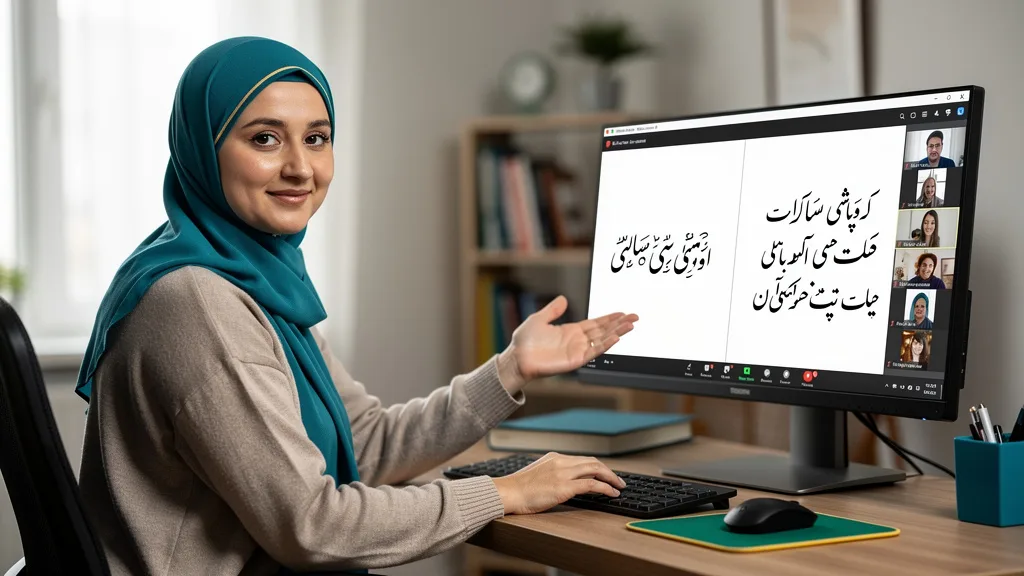
As a sincere student of the Quran, have you ever wondered how similar the Urdu you speak or hear is to the sacred Arabic of the Holy Book? While they may look similar on the page, the key difference is that Arabic is the Semitic language of divine revelation, essential for direct understanding, while Urdu is a distinct Indo-Aryan language. Understanding the Arabic vs Urdu: Key Differences for Quran Learners is the first step toward a deeper connection with the text.
Although Urdu shares a significant amount of vocabulary and its script with Arabic, its grammar, sentence structure, and core phonetic system are fundamentally different. For anyone in the UK, USA, Australia, or beyond who wants to move past translation and grasp the Quran's profound message directly, recognizing these distinctions is crucial. This guide will illuminate the path, clarifying why learning Arabic is a non-negotiable and beautiful journey for every Muslim.
Understanding the Foundational Link Between Arabic and Urdu
To appreciate the differences between Arabic and Urdu, it is helpful to first understand their historical and cultural connection. Arabic is a Semitic language, ancient and sacred, known globally as the language of the Quran. It is the liturgical language for over a billion Muslims and holds a unique, revered status as the direct word of Allah (SWT).

Urdu, on the other hand, is a much younger Indo-Aryan language that evolved in South Asia around the 13th century. Its foundational link to Arabic is primarily through the spread of Islam. As Persian, the court language of Muslim rulers in the subcontinent, became widespread, it brought with it a vast lexicon of Arabic words. This religious and cultural infusion is why an Urdu speaker will recognize many words in an Arabic text, even if the surrounding sentence is incomprehensible.
Key Differences in Script and Writing Systems
At first glance, the scripts for Arabic and Urdu appear nearly identical, which is a common source of confusion. Both are written from right to left and share a core set of letters. However, the writing systems have distinct characteristics, styles, and additional characters that set them apart.
The Arabic Script: An Abjad System
The Arabic script is a true abjad, meaning that its letters primarily represent consonants. Short vowels are indicated by diacritical marks known as harakat (like fatha, kasra, and damma), which are typically omitted in everyday writing but are essential and always present in the Quran for correct recitation. The standard Arabic alphabet consists of 28 letters, and the script style most commonly used for printing, especially for the Quran, is called Naskh, known for its clarity and legibility.

This system is perfectly suited for the language's structure, which is based on consonant roots. The absence of written short vowels in non-Quranic texts means the reader must have a strong grammatical understanding to know which vowels to supply. For Quran learners, mastering the harakat is one of the first and most critical steps.
The Urdu Script: Nastaliq and Additional Characters
The Urdu script is an adaptation of the Perso-Arabic script. While it uses the majority of the Arabic letters, it also includes additional characters to represent sounds not found in Arabic, such as 'p' (پ), 'ch' (چ), 'g' (گ), and retroflex consonants like 't' (ٹ) and 'd' (ڈ). This makes the Urdu alphabet larger than its Arabic counterpart.
Furthermore, Urdu is almost exclusively written in a calligraphic style called Nastaliq. This style is more cursive, rounded, and features a noticeable downward slope from right to left, giving it a distinct aesthetic. This can make it challenging for someone accustomed only to the blockier Naskh style of Arabic to read Urdu, and vice versa, despite the shared letter forms.
Grammar and Sentence Structure Compared
The most significant divergence between Arabic and Urdu lies in their grammar and sentence construction. This is where their different language families, Semitic and Indo-Aryan, become most apparent. Knowing the vocabulary is not enough when the rules for building a sentence are completely different.
Arabic's Triliteral Root System
Classical Arabic grammar is famously built upon a system of three-letter (triliteral) roots. These roots carry a core meaning, and by applying different patterns of vowels and adding prefixes or suffixes, a wide array of related words can be formed. For example, from the root K-T-B (related to writing), we get kitab (book), katib (writer), maktab (office/desk), and yaktubu (he writes).
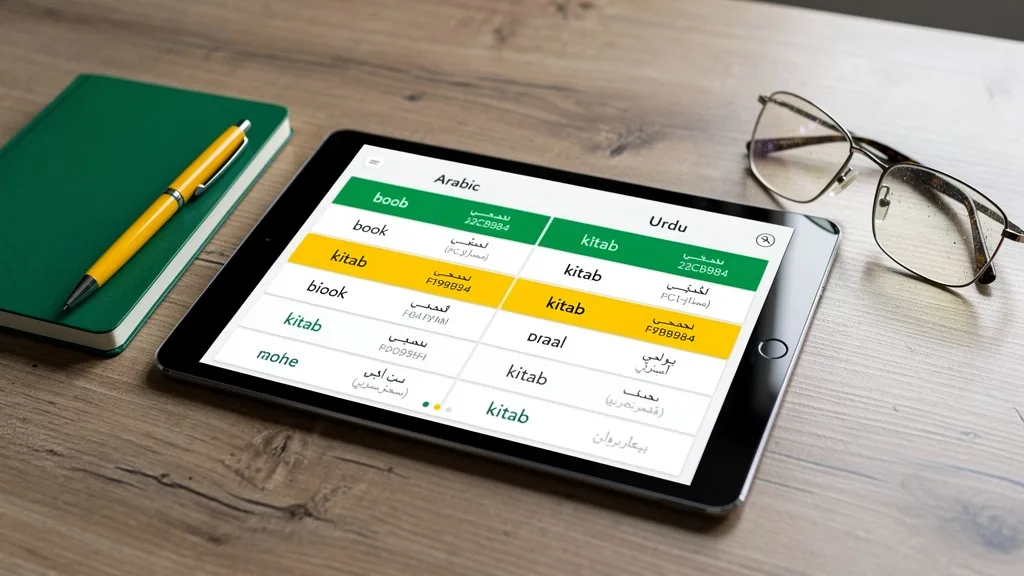
This root system creates a language that is incredibly precise, deep, and internally consistent, a key feature of the Quran's miraculous nature. For learners, understanding this system is the key to unlocking the true meaning of the verses. This system is completely absent in Urdu.
Urdu's Subject-Object-Verb Word Order
Urdu grammar follows the patterns of its Indo-Aryan relatives, like Hindi. Its standard sentence structure is Subject-Object-Verb (SOV). For example, "Zayd reads the book" would be "Zayd kitaab parhta hai" (Zayd book reads). This is in stark contrast to a typical Arabic verbal sentence, which often follows a Verb-Subject-Object (VSO) structure: "Yaqra'u Zaydun al-kitaba" (Reads Zayd the book).
Additionally, Urdu uses postpositions, which come after a noun, instead of prepositions like in Arabic and English. For example, "in the house" is "ghar mein" in Urdu, whereas in Arabic it is "fi al-bayt". These fundamental grammatical differences mean you cannot translate a sentence word-for-word between the two languages and retain its meaning.
Vocabulary: Shared Roots and Divergent Influences
The lexicon is where Arabic and Urdu show the most overlap, giving Urdu speakers a noticeable advantage when they begin their Arabic studies. However, this shared vocabulary is layered upon a base that is entirely distinct.
Arabic Loanwords Present in Urdu
It is estimated that up to 40% of the Urdu vocabulary consists of loanwords from Arabic, often passed through Persian. These words typically relate to religion, administration, law, and abstract concepts. This shared vocabulary can be a great confidence booster for new learners.
"Knowing Urdu gives a Quran student a beautiful head start. You already have a treasure chest of familiar words like 'ilm', 'sabr', and 'dua'. Our job at Hidayah Quran Academy is to give you the grammatical key to unlock how these words connect in the language of the Quran."
However, learners must be cautious of "false friends," words that look similar but have evolved to have different meanings or nuances in Urdu compared to their original Arabic. This is why structured learning is so important.

| English | Arabic Word (Transliteration) | Urdu Word (Transliteration) | Notes |
|---|---|---|---|
| Book | Kitāb | Kitāb | Identical meaning and usage. |
| Patience | Ṣabr | Sabr | Identical meaning, slight pronunciation difference. |
| Knowledge | ʿIlm | Ilm | The guttural 'ʿAyn' sound is softened in Urdu. |
| World | Dunyā | Dunyā | Identical meaning and usage. |
| Heart | Qalb | Qalb | Identical meaning and usage. |
Persian and Sanskrit Influence on Urdu Vocabulary
The core of Urdu's vocabulary, including most verbs, pronouns, and basic functional words, is derived from Prakrit, a descendant of Sanskrit. This forms the grammatical backbone of the language. On top of this base, Urdu layered extensive vocabulary from Persian, which was itself heavily influenced by Arabic.
This makes Urdu a rich, composite language. For example, a single Urdu sentence might contain a verb of Sanskrit origin, a noun from Arabic, and a conjunction from Persian. This complex heritage is what makes it so unique and also so different from the more uniform Semitic structure of Arabic.
Pronunciation and Phonetic Distinctions
Correct pronunciation is paramount in Quranic studies, as even a small error can alter the meaning of a word. This practice, known as Tajweed, highlights the critical phonetic differences between Arabic and Urdu. While an Urdu speaker can read the Arabic script, they often pronounce the letters according to Urdu phonology, which is incorrect for Quran recitation.
Arabic possesses several unique consonant sounds that have no equivalent in Urdu or English. These include the emphatic consonants (ṣād, ḍād, ṭāʾ, ẓāʾ) and the guttural sounds produced deep in the throat, such as 'ayn (ع) and ḥāʾ (ح). In Urdu, these sounds are often substituted with simpler ones. For example, the three distinct 's' sounds in Arabic (sīn, thāʾ, and ṣād) are frequently pronounced as a single 's' sound by untrained Urdu speakers. To recite the Quran correctly, one must learn the precise articulation point (makhraj) of each Arabic letter from a qualified female Tajweed teacher online.
Which Language Is Essential for True Quran Understanding?
The answer is unequivocally Arabic. While translations in Urdu or any other language are valuable aids, they are ultimately human interpretations of the divine text. They cannot fully capture the eloquence, depth, multi-layered meanings, and linguistic miracle of the Quran. Relying solely on a translation is like looking at a beautiful garden through a keyhole; you see a part of the beauty, but you miss the entire breathtaking landscape.
Learning the Quranic Arabic language allows for a direct, personal, and unfiltered connection with the words of Allah (SWT). It enables you to appreciate the subtleties of word choice, the power of the grammatical structure, and the rhythm and flow of the revelation as it was intended. For anyone serious about their relationship with the Quran, embarking on the journey to learn Arabic is not just beneficial, it is essential.
Surprising Similarities to Aid Your Learning Journey
Despite the profound differences, your background in Urdu can be a powerful asset in your quest to learn Quranic Arabic. Instead of being a source of confusion, these similarities can serve as a launchpad, accelerating your initial progress and building your confidence. The journey to real Arabic progress can start today.
Here are some of the key advantages an Urdu speaker has: mastering the harakat.
- Familiarity with the Script: You already know how to recognize the majority of the letters and the right-to-left direction of reading. This is a huge hurdle that you have already cleared.
- Shared Vocabulary Base: You will instantly recognize hundreds of nouns, adjectives, and concepts. This provides context and makes reading early texts less intimidating.
- Islamic Terminology: Words like Salat, Zakat, Hajj, and Iman are already part of your vocabulary, providing immediate connection to Islamic texts.
- Phonetic Foundation: While not identical, many of the consonant sounds are similar, providing a good starting point for refining your pronunciation with a qualified teacher.
Key Takeaways
Navigating the relationship between Arabic and Urdu is key for any Quran learner. Understanding both their connections and their critical differences empowers you to set realistic goals and appreciate the unique journey of learning the language of the Quran. Here is a summary of the essential points:
- Language Family: Arabic is a Semitic language, while Urdu is an Indo-Aryan language. This is their most fundamental difference.
- Script: Both use a Perso-Arabic script, but Urdu uses the Nastaliq style and has additional letters for sounds not found in Arabic.
- Grammar: Arabic uses a complex triliteral root system. Urdu uses a Subject-Object-Verb (SOV) sentence structure common to South Asian languages.
- Vocabulary: Urdu has borrowed a significant number of words from Arabic (up to 40%), but its core vocabulary and grammar are from Sanskrit and Persian.
- Pronunciation: Correct Quranic recitation (Tajweed) requires learning unique Arabic sounds that are pronounced differently or are absent in Urdu.
- Goal for Quran Learners: While knowledge of Urdu is a helpful starting point, learning Arabic is essential for a direct and deep understanding of the Quran.
Frequently Asked Questions
If I know Urdu, how much of the Quran's Arabic will I understand?
If you know Urdu, you will be able to recognize a significant portion of the vocabulary in the Quran, particularly nouns and abstract concepts. However, due to the completely different grammar and sentence structure, you will likely not understand the full meaning of the verses. You might grasp individual words but miss the relationships between them, which is essential for comprehension.
Think of it as having many of the right puzzle pieces but not knowing how they fit together. Your Urdu knowledge provides the pieces, but learning Arabic grammar gives you the ability to assemble the puzzle and see the complete picture as intended.
Is Arabic or Urdu harder for an English speaker to learn?
Both languages present unique challenges for native English speakers. The Foreign Service Institute (FSI) classifies Arabic as a Category V language, meaning it is exceptionally difficult and requires significantly more hours of study than a language like Spanish or French. This is due to its unfamiliar script, complex grammar, and difficult pronunciation.
Urdu is typically considered slightly easier for English speakers than Arabic. While it also has a new script and different sentence structure (SOV), its grammar is generally seen as less complex than Arabic's root system. However, both require dedication and consistent effort.
Can you read the Quran correctly if you only know the Urdu script?
You can sound out the words phonetically based on your knowledge of the Urdu script, but this is not the same as reading the Quran correctly. Correct recitation, or Tajweed, involves pronouncing each letter from its specific point of articulation and applying a set of rules for rhythm, pausing, and elongation. Many Arabic sounds are pronounced differently in Urdu.
Without studying Tajweed from a qualified teacher, an Urdu reader will invariably make errors in pronunciation that can, in some cases, alter the meaning of the words. Therefore, specific training in Quranic Arabic phonetics is necessary.
Are there different dialects of Arabic for Quranic study?
This is a crucial point. The Arabic used for Quranic study is Classical Arabic (sometimes called Quranic Arabic). This is the standardized, literary language of the 7th century and is the language of all classical Islamic texts. It is distinct from the many forms of Modern Standard Arabic (MSA) used in media and the various colloquial dialects (e.g., Egyptian, Levantine, Gulf) spoken in daily life across the Arab world.
While related, these dialects can be very different from Classical Arabic. For the purpose of understanding the Quran, your focus must be exclusively on Classical Arabic. All reputable Quranic language programs, including ours at Hidayah Quran Academy, teach this specific form of the language.
Does learning Urdu help with learning Quranic Arabic later?
Absolutely. Learning Urdu provides a significant advantage for a future student of Arabic. The two biggest initial hurdles for any beginner are learning the script and building a basic vocabulary. As an Urdu speaker, you have a massive head start on both of these fronts. You are already comfortable with the right-to-left script and will recognize a large pool of words.
This foundation allows you to focus your energy more quickly on the new, challenging aspects of Arabic, such as its unique grammar and pronunciation. It can make the initial learning phase feel much less intimidating and more rewarding, helping you build momentum on your journey.
Conclusion
While Urdu shares a script and a wealth of vocabulary with Arabic, they are fundamentally different languages with unique grammars and sound systems. For the dedicated Quran learner, knowledge of Urdu serves as an excellent bridge, but it is not the destination. The ultimate goal must be to learn Classical Arabic to connect directly with the divine message. Embracing this journey unlocks a depth of understanding and a spiritual connection that no translation can ever fully provide.
Ready to move beyond translation and experience the Quran in its original, beautiful language? Hidayah Quran Academy offers private, one-on-one classes with qualified female teachers specifically for sisters, children, and adult beginners in the UK, USA, Australia, and worldwide. Experience our supportive and modest learning environment with a complimentary 30-minute trial class. Book Free Trial and begin your rewarding journey today.