
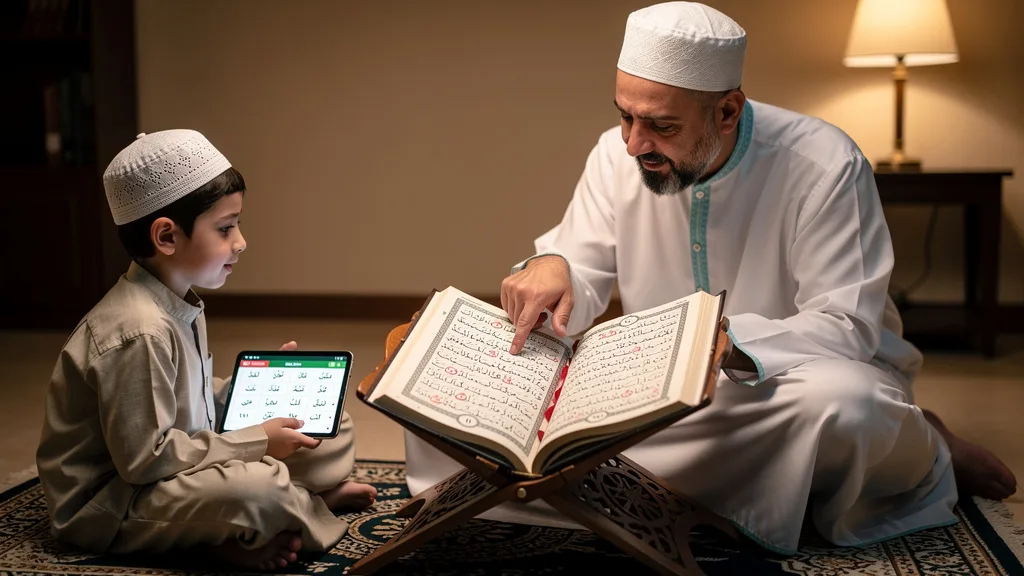
Do you wish to connect with the words of Allah SWT but feel unsure where to begin your recitation journey? Learning to recite the Quran beautifully and correctly is a profound act of worship, bringing you closer to its divine message. This guide breaks down the essential rules in a simple way, providing a clear path for any beginner to follow.
The Holy Quran recitation rules every beginner should know are collectively called Tajweed. Tajweed involves giving every letter of the Quran its right, including its correct pronunciation from the specific articulation point (Makhraj) and its inherent qualities (Sifaat). For a beginner, the first steps are to learn the Arabic alphabet, find a qualified teacher, and then gradually study core Tajweed principles like Noon Sakinah, Madd (prolongation), and Ghunna (nasalization) to ensure proper recitation.
How a Beginner Should Start Reading the Quran
Embarking on the journey of Quran recitation is a blessed endeavor that requires a structured approach. Before diving into complex rules, a beginner must build a solid foundation. This initial phase is crucial for developing the correct habits that will support your learning for years to come. The goal is not speed, but accuracy and a heartfelt connection to the words of Allah SWT.

Starting correctly sets the stage for a lifetime of beautiful and meaningful recitation. It involves a combination of seeking knowledge, mastering the basics of the Arabic language, and cultivating discipline through a consistent routine. These first steps ensure you do not develop incorrect pronunciation habits that can be difficult to unlearn later.
Finding a Qualified Teacher or Mentor
The most critical step for any beginner is to find a qualified teacher. While books and apps are helpful resources, they cannot replace the personalized feedback and correction of a live mentor. A teacher can listen to your recitation, pinpoint subtle errors in pronunciation, and guide you through the complexities of Tajweed in a way that is tailored to your pace and learning style.
A good teacher provides not only knowledge but also encouragement and motivation. They can answer your specific questions and demonstrate the correct articulation of letters. For sisters and children, finding a comfortable and private learning environment is key. This is why many families seek out a female Quran teacher online to provide expert one-on-one instruction in a modest setting.
Beginning With the Arabic Alphabet (Alif-Ba-Ta)
You cannot recite the Quran without first mastering the Arabic alphabet. The foundational text for this is often the Noorani Qaida or a similar booklet. This guide teaches you to recognize, pronounce, and join letters to form words. It is essential to learn the correct articulation point (Makhraj) for each of the 28 letters from the very beginning.
Take your time with this stage. Rushing through the alphabet will lead to persistent pronunciation mistakes. Practice each letter individually and then in combination with vowels (Fatha, Kasra, Dammah). This foundational practice is the building block upon which all quranic recitation rules are applied.
Setting a Consistent Practice Schedule
Consistency is more important than duration. A short, focused practice session every day is far more effective than a long session once a week. Set aside a specific time each day for your Quran studies, even if it is just for 15-20 minutes. This discipline builds momentum and helps reinforce what you learn from your teacher.
Your practice schedule should include reviewing past lessons and practicing new ones. This routine helps commit the rules to memory and builds muscle memory in your mouth and tongue for correct pronunciation. Treat this time as a special appointment with the Quran, free from distractions, to truly benefit from your efforts.
Core Tajweed Rules for Proper Quran Recitation
Tajweed is the science of perfecting the recitation of the Quran. The word itself means "to improve" or "to make better." These rules are not arbitrary but are based on the way the Prophet Muhammad (peace be upon him) recited the Quran as he learned from the angel Jibreel. Following Tajweed ensures that the Quran is recited as it was revealed, preserving its meaning and beauty.

For a beginner, the world of Tajweed can seem vast, but it can be broken down into manageable components. Focusing on a few core principles will dramatically improve your recitation and give you the confidence to continue learning. These rules govern how letters are pronounced, how long sounds are held, and how words flow together.
Mastering Articulation Points (Makharij al-Huruf)
Every Arabic letter has a specific point of articulation, known as the makharij al-huruf. This is the precise location in the mouth or throat from which the letter's sound originates. For example, some letters come from the lips, some from the tongue touching the teeth, and others from deep in the throat. Learning these points is the first step to correct pronunciation.
Without mastering the Makharij, letters can sound similar or incorrect, potentially altering the meaning of the words. For instance, the letters 'Ha' (ح) and 'Haa' (ه) sound different and come from different parts of the throat. A qualified teacher is invaluable in demonstrating these precise points and correcting your pronunciation until it becomes natural.
Understanding Letter Attributes (Sifaat al-Huruf)
Once you know where a letter comes from (its Makhraj), you must learn how to pronounce it (its Sifaat, or attributes). Sifaat are the characteristics of a letter, such as heaviness, lightness, whispering, and stoppage of breath. For example, some letters have a "heavy" or full-mouth sound (like ص, ض, ط, ظ), while others are light and thin.
These attributes give each letter its unique sound and texture. For example, the attribute of "Hams" (whispering) means there is a flow of breath when pronouncing certain letters, while "Jahr" (audibility) means the breath is trapped. Learning Sifaat adds clarity and precision to your recitation, making it more accurate and beautiful.
Applying the Rules of Noon Sakinah and Tanween
The rules related to a non-voweled 'Noon' (نْ) and Tanween (the double vowels an, in, un) are among the most frequent in the Quran. These four rules dictate how the 'n' sound is pronounced when followed by different letters. They are fundamental for a smooth and correct flow of recitation.
Here is a summary of the four rules:
| Rule Name | Meaning | How to Apply It |
|---|---|---|
| Izhar (Clarity) | To make clear | Pronounce the 'n' sound of Noon Sakinah or Tanween clearly without any nasalization (Ghunna). This applies when followed by one of the six throat letters (ء, ه, ع, ح, غ, خ). |
| Idgham (Merging) | To merge | Merge the Noon Sakinah or Tanween into the following letter. It can be with nasalization (for letters ي, ن, م, و) or without (for letters ل, ر). |
| Iqlab (Flipping) | To flip or convert | Flip the 'n' sound into a light 'm' sound with nasalization when followed by the letter 'Ba' (ب). |
| Ikhfa (Hiding) | To hide | Hide the 'n' sound by producing a light nasal sound (Ghunna) in the nasal passage while preparing to pronounce the next letter. This applies to the remaining 15 letters. |
Correctly Applying Prolongation (Madd)
Madd means to prolong or stretch the sound of the three vowel letters: Alif (ا), Waw (و), and Ya (ي). The length of the stretch depends on the specific type of Madd rule being applied. The most basic form is Natural Madd (Madd Tabee'i), which is prolonged for two counts or beats.
Other types of Madd occur when a Madd letter is followed by a Hamzah or a Sukoon, requiring a longer prolongation of four, five, or even six counts. Correctly applying Madd adds a melodic and rhythmic quality to the recitation, and failing to do so is considered a significant error. It is a core part of the Complete Guide to Tajweed Rules.
Perfecting Nasalization (Ghunna)
Ghunna is the beautiful nasal sound that is an intrinsic quality of the letters 'Noon' (ن) and 'Meem' (م). This sound is produced from the nasal passage and is held for approximately two beats whenever these letters have a Shaddah (ّ) on them (i.e., نّ and مّ). It is also a key component of other rules like Ikhfa, Idgham, and Iqlab.
"Perfecting Ghunna is like adding a sweet fragrance to your recitation. It is a subtle yet profound rule that distinguishes a knowledgeable reciter and is essential for adhering to the Holy Quran recitation rules every beginner should know." - Islamic Scholar
The sound of Ghunna should be smooth and consistent, not rushed or cut short. Listening to expert reciters is one of the best ways to get a feel for the correct duration and quality of this nasalization. It adds a distinct resonance and beauty to the recitation that is pleasing to the ear.
Using the Echoing Sound (Qalqalah)
Qalqalah is a unique echoing or vibrating sound made when one of five specific letters has a Sukoon (a sign indicating no vowel). These five letters are collected in the phrase قطب جد (Qutub Jud): (ق ,ط ,ب ,ج ,د). When one of these letters is sakin (has a Sukoon), you should pronounce it with a slight bounce or echo.
This rule is important to prevent the sound of the letter from being completely cut off, which can happen when it appears at the end of a word or in the middle. The strength of the Qalqalah can vary depending on where it occurs in the word. Mastering this rule adds a crispness and clarity to the pronunciation of these letters.
Navigating Pauses and Stops: The Rules of Waqf
Knowing where to pause or stop (Waqf) when reciting the Quran is just as important as knowing how to pronounce the letters. Stopping at the wrong place can inadvertently change the meaning of a verse. The rules of Waqf provide guidance on where it is permissible, recommended, or forbidden to stop, ensuring the integrity of the message is preserved.

These rules are indicated by small symbols placed above the text in the Mushaf (the written Quran). Learning to recognize these symbols will help you manage your breath and pause at appropriate places without breaking the flow of the meaning. It is a practical skill that greatly enhances the clarity and coherence of your recitation.
Recognizing Common Waqf Symbols in the Mushaf
The Mushaf contains several symbols to guide the reader on stopping. One of the most common is a small circle (ه), which marks the end of an Ayah (verse), where stopping is always permissible. Other symbols indicate different levels of preference for stopping or continuing.
- م (Meem): This indicates a mandatory stop (Waqf Lazim). You must stop here as continuing would likely corrupt the meaning.
- لا (Laa): This indicates a prohibited stop. You should not stop here unless it is the end of a verse.
- ج (Jeem): This indicates a permissible stop (Waqf Ja'iz). You have the choice to stop or continue.
- صلى (Salla): This indicates that continuing is preferred, though stopping is permissible.
- قلى (Qalla): This indicates that stopping is preferred, though continuing is permissible.
- ∴ (Three dots): These appear in pairs. They indicate that you may stop at one of the two locations, but not both.
Differentiating Between a Full Stop (Waqf) and a Brief Pause (Sakt)
While Waqf involves a full stop where you take a breath before continuing, a Sakt is a brief, breath-less pause. It is a momentary silence that is shorter than a full stop, during which you do not take a new breath. This rule is applied in only a few specific locations in the Quran, marked by a small 'seen' (س) above the word.
The purpose of a Sakt is to separate two words to avoid them being read together, which could create an incorrect meaning. For example, it prevents the reader from performing Idgham (merging) where it is not supposed to occur. Though rare, recognizing the symbol for Sakt is part of a complete understanding of recitation rules.
Practical Tips to Improve Your Recitation in 2026
Learning the theoretical rules of Tajweed is the first step, but consistent, practical application is what truly refines your recitation. As you progress, incorporating a few key habits into your routine can accelerate your improvement and help you internalize the rules more effectively. These tips are timeless but are especially accessible in 2026 with modern technology.

The journey to perfect recitation is one of continuous improvement. By actively engaging with the Quran through listening, self-assessment, and focused practice, you can transform your recitation from hesitant to confident and beautiful. These habits will help you apply the theoretical knowledge you have gained.
Listen to Expert Reciters (Qaris)
One of the most powerful ways to learn is by imitation. Spend time listening to the recitation of renowned Qaris like Sheikh Mishary Rashid Alafasy, Sheikh Abdul Rahman Al-Sudais, or Sheikh Mahmoud Khalil Al-Husary. Pay close attention to how they apply the rules of Tajweed: their pronunciation, the length of their Madd, the quality of their Ghunna, and where they choose to pause.
Use an app or website that highlights the words as they are being recited. This will help you connect the written rules to the auditory sound. Try to mimic short passages, focusing on matching their rhythm and pronunciation as closely as possible. This practice trains your ear and tongue simultaneously.
Record Yourself and Compare
It is often difficult to hear our own mistakes while we are reciting. A simple yet highly effective technique is to record yourself reading a passage and then listen back to it. Compare your recitation to that of an expert Qari reciting the same passage. This self-assessment will reveal areas that need improvement.
Are you applying Qalqalah correctly? Is your Madd long enough? Are you pronouncing the heavy letters with the right fullness? This feedback loop is like having a teacher available 24/7. It empowers you to take control of your learning and make targeted improvements to your recitation.
Focus on One Rule at a Time
Trying to apply all the rules of Tajweed at once can be overwhelming for a beginner. A more effective approach is to focus on mastering one rule at a time. For example, you might spend a week focusing solely on applying the rules of Noon Sakinah and Tanween.
During your recitation practice for that week, make that one rule your primary focus. Once you feel confident in its application, move on to the next rule, such as Madd or Qalqalah. This methodical approach builds a strong, layered understanding and prevents cognitive overload, making the learning process more manageable and rewarding. This is a key part of the 18 Quran Reading Rules Every Muslim should know.
Key Takeaways
Learning the Holy Quran recitation rules is a journey of devotion and precision. By following a structured path, any beginner can develop the skills to recite the Quran correctly and beautifully. Here are the most important takeaways from this guide:
- Find a Qualified Teacher: Personalized guidance is the fastest and most effective way to learn. A teacher can correct subtle mistakes that you might not notice on your own. Consider finding a private tutor for online Quran classes for focused attention.
- Master the Foundation: Before tackling Tajweed, ensure you have perfected the pronunciation of the Arabic alphabet and its articulation points (Makharij).
- Learn Core Tajweed Rules: Focus on high-frequency rules first, including the rules of Noon Sakinah and Tanween, Madd (prolongation), Ghunna (nasalization), and Qalqalah (echoing).
- Understand How to Pause: Learn the symbols of Waqf (stopping) to know where to pause without altering the meaning of the verse.
- Practice Smart: Improve your recitation by listening to expert Qaris, recording yourself for self-assessment, and focusing on mastering one rule at a time.
- Consistency is Key: A short, daily practice session is more powerful than infrequent, long ones. Make Quran recitation a consistent part of your daily routine.
Frequently Asked Questions
What are the 7 essential rules of Tajweed?
While Tajweed has many rules, a beginner can focus on seven essential areas. These include: 1. Makharij al-Huruf (articulation points), 2. Sifaat al-Huruf (letter attributes), 3. The rules of Noon Sakinah and Tanween (Izhar, Idgham, Iqlab, Ikhfa), 4. The rules of Meem Sakinah, 5. Madd (prolongation), 6. Ghunna (nasalization), and 7. Qalqalah (echoing).
Mastering these seven categories will cover the vast majority of the rules you encounter while reciting the Quran. They form the core of proper pronunciation and flow, helping you avoid major errors and recite with confidence and clarity.
What are the 7 ways of reciting the Quran (Qira'at)?
The seven Qira'at are the seven authentic and mutawatir (mass-transmitted) methods of reciting the Quran. These variations in recitation were all taught by the Prophet Muhammad (pbuh) and are preserved through chains of narration. They differ slightly in pronunciation, vowel points, and sometimes even letters, but the core meaning remains the same.
These seven ways are named after the famous Qari (reciter) who was the primary transmitter of that method. The most common recitation in the world today is the Qira'ah of 'Asim in the transmission (Riwayah) of Hafs. For a beginner, it is essential to stick to one recitation method to avoid confusion.
Do I need a teacher to learn Quran recitation rules?
Yes, it is highly recommended, and many scholars consider it obligatory to learn from a qualified teacher. Tajweed is a practical science that involves precise sounds and movements of the mouth and tongue that cannot be fully learned from a book or video. A teacher provides real-time feedback and correction, which is crucial for mastering pronunciation.
Without a teacher, you risk ingraining incorrect habits that are very difficult to fix later. A teacher ensures you are applying the rules correctly and can guide you through the learning process. Platforms offering a female Tajweed teacher online make this accessible for sisters and children everywhere.
How long does it take to learn basic Tajweed?
The time it takes to learn basic Tajweed varies greatly depending on the student's background, effort, and consistency. With a qualified teacher and dedicated daily practice of about 30 minutes, a beginner can typically learn the fundamental rules and apply them with reasonable accuracy within 3 to 6 months.
However, mastering Tajweed and reciting with the fluency of an expert is a lifelong journey. The goal for a beginner should be to learn the core rules to avoid major mistakes and then continue to refine their recitation over time. Consistency is more important than speed.
Can I learn Tajweed rules online?
Absolutely. In 2026, learning Tajweed online is one of the most effective and convenient methods available. Online classes with a live teacher via platforms like Zoom or WhatsApp provide the same one-on-one interaction and personalized feedback as in-person classes. This is especially beneficial for those with busy schedules or who lack access to qualified teachers locally.
Online learning allows you to find a teacher who matches your learning style and needs, including the option for private classes with a female teacher for sisters and children. Many academies offer structured courses from the Noorani Qaida for beginners to advanced Tajweed and Hifz programs, making it a comprehensive solution.
Conclusion
Learning the Holy Quran recitation rules is a beautiful and rewarding act of devotion that connects you directly to the words of Allah SWT. By starting with a qualified teacher, mastering the Arabic alphabet, and methodically learning the core principles of Tajweed, you can build a strong foundation for a lifetime of correct and heartfelt recitation. Remember to be patient with yourself, practice consistently, and embrace the journey of continuous improvement.
Ready to begin your journey with a qualified female teacher? Hidayah Quran Academy offers private, one-on-one classes for sisters, children, and adult beginners. Start with a free 30-minute trial to experience our supportive and professional learning environment. Book Free Trial today and take the first step towards beautiful recitation.