
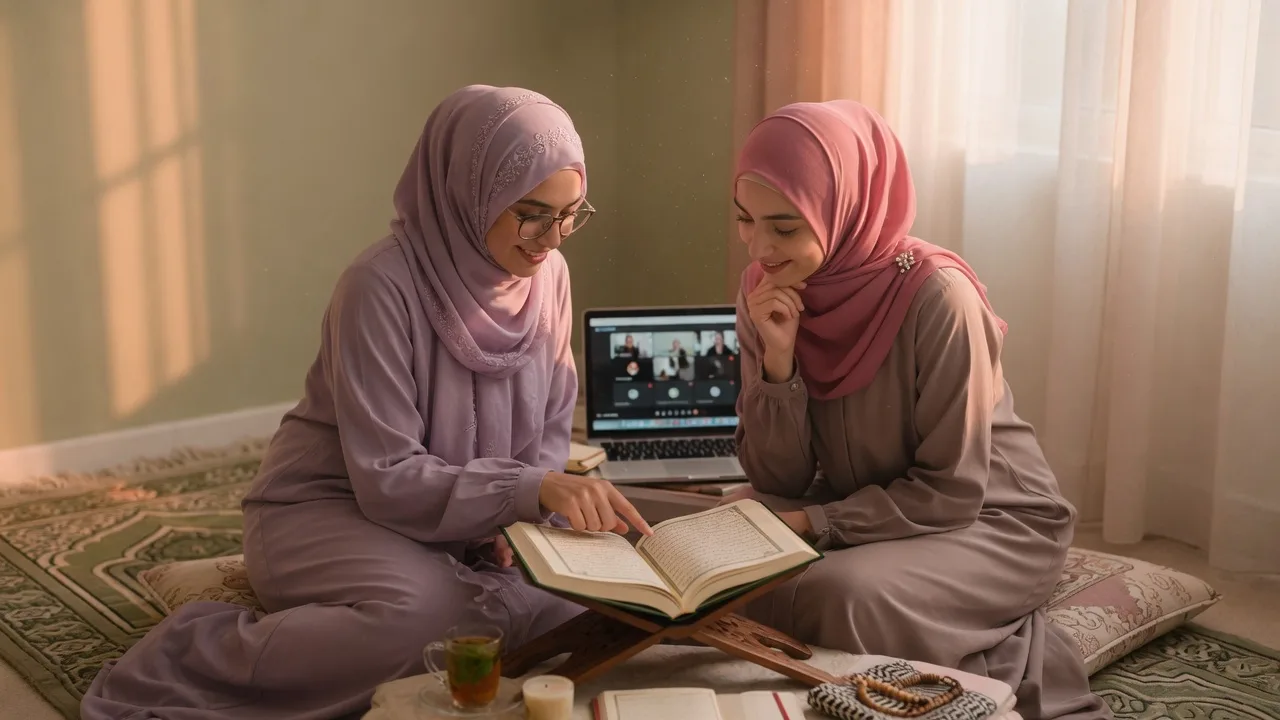

Quran classes for sisters work best as private 1-on-1 lessons with a qualified female teacher, on a schedule that fits real life. At Hidayah Quran, sisters can learn Nazra (Quran reading), Tajweed, online Hifz classes, and Islamic basics from home via Zoom, WhatsApp, or Google Meet, with a free 30-minute trial and no payment required to start.
Updated Augfemale Quran tutor in the USAt 2026
Quick answer for busy sisters
| Need | Best fit |
|---|---|
| Start from Arabic letters | Noorani Qaida / beginner path |
| Read Mushaf more fluently | Nazra (Quran reading) |
| Fix pronunciation and makharij | Tajweed |
| Memorise surahs or longer portions | Hifz with a realistic plan |
| Salah duas, adhkaar, short surahs | Islamic basics |
| Privacy and comfort | Female teacher, 1-on-1 only |
| UK, USA, or other remote zones | Flexible morning, evening, weekend slots |
Hidayah Quran is led by Ustadha Fatima, a Hafiza and female Quran teacher from Pakistan with over 10 years of online teaching experience. Classes are private, patient, and designed for sisters, adult beginners, reverts, housewives, and working women who need a modest learning space.
If you want the wider females and ladies overview, see our guide to online Quran classes for females. To understand how hiring works, read female Quran teacher online.
Why sisters prefer female-only learning spaces
Sisters prefer female-only Quran learning because it protects hayaa (modesty), reduces social awkwardness on video, and makes it easier to ask questions without hesitation.
Many sisters want to learn, but the setting matters as much as the syllabus. A private class with a female teacher lets you:
- Keep the camera and conversation within a comfortable, sister-to-sister space
- Ask about pronunciation, mistakes, or personal learning gaps without pricing and class schedulesling self-conscious
- Practise aloud without worrying about a mixed or group environment
- Choose a path that respects family expectations for girls and adult women
- Stay focused on the words of Allah instead of managing social tension
Comfort is not a luxury here. It is a practical condition for consistent learning. When a sister feels safe, she corrects herself more often, revises more honestly, and stays with the habit longer.
Parents looking for their daughters often choose the same setup. A female teacher gives parents peace of mind while giving young girls a strong female role model in Islamic knowledge. For a deeper look at this preference, see why choose a female Quran teacher.
Online private classes add another layer of privacy. You learn from your own home, on your own device, with no commute and no public classroom. That combination, female teacher plus 1-on-1 online format, is why so many sisters search specifically for online Quran classes for sisters rather than a general mixed academy.
Class formats (Nazra, Tajweed, Hifz, Islamic basics)
Hidayah Quran offers sisters four main learning tracks: Nazra for reading fluency, Tajweed for correct recitation, Hifz for memorisation, and Islamic basics for everyday worship skills. Your teacher places you after a short assessment, so you do not guess your level alone.
Nazra (Quran reading)
Nazra is for sisters who want to read from the Mushaf with more confidence. Lessons build page fluency, pause points, and steady daily reading habits. If you can recognise letters but still stumble on longer ayahs, Nazra is usually the right next step.
Tajweed
Tajweed is for sisters who can already read but want cleaner pronunciation, clearer makharij, and fewer repeated mistakes. Live correction matters here. A female teacher can stop you gently, show the sound, and rebuild the habit one rule at a time. Tajweed is ideal if you lead family prayer quietly at home, recite for yourself, or simply want your tilawah to feel more correct.
Hifz (memorisation)
Hifz for sisters is realistic when the plan matches your available time. Some sisters memorise selected surahs. Others aim for longer portions with a structured sabaq and revision cycle. Progress depends on age, schedule, and consistency, not on rushing. Adult sisters can succeed when the daily load stays small and revision stays non-negotiable.
Islamic basics
Islamic classes for sisters often include Salah related duas, daily adhkaar, short surahs, and simple foundations that support worship. This track suits reverts, complete beginners, and sisters who want practical knowledge alongside reading. It pairs well with Qaida or early Nazra.
How placement usually works
| Starting point | Common first track | Typical early outcome |
|---|---|---|
| Cannot read Arabic yet | Noorani Qaida, then Nazra | Letters, vowels, joining, simple words |
| Reads slowly with many stops | Nazra | Smoother page reading |
| Reads but mispronounces rules | Tajweed | Clearer sound and fewer repeated errors |
| Wants memorisation | Hifz plan | New lesson plus daily revision routine |
| Needs worship essentials | Islamic basics | Short surahs, duas, everyday adhkaar |
You do not need to name the course perfectly before you message us. Share your goal in plain words: “I want to read Quran properly,” “I am a revert,” “I want to fix Tajweed,” or “I want to memorise Juz Amma.” The trial class turns that goal into a simple plan.
Timings for busy schedules (UK / USA / remote)
Quran classes for sisters can fit UK, USA, and other remote time zones when lessons are private and the teacher books around your real week, not a fixed group timetable.
Busy sisters usually need one of these patterns:
- Early morning before school runs or work
- Midday windows for housewives or remote workers
- Evening slots after Maghrib or after children sleep
- Weekend blocks for sisters with unpredictable weekdays
Hidayah Quran teaches students in the UK, USA, Australia, UAE, and other international locations. Classes run seven days a week subject to availability. Session length is commonly 30 minutes for focused daily practice, 45 minutes for many sisters, or up to 60 minutes for deeper Tajweed or adult study, depending on the plan agreed after the trial.
Practical scheduling tips for sisters
- Pick a time you can protect three or more days each week. Consistency beats long irregular sessions.
- Keep the device and Mushaf (or Qaida) in one place so class setup takes under two minutes.
- If you have young children, choose a slot when another adult can help, or when children are usually settled.
- Tell the teacher your time zone clearly (for example London, New York, Toronto, Dubai, Sydney).
- Start with a sustainable frequency. Many sisters do well with three to five classes per week.
Remote learning removes travel, waiting rooms, and weather problems. That is especially helpful for sisters who cannot leave home easily, prefer not to attend mixed spaces, or live far from a mosque class that offers a suitable female teacher. Online does not mean impersonal. In a 1-on-1 lesson, your teacher hears every letter and adjusts the pace to you.
Beginners welcome (no shame starting late)
Adult sisters can start Quran from zero at any age, and there is no shame in beginning late. Many women begin after marriage, after children, after reverting to Islam, or after years of wishing they had learned earlier. The right response is a gentle path, not self-blame.
A beginner-friendly path usually looks like this:
- Arabic letters and sounds with patience
- Short joining practice and simple words
- Qaida completion or equivalent foundations
- Transition into easy Quran reading
- Optional Tajweed refinement once reading is stable
You may already know some surahs by memory from Salah without being able to read the Mushaf. That is common. Your teacher can honour what you already know while filling the gaps carefully.
Reverts are welcome. So are sisters who studied years ago and forgot almost everything. So are mothers who want to learn beside their daughters. The classroom tone at Hidayah Quran is non-judgmental by design. Mistakes are normal. Repetition is normal. Asking the same question twice is normal.
What helps beginners most:
- A female teacher who slows down without making you feel slow
- Private classes so you can practise aloud freely
- Short, clear homework you can actually finish
- Progress measured by clarity and confidence, not by comparing yourself to others
If you have delayed for years because of embarrassment, treat the free trial as a low-pressure first step. You are not behind. You are beginning, and beginning is an act of sincerity.
Trial class: what to expect
A free trial Quran class for sisters is a short, private 30-minute meeting to assess your level, answer questions, and see whether the teacher and schedule feel right, with no payment and no commitment required.
Here is what usually happens:
- You message on WhatsApp or use the contact form. Share your country, time zone, current level (even if it is “complete beginner”), and preferred days or times.
- A trial slot is confirmed. You join on Zoom, WhatsApp video, or Google Meet, whichever is easiest for you.
- The teacher greets you and checks comfort. Camera preferences and basic setup can be discussed respectfully.
- A light assessment begins. This may include letters, a short reading sample, or a conversation about your goals if you are new to Arabic.
- You receive a simple recommendation. Course track, suggested class length, and a realistic weekly rhythm are explained only if you want to continue.
- You decide without pressure. If the fit is good, you choose a plan. If not, you leave with clarity and no invoice for the trial.
What to prepare before the trial
- A quiet corner for 30 minutes
- Phone, tablet, or laptop with a stable connection
- Headphones if your home is busy
- Your Mushaf or a beginner book if you already have one (optional)
- One clear goal sentence, such as “I want to read Quran fluently” or “I want correct Tajweed for Salah”
The trial is also the right time to ask practical questions: languages supported (English and Urdu are available), how homework works, how progress is reviewed, and which days remain open in your time zone.
Ready to begin?
Book your free 30-minute trial and meet a female Quran teacher in a private sister-friendly class:
- Book free trial on WhatsApp
- Or use the contact form
No payment. No commitment. Just one calm first lesson.
FAQs
Are Quran classes for sisters only taught by female teachers at Hidayah Quran?
Yes. Hidayah Quran’s lead teacher is a qualified female educator, so sisters, ladies, and girls can learn in a private, modest setting. This is the standard arrangement for families who specifically want a female teacher.
Can I take online Quran classes for sisters from the UK or USA?
Yes. Sisters in the UK, USA, and other remote locations can book private online lessons that respect their local time zone. Morning, evening, and weekend options are arranged according to availability after the trial.
What is the difference between Nazra and Tajweed for sisters?
Nazra focuses on reading the Quran more fluently from the page. Tajweed focuses on pronouncing letters and rules correctly. Many sisters start with reading confidence, then refine Tajweed, while some combine both under one personalised plan.
I am an adult beginner. Will I feel out of place?
No. Adult beginners and reverts are welcome. Lessons start from your actual level, including from Arabic letters if needed. Private 1-on-1 classes remove the social pressure that often stops sisters from starting.
Do islamic classes for sisters include duas and Salah basics?
Yes. Alongside Quran reading tracks, sisters can learn practical Islamic basics such as short surahs, Salah related duas, and daily adhkaar. Your teacher can blend these with Qaida or Nazra when that supports your goals.
Is the trial class really free?
Yes. The first 30-minute trial is free, with no payment and no commitment. After the teacher understands your level and schedule, a suitable plan is shared only if you choose to continue.
Start your sister-friendly Quran journey
Quran classes for sisters should feel safe, flexible, and genuinely useful. Private 1-on-1 lessons with a female teacher give you room to learn without shame, ask without fear, and build a habit that fits family life in the UK, USA, or anywhere remote.
Whether you need Nazra, Tajweed, Hifz, or Islamic basics, begin with a free trial and a clear next step.
Book My Free Trial on WhatsApp · Contact Hidayah Quran
💡 Want Your Child to Learn Quran from Home?
Give your child the gift of fluent Quran reading with correct Tajweed and Islamic values. Join hundreds of American Muslim families learning 1-on-1 with certified female tutors.
Book a Free 3-Day Trial Class →