
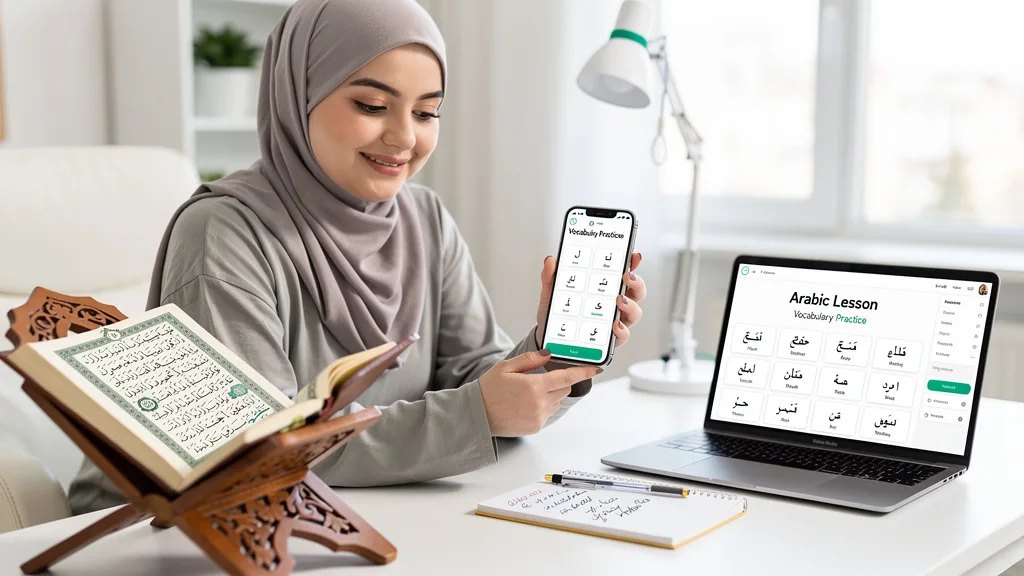
Are you looking for a more effective way to build your Quranic Arabic vocabulary and deepen your connection with the Holy Quran? The right digital tools can transform your study from a slow-moving task into an engaging and rewarding journey. The best vocabulary trainers for learning Quranic Arabic leverage proven memory techniques like spaced repetition and contextual learning to help you retain words efficiently and understand them within the sacred text itself. These apps are designed to fit into your daily routine, making consistent learning achievable.
The top choices for 2026 include customizable flashcard systems like Anki for serious learners and gamified apps like Memrise or the all-in-one Quranic app for those who prefer a guided experience. These tools help you master high-frequency words, understand root meanings, and hear authentic pronunciation, which are all essential for true comprehension. By integrating one of these trainers into your study plan, you can significantly accelerate your progress in understanding the language of the Quran.
Why Use a Dedicated Vocabulary Trainer for Quranic Arabic?
While traditional methods like writing out word lists have their place, dedicated vocabulary trainers offer a scientifically-backed approach to language acquisition. These applications are built around principles of cognitive science to help you learn faster and forget less. Unlike passively reading a list, these tools force active recall, which is the process of actively retrieving information from your memory. This action strengthens neural pathways, embedding the vocabulary more deeply into your long-term memory.
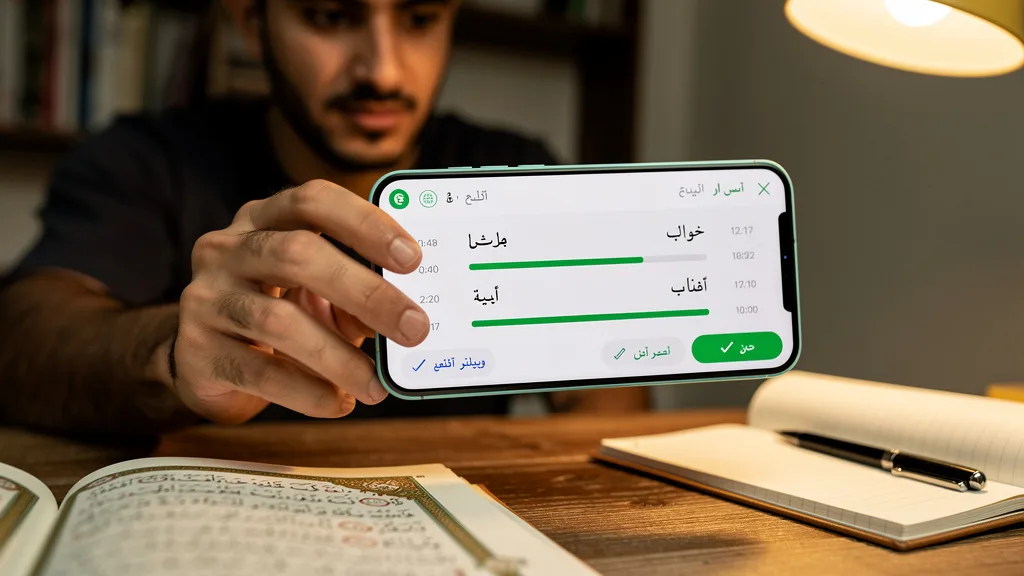
Furthermore, technology allows for a level of organization and efficiency that is difficult to replicate manually. An app can track thousands of words, schedule reviews automatically, and provide instant feedback on your progress. This structured environment removes the guesswork from your studies, ensuring you are always working on the material that needs the most attention. This frees you to focus on what truly matters: connecting with the meaning of the Quranic verses you are studying. For many, this structured approach is a key part of an effective Quranic Arabic learning path.
Key Features of an Effective Quranic Vocabulary App
Not all vocabulary apps are created equal, especially when it comes to a language as nuanced as Quranic Arabic. The most effective trainers share several core features designed to maximize learning efficiency and ensure the knowledge you gain is both accurate and lasting. When evaluating options, look for tools that go beyond simple flashcards and incorporate a more holistic and intelligent approach to vocabulary building.
Spaced Repetition System (SRS) for Long-Term Retention
A Spaced Repetition System, or SRS, is arguably the most critical feature of a modern vocabulary trainer. This intelligent algorithm tracks how well you know each word and schedules it for review at the perfect moment: right before you are likely to forget it. Instead of reviewing words at random or all at once, SRS prioritizes the vocabulary that is weakest in your memory, while showing you stronger words less frequently.
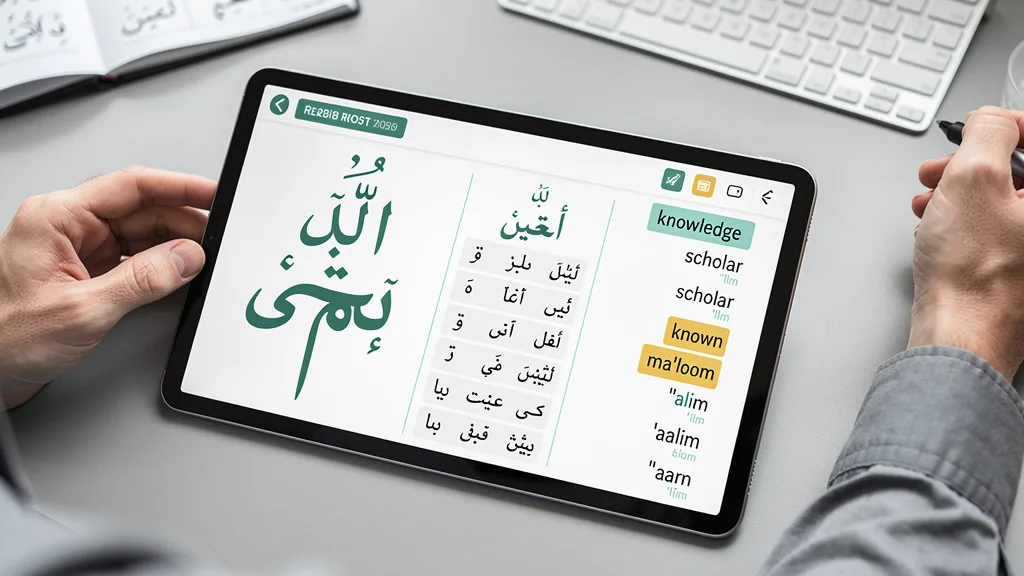
This method is far more efficient than traditional cramming, which often leads to short-term gains but long-term forgetting. By optimizing your review schedule, SRS ensures that every minute of your study time is spent as effectively as possible. This leads to durable, long-term retention, allowing you to build a large and stable vocabulary over time without feeling overwhelmed.
Contextual Learning with Verses from the Quran
Memorizing a word's definition is one thing, but understanding how it functions in a sentence is another. The best Quranic vocabulary apps provide context by showing you each new word within an actual verse from the Quran. This approach has multiple benefits, as it helps you grasp the word's nuanced meaning, see its grammatical role, and connect it directly to the sacred text.
Learning words in context makes them more memorable and meaningful. When you encounter that word again during your reading of the Quran, you will recognize it not as an isolated piece of data but as part of a familiar divine message. This method transforms vocabulary acquisition from a purely academic exercise into a deeply spiritual one, reinforcing your connection with the text you aim to understand.
Root Word Analysis and Morphology
The Arabic language is built upon a system of three-letter roots from which families of related words are derived. Understanding this system is a powerful shortcut to unlocking a vast vocabulary. An app that includes root word analysis and morphology can show you how different words share a common root and a related core meaning, helping you make connections and learn more efficiently.
For example, by learning the root K-T-B (related to writing), you can more easily understand words like 'kitab' (book), 'katib' (writer), and 'maktab' (office or desk). A feature that breaks down words into their roots and patterns demystifies the language and equips you with the skills to infer the meaning of new words you encounter. This analytical approach is fundamental to achieving a deeper level of linguistic competence.
Authentic Audio Pronunciation
Correct pronunciation is essential for both understanding and recitation. The Quran is a text meant to be heard and spoken, and internalizing the correct sounds is a crucial part of the learning process. An effective vocabulary trainer must include high-quality, authentic audio recordings for every word and example verse, preferably from a native speaker with clear articulation.
Listening to correct pronunciation helps solidify your memory of a word and trains your ear to recognize it when you listen to recitations. It also builds your confidence in speaking the words yourself. This auditory reinforcement complements the visual learning from flashcards and reading, creating a multi-sensory learning experience that leads to better retention and a more accurate command of the language.
Top Vocabulary Trainers for Quranic Arabic Reviewed for 2026
Choosing the right app depends on your learning style, budget, and goals. Some learners thrive with full customization, while others prefer a guided, game-like experience. Below is a review of the top vocabulary trainers available in 2026, each with its unique strengths for students of Quranic Arabic.
Anki: The Customizable Powerhouse for Serious Learners
Anki is a free, open-source flashcard program that is widely considered the gold standard for SRS learning. It is not a language app itself but a powerful, highly customizable platform for creating and studying flashcards. Its strength lies in its flexibility. You can download pre-made decks of Quranic vocabulary created by other users or build your own from scratch, tailoring them precisely to your study needs.

While its interface can be less polished and has a steeper learning curve than other apps, its power is unmatched for dedicated students. With add-ons, you can embed audio, images, and contextual sentences into your cards. Anki is ideal for the self-directed learner who wants total control over their study material and is committed to a long-term, systematic approach to vocabulary building.
Memrise: Gamified Learning with Community-Created Decks
For those who find Anki's interface intimidating, Memrise offers a more engaging and user-friendly experience. It combines SRS with gamification, using points, leaderboards, and creative mnemonic devices to make learning feel less like a chore. The platform hosts a vast library of community-created courses, including many dedicated to Quranic Arabic vocabulary.
A key feature of Memrise is its use of short videos of native speakers, which helps with pronunciation and real-world recognition. While the quality of user-generated content can vary, there are many excellent, well-structured courses available. Memrise is a great choice for beginners or learners who are motivated by a fun, interactive, and game-like environment.
Quranic: The All-in-One Guided Study App
Developed by the team behind Quran.com, the Quranic app is designed specifically for learning the language of the Quran. It offers a structured, story-based curriculum that teaches vocabulary and grammar in the context of Quranic verses. This all-in-one approach is perfect for beginners who want a clear path to follow without the need to find or create their own study materials.
The app's lessons are bite-sized and interactive, making it easy to fit learning into a busy schedule. It focuses on high-frequency words and introduces concepts gradually, building a solid foundation for understanding the text. If you are looking for a guided, Quran-centric learning experience, this is one of the top apps to learn Quranic Arabic available today.
Bayna Yadayk: A Comprehensive Curriculum-Based Approach
The 'Al-Arabiyyah Bayna Yadayk' (Arabic at Your Hands) series is a well-respected, comprehensive curriculum used in institutions worldwide. While traditionally a textbook series, its content is increasingly available through digital platforms and apps. This approach is much more than a simple vocabulary trainer; it is a complete language program covering dialogue, grammar, reading, and writing.
This option is best suited for serious students who desire a formal, academic structure for their learning. It provides a deep and thorough grounding in the language that goes beyond just vocabulary. If your goal is not just to understand the Quran but to achieve a high level of proficiency in Classical Arabic, the Bayna Yadayk curriculum is an excellent and rigorous choice.
How to Build an Effective Vocabulary Learning Routine
Having the best tool is only half the battle. The other half is using it effectively. Building a consistent and intelligent study routine is essential for making real progress. A disciplined approach will ensure that you get the most out of your chosen vocabulary trainer and steadily build your comprehension of the Quran.
Set Realistic and Consistent Daily Goals
The key to long-term success is consistency, not intensity. It is far more effective to study for 15-20 minutes every day than to cram for three hours once a week. Set a small, achievable goal for yourself, such as learning 5 or 10 new words per day. This consistency builds a powerful habit and allows the principles of spaced repetition to work their magic.

Track your progress and celebrate your consistency. Most apps have features that show your daily streak, which can be a great motivator. Remember that language learning is a marathon, not a sprint. A sustainable daily habit will yield far greater results over time than sporadic bursts of effort. There are many proven techniques for how to learn Arabic vocabulary, and consistency underpins them all.
Focus on High-Frequency Quranic Words First
Not all words are equally important for a beginner. A relatively small number of high-frequency words make up a large percentage of the Quranic text. By focusing on these words first, you can quickly build your ability to understand the gist of many verses, which is incredibly motivating and accelerates your learning.
Many pre-made decks and apps are structured around this principle, starting with the most common words found in the Quran. Prioritizing this core vocabulary provides the biggest return on your study time and builds a strong foundation upon which you can add more specialized words later. You can start with a basic Quranic Arabic vocabulary list for beginners to see this principle in action.
Combine App-Based Learning with Active Reading
Vocabulary trainers are powerful supplements, but they should not be your only learning activity. The ultimate goal is to read and understand the Quran itself, so it is crucial to integrate active reading into your routine. As you learn new words in your app, make a conscious effort to find and recognize them as you read the Quran.
This practice bridges the gap between theoretical knowledge and practical application. It reinforces what you have learned and helps you see the words in their natural, divine context. This synergy between app-based drills and real-world reading creates a virtuous cycle where each activity enhances the other. You can learn Quranic Arabic vocabulary from your daily reading by actively looking for the words you've just studied.
Feature Comparison of Leading Quranic Arabic Trainers
To help you decide which tool best fits your needs, here is a side-by-side comparison of the key features of the top vocabulary trainers discussed. Consider your personal learning style, technical comfort, and desired level of structure when making your choice.
| Feature | Anki | Memrise | Quranic | Bayna Yadayk |
|---|---|---|---|---|
| Spaced Repetition (SRS) | Excellent (Core Feature) | Very Good | Good | Varies by Platform |
| Gamification | None | Excellent | Good | Minimal |
| Contextual Verses | User-Dependent | Varies by Course | Excellent (Core Feature) | Good |
| Root Word Analysis | Possible with Add-ons | Limited | Good | Very Good |
| Cost Model | Free (Paid Mobile App) | Freemium | Freemium | Paid |
Key Takeaways
- The best vocabulary trainers for Quranic Arabic utilize Spaced Repetition Systems (SRS) to ensure long-term retention of words.
- Learning vocabulary in the context of Quranic verses is far more effective than studying isolated word lists for true comprehension.
- Key features to look for in an app include SRS, contextual examples, root word analysis, and authentic audio pronunciation.
- Top apps for 2026 include the highly customizable Anki, the gamified Memrise, the guided Quranic app, and the comprehensive Bayna Yadayk curriculum.
- To succeed, build a consistent daily study habit, focus on high-frequency words first, and combine your app-based learning with active reading of the Quran.
Frequently Asked Questions
Can I learn Quranic Arabic using free vocabulary apps?
Absolutely. You can make significant progress using free tools, especially a powerful platform like Anki, which is free on desktop and Android. Many other apps, including Memrise and Quranic, offer robust free tiers that allow you to learn a substantial amount of vocabulary without any cost. These free apps to learn Quranic Arabic are an excellent starting point for any student.
What is the main difference between Quranic and Modern Standard Arabic?
However, paid versions or premium subscriptions often provide added benefits like more structured content, advanced features, offline access, and an ad-free experience. For learners who value a guided curriculum and professionally curated content, investing in a paid app can be a worthwhile way to accelerate their progress and support the developers.
How many words do I need to know to understand most of the Quran?
Quranic Arabic, also known as Classical Arabic, is the form of the Arabic language found in the Quran. Modern Standard Arabic (MSA) is its direct descendant and is used today in books, news broadcasts, political speeches, and formal education across the Arab world. While they share much of the same grammar and vocabulary, there are distinct differences.
Is it better to learn words in isolation or within Quranic verses?
Quranic Arabic contains some vocabulary and grammatical structures that are no longer in common use in MSA. The style is also more poetic and concise. While learning MSA can certainly help you understand the Quran, studying Quranic Arabic specifically is essential for grasping the precise and profound meanings of the divine text. You can explore the differences between Quranic and Modern Standard Arabic in more detail to guide your studies.
How long does it take to build a strong Quranic Arabic vocabulary?
You might be surprised to learn that a relatively small vocabulary can unlock a great deal of the Quran. Due to the repetition of key terms and concepts, it is estimated that learning just 300 to 500 of the most frequently occurring words can help you recognize and understand up to 70-80% of the Quranic text. This makes the initial learning process highly rewarding.
Of course, full comprehension requires a much larger vocabulary, as well as a deep understanding of grammar, context, and theology. However, focusing on this core vocabulary first is a highly effective strategy that builds confidence and provides a strong foundation for more advanced study. It makes the text accessible much more quickly than a random approach would.
It is far better to learn words within the context of Quranic verses. While flashcards of isolated words can help with initial memorization, context is what gives a word its true meaning and depth. Learning a word within a verse teaches you its usage, its relationship to other words, and its specific connotation in a sacred context.
Contextual learning aids memory by creating stronger mental connections. When you see the word in a sentence, it becomes part of a larger, meaningful unit rather than an abstract piece of data. This method directly prepares you for the act of reading the Quran, as you are learning the words in the exact way you will encounter them.
The time it takes to build a strong vocabulary depends entirely on your consistency, study methods, and the amount of time you dedicate each day. With a consistent effort of 20-30 minutes daily using an effective SRS app, a dedicated learner can build a core vocabulary of several hundred high-frequency words within a few months.
Achieving a truly strong vocabulary of several thousand words, enough for comfortable reading, can take a year or more of sustained effort. The journey is a marathon, not a sprint. The key is to remain patient, stay consistent with your daily routine, and celebrate the progress you make along the way.
Conclusion
In 2026, leveraging the best vocabulary trainers for learning Quranic Arabic is a smart and effective strategy for any student. By choosing a tool that aligns with your learning style, whether it is the customizable power of Anki or the guided path of Quranic, you can make your study time more efficient and rewarding. The key is to combine these powerful apps with a consistent daily routine and active reading to transform your understanding and deepen your connection to the Holy Quran.
While apps are powerful tools, nothing replaces the guidance of a qualified teacher. For personalized feedback, correct pronunciation, and a structured learning path, consider one-on-one lessons. Hidayah Quran Academy offers dedicated classes for sisters and children with experienced female teachers. Ready to deepen your connection with the Quran? Book Free Trial today.