

Have you ever wished you could connect with the Quran on a deeper level by reading and understanding its original language? A dedicated study plan can turn this aspiration into a reality. This guide provides a comprehensive Fast Track to Quranic Arabic: A 30 Day Plan designed to help you complete a full reading of the Quran and build a foundational understanding of its language within a month.
This structured plan is perfect for beginners and those looking to refresh their skills. It breaks down the immense goal of learning Quranic Arabic and reading the entire scripture into manageable daily and weekly tasks. By focusing on consistency, core vocabulary, and practical reading schedules, you can make significant progress in a short amount of time, especially with the right guidance and resources. This journey will not only enhance your reading ability but also deepen your spiritual connection.
Embarking on a 30-day plan to learn Quranic Arabic is an ambitious and rewarding goal. Realistically, you will not become a fluent scholar in one month. However, you can achieve a strong foundational understanding that allows you to read the Quran, recognize common words, and grasp the basic structure of verses. The primary objective is to build a consistent habit and a solid base from which you can continue to grow your knowledge.

Expect to dedicate focused time each day. This plan is a 'fast track', which means it requires commitment. You will learn the entire Arabic alphabet, key Tajweed rules for proper pronunciation, and a vocabulary of the most frequently used words in the Quran. By the end of the 30 days, you should be able to read the text with increasing confidence and have completed a full recitation of the entire Quran, which is a monumental achievement in itself.
Structuring Your 30-Day Quran Reading Schedule
A well-structured schedule is the backbone of completing the Quran in 30 days. The most common method involves dividing the Quran into 30 parts, known as Juz' (plural: Ajza'). Since a standard copy of the Quran (Mus'haf) has approximately 600 pages, this simplifies the goal into reading about 20 pages per day. This approach makes the task feel less overwhelming and provides a clear daily target.
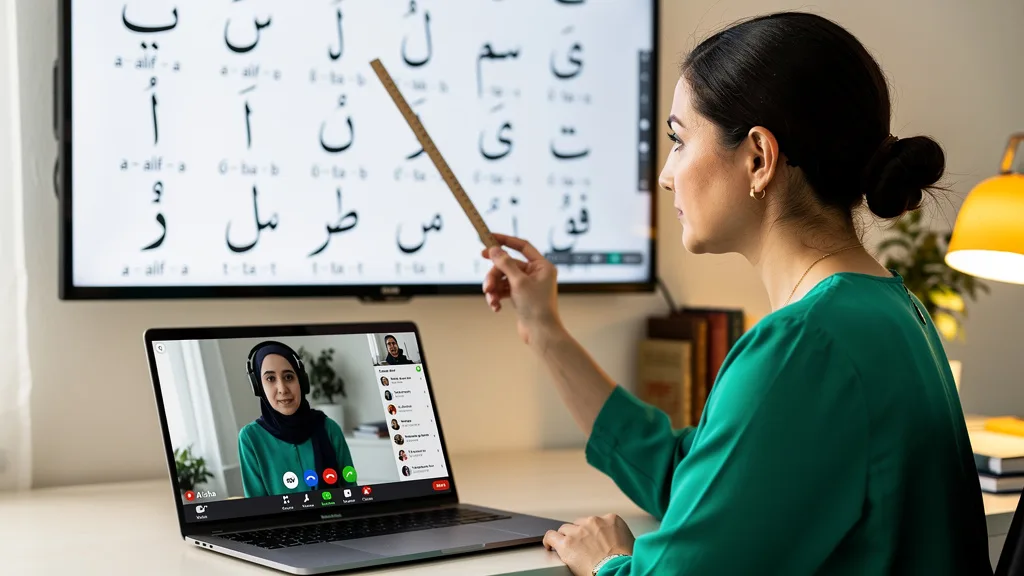
Your schedule should be both ambitious and flexible. While the 20-pages-per-day model is effective, it's important to adapt it to your personal routine and reading speed. The key is consistency, not perfection. Missing a day or falling slightly behind is not a failure; it's an opportunity to adjust your schedule for the following day. The goal is to maintain momentum and stay connected to the Quran daily throughout the month.
Calculating Daily Pages to Finish the Quran in 30 Days
The calculation is straightforward. The Quran is divided into 30 Juz', and a standard Mus'haf contains about 600 pages. To complete the Quran in 30 days, you simply read one Juz' per day.
Calculation: 600 pages / 30 days = 20 pages per day.
This daily goal of 20 pages is the cornerstone of most 30-day reading plans. It's a significant amount of reading, but it is achievable when broken down into smaller sessions throughout the day. Visualizing the goal as just 20 pages, rather than the entire book, makes it mentally manageable and helps you build momentum from day one. Remember that page counts can vary slightly between different prints of the Quran, so the one-Juz'-per-day rule is the most accurate measure.
To keep track, you can use the table of contents in your Quran, which clearly marks the beginning of each Juz'. Many Qurans also have markers in the margins to indicate the divisions of a Juz' (like Hizb and Rubu'), which can help you pace yourself even further. Using these built-in guides simplifies the process of tracking your daily progress.
How to Divide Reading Across the Five Daily Prayers
One of the most effective strategies for reading 20 pages daily is to link your reading sessions to the five daily prayers. This method integrates your Quran reading into your existing spiritual routine, making it easier to maintain consistency. By dividing the 20 pages by five, you only need to read four pages after each of the five prescribed prayers.
This approach breaks the large task into small, five-to-ten-minute sessions. Reading four pages is far less daunting than sitting down to read 20 pages at once, especially for those with busy schedules. It also provides regular moments of spiritual reflection throughout the day, connecting you with the words of Allah from sunrise to nightfall. This consistent engagement is key to building a lasting habit beyond the initial 30 days.
Here is a sample table to help you visualize this division:
| Prayer | Pages to Read | Estimated Time |
|---|---|---|
| Before or After Fajr | 4 Pages | 10-15 minutes |
| Before or After Dhuhr | 4 Pages | 10-15 minutes |
| Before or After Asr | 4 Pages | 10-15 minutes |
| Before or After Maghrib | 4 Pages | 10-15 minutes |
| Before or After Isha | 4 Pages | 10-15 minutes |
A Modified Plan for Beginners and Slow Readers
If you are a beginner or find that 20 pages a day is too fast to maintain proper pronunciation and reflection, it is perfectly acceptable to modify the plan. The goal is a meaningful connection with the Quran, not just a race to the finish line. A modified plan might involve aiming to complete the Quran in 60 or 90 days instead of 30.
For a 60-day plan, you would simply halve the daily goal to 10 pages per day. This can be broken down into reading two pages after each of the five daily prayers. For a 90-day plan, you would read approximately 6-7 pages per day. This slower pace allows for more time to focus on proper Tajweed, look up the meanings of words, and reflect on the Quranic verses. Remember, consistency is more important than speed. Choose a pace that is sustainable for you.
This section breaks down the language-learning component of your 30-day plan. While you are completing your daily reading, you will also dedicate a portion of your study time to understanding the language itself. This parallel approach of reading and learning accelerates your comprehension and makes your recitation more meaningful.

Each week focuses on a different building block of the language. Starting with the alphabet and moving through vocabulary, verbs, and sentence structure, this structured approach ensures you are not overwhelmed. By the end of the month, you will have a practical framework for understanding the text you are reading, transforming the experience from recitation to conversation.
Week 1: Mastering the Alphabet and Basic Tajweed Rules
The first week is all about the foundation. Your primary goal is to master the 28 letters of the Arabic alphabet, including their shapes, sounds, and how they connect to form words. Use flashcards, apps, and writing exercises to solidify your knowledge. It is crucial to learn the correct pronunciation (makhraj) for each letter from the very beginning to avoid developing bad habits.
Alongside the alphabet, you will begin learning basic Tajweed rules. Focus on essential rules like the correct pronunciation of vowels (short and long), the concept of noon saakin and tanween, and the rules of Qalqalah. Don't try to learn everything at once. Mastering a few key rules will significantly improve the quality of your recitation. For a detailed guide, you can review the Arabic alphabet and its pronunciation to get started on the right foot.
Week 2: Building Your Core Quranic Vocabulary
In week two, the focus shifts to vocabulary. You don't need to learn all 77,000+ words in the Quran. A surprisingly small number of words make up a large percentage of the text. Studies show that learning just 300 of the most common words can help you understand up to 70-80% of the Quranic text. These include common nouns, pronouns, prepositions, and connectors.
Create a list of high-frequency words and commit to learning 10-15 new words each day. Use flashcards (physical or digital) with the Arabic word, its transliteration, and its English meaning. As you do your daily Quran reading, actively look for these words. Seeing them in context will reinforce your memory and show you how they function within a verse, which is a key part of the plan to Read Quranic Arabic in 90 days or even 30.
Week 3: Understanding Common Verbs and Sentence Patterns
With a foundation in the alphabet and core vocabulary, week three introduces you to the engine of the Arabic language: verbs. You will focus on the most common verb patterns (awzan) and how they are conjugated in the past, present, and command forms. Understanding the three-letter root system is a major breakthrough, as it allows you to recognize the meaning of many different words derived from the same root.
At the same time, you will start identifying basic sentence structures. Quranic Arabic primarily uses two types of sentences: verbal sentences (which start with a verb) and nominal sentences (which start with a noun). Learning to recognize these patterns will help you deconstruct verses and understand the relationship between different words. This grammatical knowledge elevates your reading from simply decoding letters to comprehending the message.
Week 4: Reading for Comprehension and Deeper Meaning
In the final week, you bring everything together. Your focus shifts from learning new concepts to applying them for deeper comprehension. As you complete your daily reading, pause after each verse or section to try and understand its meaning using the vocabulary and grammar you have learned. Keep a translation alongside your Quran to check your understanding and fill in the gaps.
This is also the time to start appreciating the beauty and nuance of the language. Pay attention to how different sentence structures are used for emphasis and how the choice of words conveys a precise meaning. This practice of active reading and reflection is how you begin to deepen your connection with the Quran. The goal is no longer just to finish the pages but to let the message enter your heart.
Balancing Proper Tajweed with Your Completion Goal
A common dilemma for students is whether to prioritize speed to complete the schedule or slow down to perfect their Tajweed. The ideal approach is to find a healthy balance. It is essential to recite the Quran as correctly as possible, as Tajweed is the science of proper pronunciation. However, for a beginner, achieving perfect Tajweed on every letter from day one is an unrealistic expectation that can lead to frustration and burnout.
"Striving to recite Quranic ayahs with proper Tajweed is a lifelong journey of improvement. In a 30-day plan, focus on applying the basic rules you know and be patient with yourself. The effort to read and connect with the Quran is beloved by Allah, even if your recitation is not yet perfect." - Hidayah Quran Academy, Expert Female Tutors
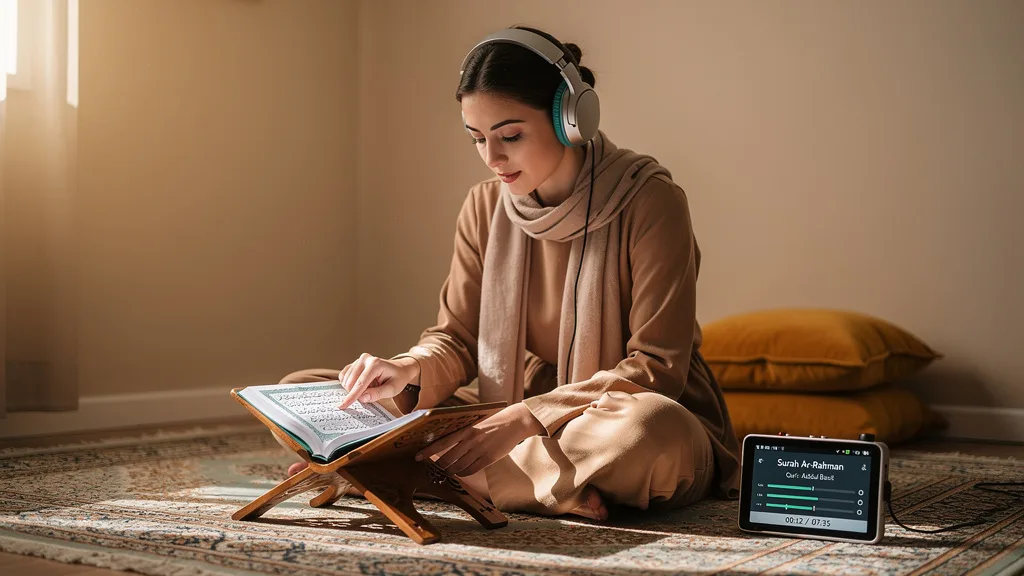
Your goal should be continuous improvement. Focus on the fundamental rules you learned in week one and try to apply them consistently. Listen to recitations by qualified Qaris (reciters) to train your ear and imitate their pronunciation. If you struggle with a word, don't get stuck. Try your best, make a note to ask a teacher later, and continue. The act of reading and engaging with the Quran is a meritorious deed in itself.
Practical Tips to Stay Consistent with Your Study Plan
Consistency is the single most important factor for success in your 30-day plan. Motivation can fluctuate, but a strong routine and practical strategies will carry you through the challenging days. The following tips are designed to help you build a sustainable habit and stay on track toward your goal.
These are not just suggestions but proven methods used by successful students of the Quran. By implementing a fixed schedule, visualizing your progress, and creating a support system, you build a powerful structure around your learning. This transforms your plan from a mere to-do list into an integrated part of your daily life.
Set a Fixed Time and Place for Daily Study
Designate a specific time and a quiet, clean space for your Quran study each day. This creates a powerful psychological trigger. When you enter that space at that specific time, your mind will automatically switch into learning mode. Whether it's a corner of your bedroom in the early morning before Fajr or your desk after Isha, having a consistent routine minimizes the need for daily decision-making and willpower.
Treat this time as a non-negotiable appointment with yourself and with the Quran. Inform your family about your study schedule so they can support you by minimizing interruptions. Having a dedicated space, free from distractions like your phone or television, will dramatically improve your focus and the quality of your study sessions.
Use a Tracker to Visualize Your Progress
A progress tracker provides a powerful visual representation of your accomplishments and keeps you motivated. You can use a simple calendar, a dedicated journal, or a digital app. Mark off each day you complete your reading and study goals. Seeing the chain of completed days grow is incredibly encouraging and makes you less likely to skip a day.
Your tracker can be as simple or as detailed as you like. You can track pages read, new vocabulary learned, or Tajweed rules practiced. This visual feedback serves as a constant reminder of how far you've come, which is especially helpful on days when you feel like you're not making much progress. It turns an abstract goal into a tangible achievement.
Find a Study Partner to Maintain Accountability
Accountability is a game-changer. Find a friend, family member, or a dedicated teacher who is also committed to their Quranic studies. You can check in with each other daily or weekly to share your progress, discuss challenges, and offer encouragement. Knowing that someone else is expecting an update from you can provide the extra push you need to stay consistent.
A study partner can also be a valuable learning resource. You can practice reciting to each other, quiz one another on vocabulary, and discuss the meanings of verses. For sisters seeking a supportive and knowledgeable guide, working with a qualified female teacher provides professional accountability and expert feedback, ensuring you are learning correctly and staying motivated throughout your journey.
Key Takeaways
Successfully completing a 30-day plan for Quranic Arabic requires dedication and a smart strategy. By focusing on these key principles, you can make your goal achievable and deeply rewarding.
- Structure is Key: Divide the Quran into 30 parts (Juz') and aim to read one part (about 20 pages) per day. Integrating this reading into your five daily prayers by reading 4 pages after each prayer makes it manageable.
- Balance Reading and Learning: Use a week-by-week plan to learn the language. Focus on the alphabet and basic Tajweed first, then move to core vocabulary, verbs, and sentence patterns.
- Consistency Over Speed: The goal is a meaningful connection, not just a race. If you are a beginner, it is better to adopt a slower, more sustainable pace (e.g., a 60 or 90-day plan) than to rush and burn out.
- Build a Support System: Set a fixed time and place for study, use a tracker to visualize your progress, and find an accountability partner or teacher to keep you motivated.
- Perfection is a Journey: Strive for proper Tajweed, but don't let small mistakes paralyze you. The effort to read and understand the Quran is a beautiful act of worship in itself.
Frequently Asked Questions
What is the best way to structure a 25-day Quran reading plan?
To finish the Quran in 25 days, you need to read more than one Juz' per day. Since the Quran has 30 Juz', you would divide 30 by 25, which equals 1.2. This means you need to read 1.2 Juz' each day. In terms of pages, this translates to approximately 24 pages daily (1.2 Juz' x 20 pages/Juz').
A practical way to structure this is to read one full Juz' (20 pages) and then an additional four pages each day. You can distribute this across your five daily prayers by reading five pages after four of the prayers and four pages after one of them. This slightly more intensive schedule is great for those who want to complete their reading before the last few nights of Ramadan.
What are the best apps for learning Quranic Arabic in 2026?
In 2026, several excellent apps can supplement your learning journey. For vocabulary building, apps like Quranic (formerly Quranic Arabic) and Bayna are highly effective as they focus on high-frequency words through interactive lessons. For grammar and morphology, 'Arabic with Taimur' on YouTube provides deep dives, while apps like Duolingo can offer basic sentence structure practice, though it focuses on Modern Standard Arabic.
For listening and Tajweed practice, Quran Explorer and Tarteel AI are top choices. Tarteel uses artificial intelligence to listen to your recitation and highlight mistakes, which is incredibly useful for self-correction. For a comprehensive list and reviews, check out our guide to the top apps for learning Quranic Arabic in 2026.
Is it possible to do Hifz (memorization) on my own?
While it is technically possible for a highly disciplined individual to begin memorizing the Quran on their own, it is strongly discouraged. Hifz is not just about memorizing words; it is about memorizing them with perfect Tajweed and pronunciation. Without a qualified teacher to listen to your recitation and correct your mistakes, it is very easy to memorize verses incorrectly, and these mistakes can be extremely difficult to unlearn later.
A teacher provides accountability, a structured plan, and crucial feedback on your recitation. They ensure your foundation is solid before you build upon it. For sisters and children, learning with a qualified female teacher in a one-on-one setting creates a comfortable and effective environment for successful memorization.
How much time should I dedicate daily for this 30-day plan?
You should plan to dedicate approximately 60 to 90 minutes per day. This can be broken down into two main components. First, the reading portion, which involves reciting 20 pages. For an average reader, this will take about 45-60 minutes in total (around 10-12 minutes for each 4-page session after prayers).
Second, you should allocate an additional 15-30 minutes for focused language learning. This is the time you will use to study the alphabet, learn new vocabulary, or review grammar rules. By breaking up the total time into smaller, focused sessions throughout the day, it becomes much more manageable and less overwhelming.
Can I learn Quranic Arabic effectively without a teacher?
Self-study resources can help you build a basic foundation, and it is possible to learn the alphabet and some vocabulary on your own. However, to learn effectively and correctly, a teacher is indispensable. A qualified teacher provides personalized feedback, corrects pronunciation and Tajweed mistakes you may not even be aware of, and answers your specific questions.
A teacher also provides motivation and a structured curriculum tailored to your pace. While some progress can be made alone, it is often slow and prone to errors. For something as important as the language of the Quran, guidance from an expert, like the one-on-one sessions offered by Hidayah Quran Academy, ensures you are on the right path from the very beginning.
Conclusion
Embarking on a Fast Track to Quranic Arabic: A 30 Day Plan is a transformative commitment that deepens your relationship with the words of Allah. By implementing a structured reading schedule, dedicating time to learning the core components of the language, and staying consistent, you can achieve this remarkable goal. Remember that the objective is not just completion, but a more profound and meaningful connection. This 30-day plan is your first major step on a lifelong journey of learning and spiritual growth.
If you are a sister, mother, or beginner seeking a supportive and expert guide on this journey, personalized instruction can make all the difference. Our qualified female teachers specialize in creating a comfortable and effective learning environment for students worldwide. Take the next step with confidence. Book Free Trial.