

Are you ready to begin your Quran learning journey but feel unsure about which path to take? Deciding between a trial lesson and a full course can feel like a major commitment, especially when balancing your spiritual goals with a busy schedule. Understanding the distinct purpose of each option is the key to making an informed choice that sets you up for success.
A trial Quran lesson is a short, introductory session designed for you to evaluate a teacher and platform without any commitment. In contrast, a full Quran course is a structured, long-term program aimed at achieving specific learning milestones, such as mastering Tajweed or completing Hifz. The best choice for you depends entirely on your current goals, availability, and learning style.
A trial Quran lesson is a one-time, introductory session offered by an online academy to give you a firsthand experience of their services. Typically lasting around 30 minutes, this lesson allows you to meet a potential tutor, test the online platform (like Zoom or WhatsApp), and get a feel for the teaching methodology. It is a no-risk opportunity to ask questions and determine if the learning environment is the right fit for you or your child.
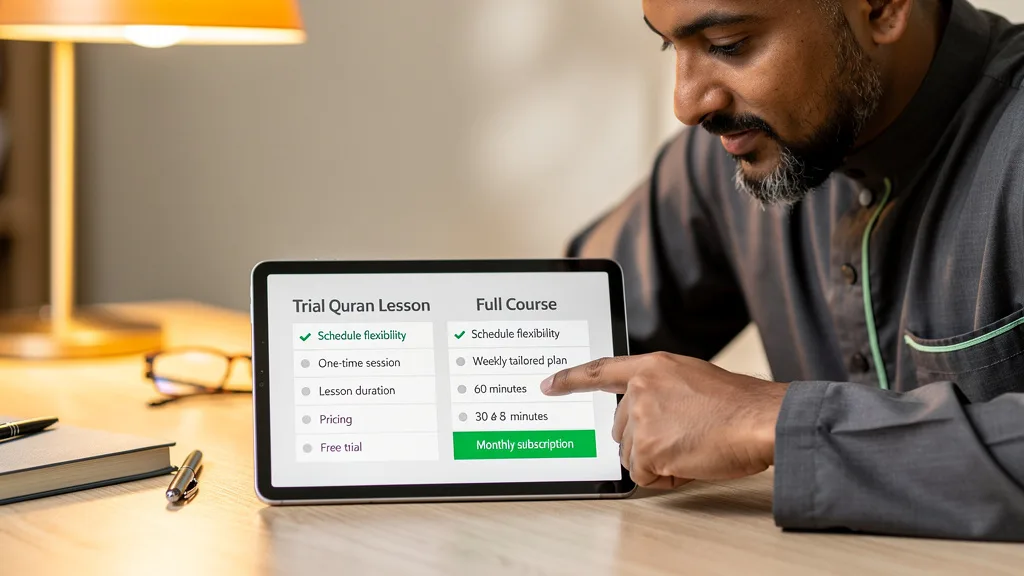
The primary purpose of a trial is not to cover a significant amount of curriculum but to build confidence and clarity. It helps you assess the tutor's communication style, their ability to connect with the student, and the overall quality of the instruction. For many, this initial session is a crucial step before committing financially and emotionally to a full course, ensuring the foundation of your learning journey is strong. You can learn more about what to expect by reading about things not to worry about before your trial class.
A full Quran course is a comprehensive, structured program designed for long-term, in-depth study of the Holy Quran. Unlike a trial, a full course follows a specific curriculum with clear objectives, regular classes, and progress tracking. These courses are tailored to help you achieve significant goals, whether it's learning to read Arabic with the Noorani Qaida, perfecting your recitation with Tajweed rules, or embarking on the journey of Hifz (memorization).

Enrolling in a full course signifies a serious commitment to your Islamic education. It involves a consistent schedule, regular interaction with your dedicated tutor, and often includes assignments and assessments to ensure you are mastering the material. This structured approach provides the accountability and depth necessary for true progress and a deeper connection with the words of Allah.
Choosing between a trial lesson and a full course comes down to understanding their fundamental differences in purpose, structure, and commitment. A trial is an exploratory step, while a full course is a dedicated journey. The following sections break down these distinctions to help you decide which option aligns with your current needs.
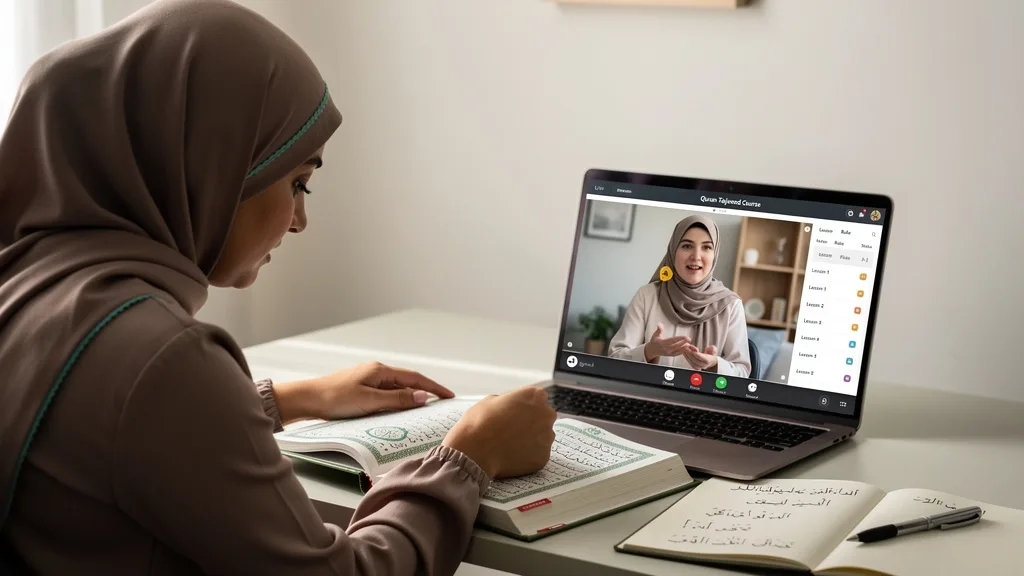
To visualize these differences clearly, consider how each format impacts key aspects of your learning experience. From the time you invest to the outcomes you can expect, each path offers a unique set of benefits. The table below provides a side-by-side comparison of the most important factors.
| Feature | Trial Quran Lesson | Full Quran Course |
|---|---|---|
| Time Commitment | One-time session (e.g., 30 minutes) | Regular, recurring classes (e.g., 2-3 hours per week) |
| Cost | Usually free or very low cost | Requires a recurring financial investment (e.g., monthly fee) |
| Curriculum | Brief introduction or sample topic | Structured, in-depth curriculum covering specific skills |
| Learning Goals | Evaluate tutor, platform, and teaching style | Achieve mastery of skills (reading, Tajweed, Hifz) |
| Tutor Interaction | Introductory meeting to assess compatibility | Ongoing mentorship and personalized guidance |
Time Commitment and Scheduling
The most significant difference lies in the time commitment. A trial lesson is a single, short session that can often be scheduled flexibly to fit into a free slot in your day. Its purpose is to be convenient and accessible, requiring no long-term planning.
A full course, however, demands a consistent and regular time commitment. You will typically agree to a fixed schedule with your tutor, such as two or three classes per week at the same time. This regularity is essential for building momentum and making steady progress in your studies.
Cost and Financial Investment
From a financial perspective, a trial lesson is designed to be risk-free. Most reputable academies, including Hidayah Quran Academy, offer this initial session for free. This allows you to experience the service without any financial pressure.
Committing to a full course involves a financial investment in your education. These courses are typically priced on a monthly subscription basis, reflecting the dedicated time of a qualified tutor and a structured curriculum. Understanding the cost of an Arabic course helps you plan for this important investment in your spiritual growth.
Curriculum Depth and Structure
A trial lesson offers only a glimpse into the curriculum. The tutor might assess your current level, teach a basic concept, or walk you through a small portion of a lesson. The focus is on the experience rather than deep learning.
A full course is built around a comprehensive and structured curriculum. For example, a Tajweed course will systematically cover all the rules of pronunciation, from makharij (articulation points) to sifaat (attributes of letters). This structured approach ensures that you build your knowledge logically and completely, with each lesson building upon the last. Many top programs follow a proven structure, such as the Al Azhar online Quran curriculum.
Learning Goals and Outcomes
The goal of a trial lesson is simple: to help you decide. The desired outcome is clarity on whether you wish to enroll in a full course with that specific tutor and platform. It is a tool for evaluation.
In contrast, a full course has concrete learning goals. Your objective might be to read the Quran fluently, memorize a certain number of surahs, or understand the principles of Tajweed. The outcome is tangible skill acquisition and a measurable increase in your Quranic knowledge.
Who Should Choose a Trial Quran Lesson?
A trial Quran lesson is the ideal starting point for several types of learners. It serves as a low-pressure gateway to online Quranic education, allowing you to explore your options with confidence before making a larger commitment. If you find yourself in one of the following situations, a trial lesson is likely the perfect first step for you.
For Beginners Testing the Waters
If you are an absolute beginner, a new revert, or are considering online learning for the first time, a trial lesson is invaluable. It allows you to experience the virtual classroom environment without the pressure of a long-term commitment. This single session can help demystify the process and show you how effective and personal online learning can be. It's a great way to prepare for your first Quran class and ease into your studies.
To Evaluate a Tutor or Platform
The relationship with your Quran tutor is deeply personal and crucial for your success. A trial lesson gives you the chance to interact with a one-on-one female Quran tutor and see if their teaching style resonates with you. You can assess their patience, clarity, and expertise, ensuring you find a mentor who can truly guide you. It's also an opportunity to test the technical aspects, ensuring the video and audio quality are sufficient for a smooth learning experience.
For Learners with Unpredictable Schedules
If your schedule is currently hectic or unpredictable, committing to a full course might seem daunting. A trial lesson can be a way to fit in a single, focused session of learning when you have a brief window of availability. This can help you stay connected to the Quran even during busy periods and may help you identify a potential tutor who offers the flexibility you need for a future course.

Who Should Commit to a Full Quran Course?
While a trial is for exploration, a full Quran course is for transformation. This path is suited for individuals who have clear learning objectives and are ready to dedicate consistent time and effort to their Quranic studies. If you are serious about making significant progress, a structured course is the most effective way to achieve your goals.
For Serious, Long-Term Study Goals
If your ambition is to memorize the Quran (Hifz), gain an Ijazah (a license to teach), or develop a deep understanding of Tafsir (exegesis), a full course is non-negotiable. These profound goals require a long-term, systematic approach that only a comprehensive program can provide. A dedicated tutor will guide you through a multi-stage curriculum, ensuring you build a strong and lasting foundation.
For Structured Learning and Accountability
Many learners thrive with structure and accountability. A full course provides a regular schedule that helps you build a consistent habit of study. Knowing you have a class and a tutor waiting for you is a powerful motivator to stay on track. This consistent feedback loop and structured progression are essential for overcoming plateaus and achieving fluency. qualified female tutor.
To Master Specific Skills like Tajweed
Mastering the science of Tajweed is a journey of precision and practice. The subtle rules of pronunciation, articulation, and phonetics cannot be learned in a single session. A full course allows your tutor to introduce concepts incrementally, listen to your recitation carefully, and provide immediate, personalized corrections. This dedicated attention is the key to perfecting your recitation and honoring the words of the Quran as they were revealed.
What to Look for in an Online Quran Learning Platform
When you're ready to choose a platform for your Quranic education, several key features can make a significant difference in your learning experience. Making the right choice involves looking beyond the curriculum and considering the support system that will help you succeed. A great platform combines qualified instruction with learner-centric features.
As you compare your options, use the following points as a checklist to ensure you find a high-quality, supportive, and effective learning environment.
"When choosing an online Quran platform, look for a personal connection. A trial lesson isn't just about technology; it's about finding a teacher who understands your goals and can guide you with patience and expertise."
- Qualified and Certified Tutors: Look for instructors with proper qualifications, such as certification from respected institutions like Al-Azhar University. This ensures they have a deep and authentic knowledge of the Quran and teaching methodologies.
- One-on-One Classes: Private lessons provide personalized attention, allowing the tutor to focus entirely on your specific needs, pace, and challenges. This is especially critical for mastering pronunciation in Tajweed.
- Female Tutors for Sisters and Children: For many sisters and families, learning with a female tutor provides a comfortable and modest environment conducive to focused study.
- Free Trial Option: A platform confident in its quality will offer a free trial. This transparency allows you to experience their service firsthand before making a commitment.
- Clear and Structured Curriculum: The platform should have well-defined courses for different levels and goals, from basic Noorani Qaida for beginners to advanced Hifz programs.
- Flexible Scheduling: Top platforms cater to a global student base and should offer flexible scheduling options, including evening and weekend classes, to accommodate different time zones and busy lifestyles.
Key Takeaways
Navigating the choice between a trial Quran lesson and a full course is a critical step in your learning journey. To simplify your decision, here are the most important points to remember from our 2026 guide on the Trial Quran vs Full Course: Which One Suits Your Schedule debate.
- Purpose Defines the Path: A trial lesson is for evaluation and exploration. A full course is for dedicated, long-term learning and skill mastery.
- Commitment is Key: Your choice should align with your current availability and level of commitment. A trial is a one-time event, while a course requires a regular schedule.
- Start with a Trial: For most learners, especially beginners, starting with a free trial is the wisest first step. It provides clarity and confidence without any risk.
- Goals Dictate the Need for a Course: If you have serious goals like mastering Tajweed or Hifz, a structured full course is essential for success.
- Evaluate Platforms Carefully: Always look for qualified female tutors, one-on-one options, and a free trial when selecting an online Quran academy.
Frequently Asked Questions
Are online Quran courses effective for learning Tajweed?
Yes, online Quran courses are highly effective for learning Tajweed, especially when conducted in a one-on-one format. In a private lesson, your tutor can listen to your recitation intently and provide immediate, specific feedback on your pronunciation, articulation points (makharij), and the attributes of the letters (sifaat). This personalized attention is difficult to achieve in a group setting.
Modern technology, such as high-quality video and audio calls, allows for clear communication, making it possible for tutors to demonstrate correct mouth and tongue positions. Many students find this focused environment accelerates their progress and helps them master the intricate rules of proper recitation with precision.
Are Quran trial classes usually free?
Yes, the vast majority of reputable online Quran academies offer trial classes for free. This has become an industry standard because it demonstrates a platform's confidence in the quality of its tutors and technology. A free trial is a sign of transparency and a commitment to student satisfaction.
This no-cost, no-obligation session is designed to benefit you, the student. It allows you to assess compatibility and make an informed decision without any financial risk. At Hidayah Quran Academy, we proudly offer a free 30-minute trial lesson to all new students to ensure you feel completely comfortable before enrolling.
How long does it take to complete a full online Quran course?
The duration of a full online Quran course varies significantly based on several factors: the specific course, the student's starting level, the frequency of classes, and the amount of time dedicated to practice outside of class. For example, a Noorani Qaida course for a complete beginner might take 3 to 6 months to complete.
More advanced goals, such as completing the Hifz of the entire Quran, is a much longer journey that can take several years of dedicated study. A good academy will assess your current level and help you set a realistic timeline based on your personal goals and commitment.
Are there specific Quran courses for adults with busy schedules?
Absolutely. Many online Quran platforms specialize in providing flexible learning options for adults with busy professional and family lives. These platforms understand that a standard 9-to-5 schedule doesn't work for everyone and therefore offer classes in the evenings, early mornings, and on weekends.
The one-on-one nature of these courses also allows for greater flexibility. If you need to reschedule a class, it is often possible with advance notice. This adaptability makes it possible for even the busiest adults to pursue their Quranic education consistently.
Qutor vs. Tarteel AI vs. Baynaat: Which is better for structured learning?
These three represent different approaches to online Quran learning. Qutor is primarily a marketplace that connects students with a wide range of independent tutors. While you can find structured learning, the quality and methodology can vary greatly from one tutor to another. Tarteel AI is an excellent AI-powered application for recitation practice and memorization aid, but it is a supplementary tool, not a replacement for a live teacher who can provide nuanced feedback and personalized guidance.
For truly structured learning, a dedicated academy like Baynaat or Hidayah Quran Academy is often a better choice. These platforms offer a standardized curriculum, vetted tutors, and a cohesive learning methodology. While AI tools are useful for practice, the accountability, motivation, and expert correction from a live, qualified tutor in a structured course are essential for deep and accurate learning, particularly for complex subjects like Tajweed. For more on this, you might find resources from academic institutions like Georgetown University's Bridge Initiative helpful in understanding different educational approaches.
Conclusion
Ultimately, the choice in the Trial Quran vs Full Course decision depends on where you are in your personal journey. A trial lesson is your no-risk opportunity to explore, evaluate, and find the perfect guide for your studies. A full course is your commitment to walking the path of knowledge with dedication. For most, the journey begins with a single, exploratory step. Taking a trial lesson is the wisest way to ensure your long-term commitment is built on a foundation of confidence and compatibility.
Are you ready to experience a personalized, one-on-one Quran class with a qualified female teacher? We invite sisters, children, and beginners to discover the supportive and effective learning environment at Hidayah Quran Academy. Your journey to a deeper connection with the Quran can start today. Book Free Trial.