
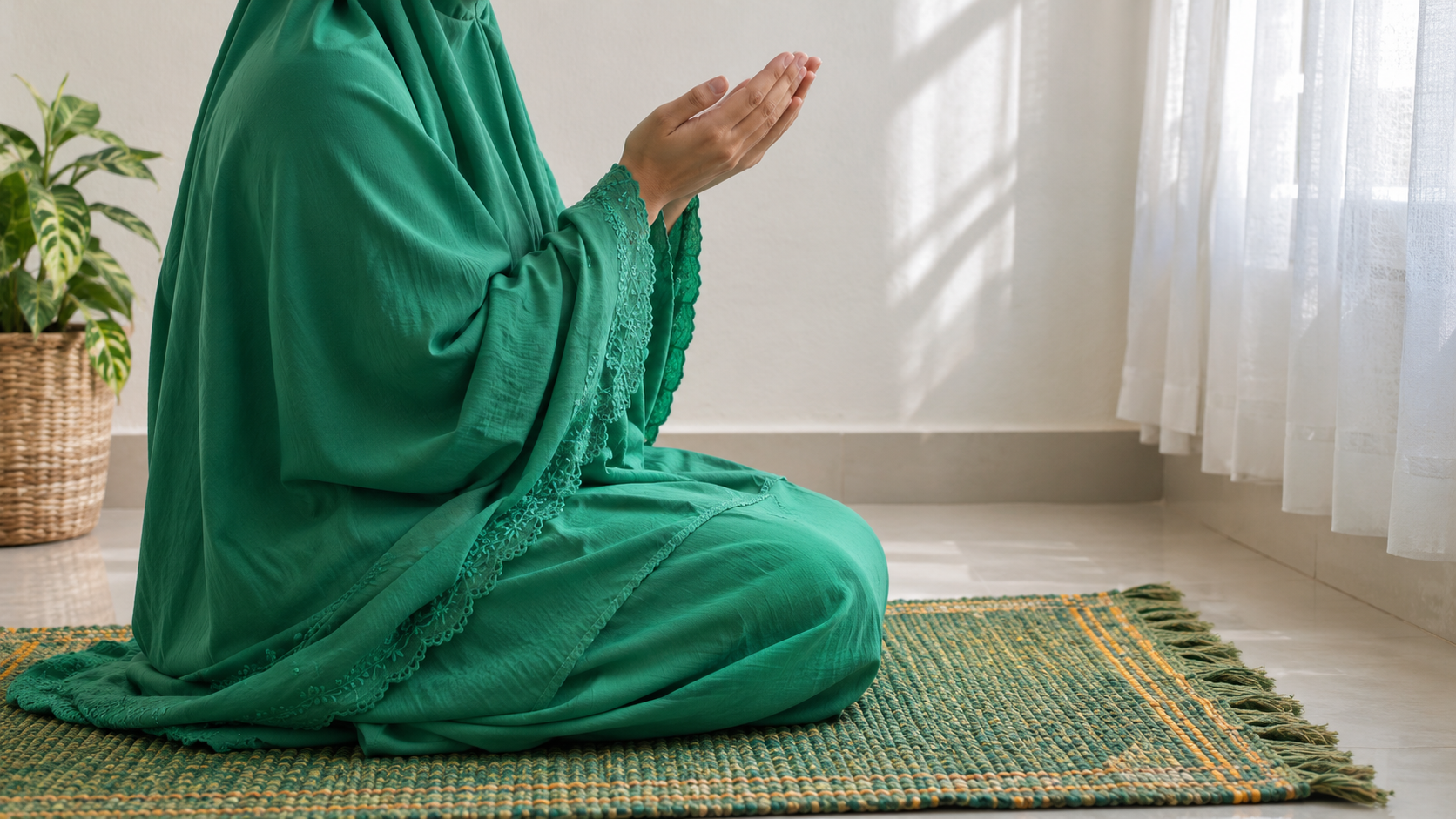
When you have a pressing need, it can be hard to know how to begin Salatul Hajat. This Salatul Hajat Checklist for Beginners gives you a simple starting point: make wudu, face the qiblah, pray two voluntary rakats at a suitable time, and ask Allah for what you need.
To pray the Prayer of Need, prepare as you would for any voluntary salah. Make your intention inwardly, pray two rakats in the usual way, and finish with salam. Then praise Allah, send blessings upon the Prophet Muhammad, and make your request in words you understand. You can start with a short, sincere dua in your own language.
The Purpose of Salatul Hajat
Salatul Hajat is a voluntary prayer you can offer when you want to ask Allah for help with a specific need. You might be facing an urgent decision, caring for a sick relative, or hoping for ease with an everyday responsibility. In each case, the prayer gives you a moment to worship Allah and express what you are asking Him for.
You can make dua as soon as a concern arises, even if you need to wait for a suitable time to offer voluntary salah. If a decision has you worried, for example, ask Allah for clarity and then take the practical steps available to you. You can explore how worship and supplication fit together in our Prayer of Need guide.
Your Checklist Before You Pray
Before you pray, check that you are ready for salah and that the time is suitable for voluntary prayer. Set aside a few uninterrupted minutes so you can recite at a steady pace. If you are new to praying, follow the sequence of a two rakat prayer that you have already learned.
Think of one need you want to bring to Allah. If it feels hard to put into words, name the kind of help you are seeking, such as patience through a difficult conversation or clarity about a family decision. You can keep that request in mind and say it after the prayer.
Wudu and Your Prayer Space
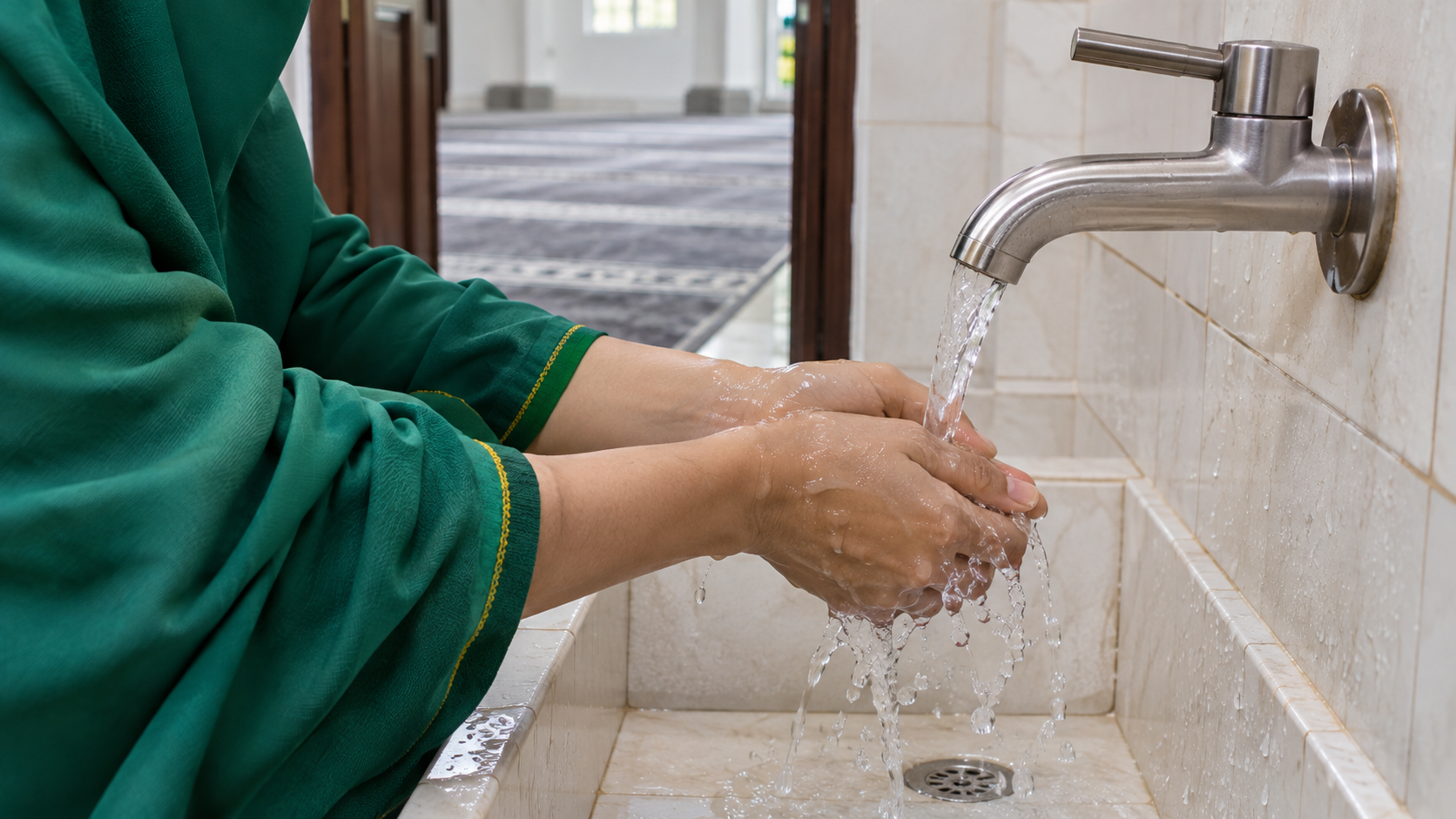
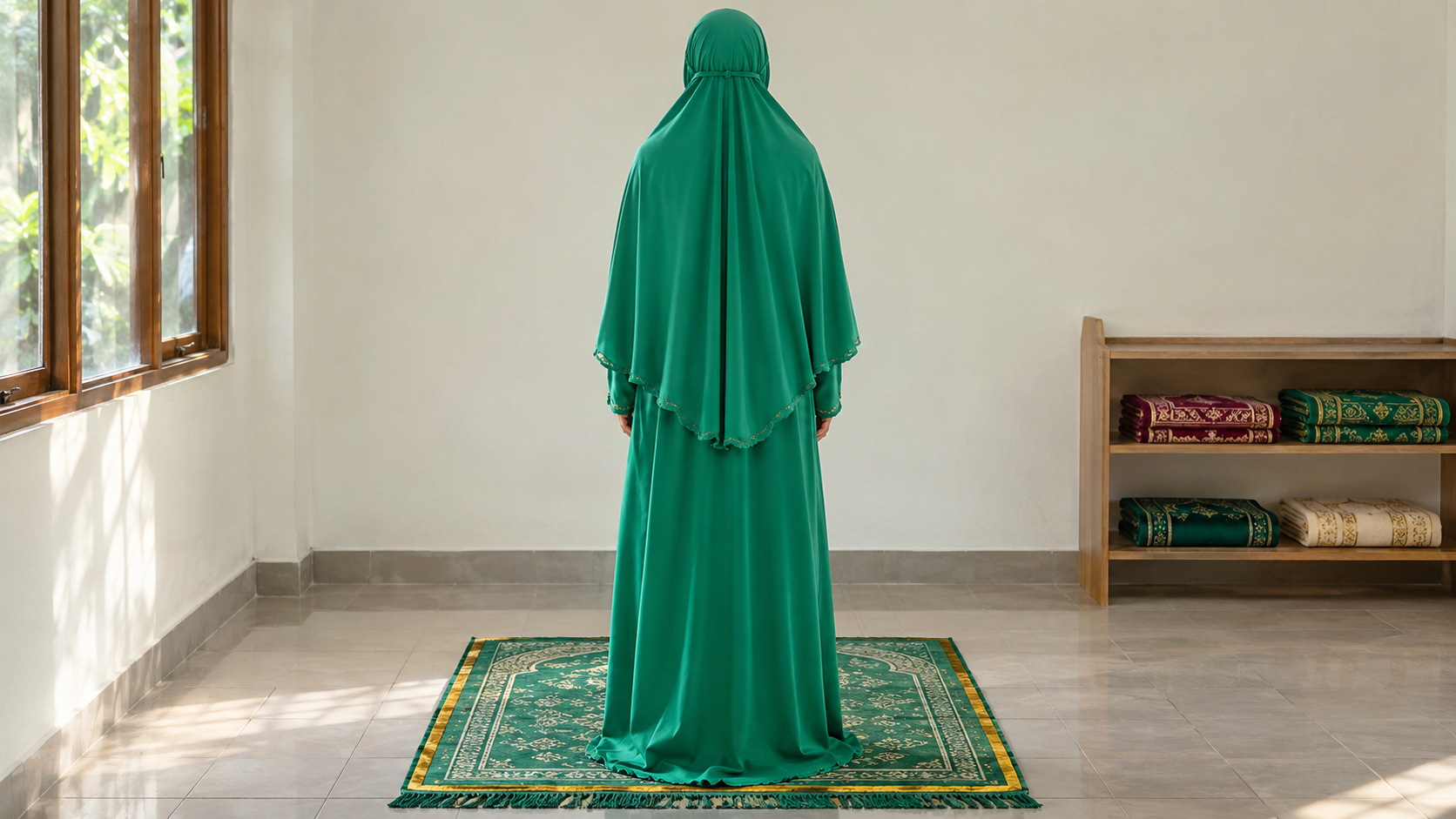
Make wudu if you need to renew it, wear clothing suitable for salah, and choose a clean place to pray. Face the qiblah, the direction of the Kaaba in Makkah. If you are somewhere unfamiliar, ask the people responsible for the prayer space or use a reliable way to check the direction.
At home, give yourself enough space to stand, bow, and prostrate comfortably. You can pray on a clean floor or use a prayer mat. If you are helping a child prepare, show them where to stand so they can focus on the movements once the prayer begins.
Your Intention for the Prayer
Make your niyyah, or intention, in your heart before you begin. Know that you are about to offer voluntary prayer to Allah and that you want to turn to Him about a need. A spoken formula is unnecessary for forming that intention.
Keep the intention simple if you are still learning the movements and recitations. Once you begin with the opening takbir, give your attention to the prayer itself. After salam, you can take your time explaining your situation in dua.
Rakat Counts in the Prayer of Need
Two rakats are a practical starting point for Salatul Hajat. A rakat is one unit of salah, and you can complete two using the familiar sequence of voluntary prayer. You may also encounter instructions for twelve rakats, so it helps to understand the basis of each account before treating any count as a requirement.
The count and the strength of the evidence are separate questions. You can offer ordinary voluntary prayer and then ask Allah for help. When a set of instructions also assigns a specific recitation or promises a particular result, check the basis for that claim with a teacher you trust.
The Basis for Two Rakats
The commonly cited account of Salatul Hajat describes making wudu, praying two rakats, praising Allah, sending blessings on the Prophet, and then supplicating. Al Tirmidhi comments on weakness in the chain of narration, which matters when deciding how confidently to attribute the specific formula to the Prophet. You can read the account and his comment in Jami al Tirmidhi 479.
For your own practice, you can pray two ordinary voluntary rakats and follow them with dua. Use the recitation and movements you have learned for voluntary salah. If you are still learning the sequence, review it with your teacher so you can approach the prayer with more confidence.
The Basis for Twelve Rakats
The twelve rakat version circulates as a longer, prescribed sequence, with particular recitations in some descriptions. The reports used to support this version lack reliable evidence for presenting it as an established practice of the Prophet. If you encounter a guide to twelve rakats, ask a qualified teacher about the report behind the count and the prescribed wording.
You can keep your own routine simple while you learn. Use two voluntary rakats and a personal dua as your starting point whenever you have a suitable opportunity. If you already follow a particular school of Islamic law, ask your teacher how it approaches named voluntary prayers and the evidence for their forms.
| Count | Basis | What to do |
|---|---|---|
| Two rakats | A commonly cited report with a weak chain | Pray two ordinary voluntary rakats and make dua. |
| Twelve rakats | Reports that lack reliable evidence for the prescribed sequence | Ask a qualified teacher before adopting a fixed routine. |
The Dua for Salatul Hajat
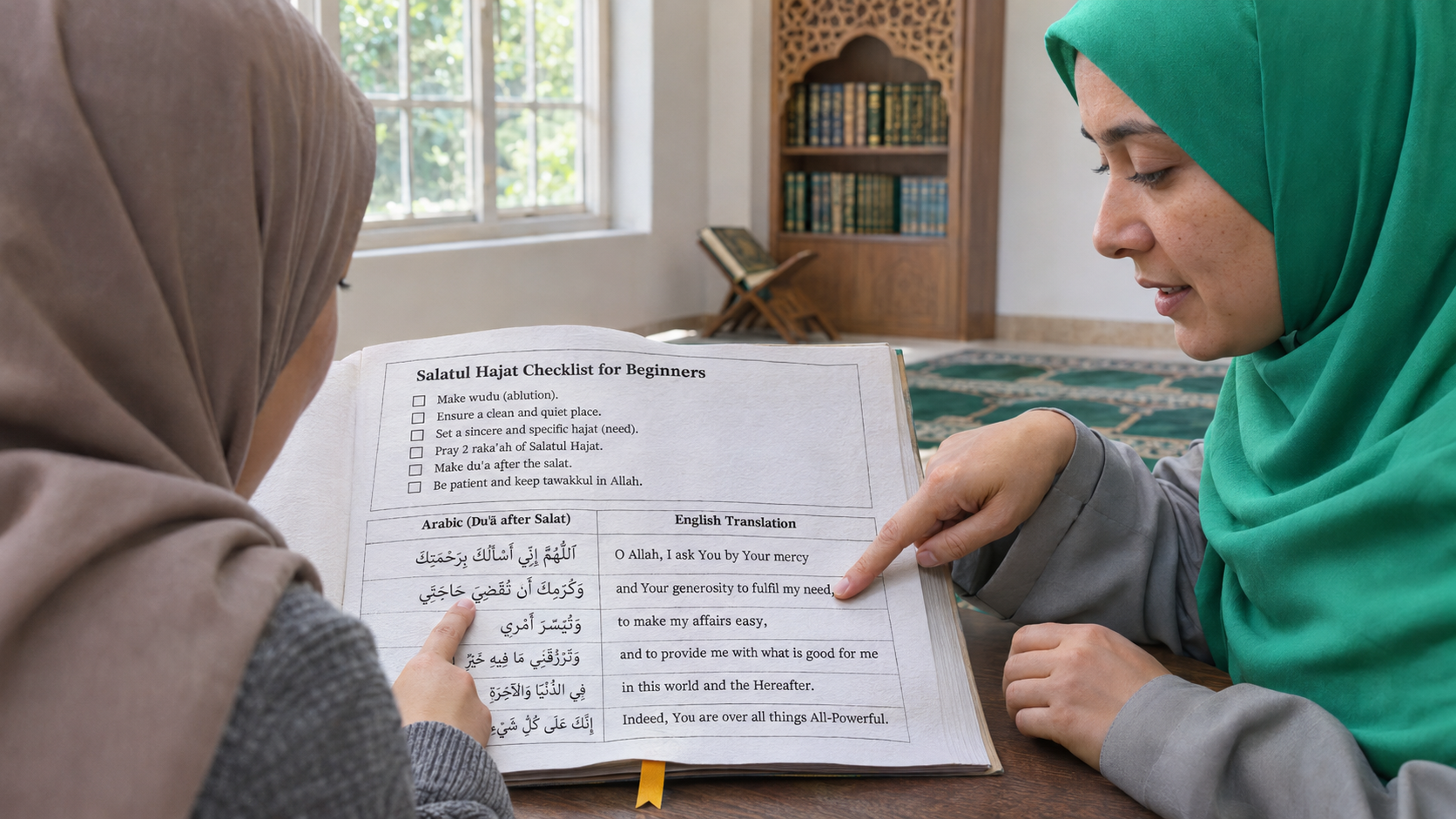
After salam, you can praise Allah, send blessings upon the Prophet Muhammad, and make dua for your need. Choose words you understand and include the help you are asking for. If you searched for Salatul Hajat ki dua, you may have seen the longer Arabic supplication transmitted in the report about the two rakat prayer.
You can also use a short Quranic dua before adding your own request. Reading its meaning can help you pay attention to what you are asking for. You can work through more examples with our beginner’s guide to duas.
Arabic Wording and English Meaning
One short Quranic dua you can use is رَبِّ إِنِّي لِمَا أَنْزَلْتَ إِلَيَّ مِنْ خَيْرٍ فَقِيرٌ. Its meaning is “My Lord, I am in need of whatever good You send down to me.” These are the words of Musa in Surah Al Qasas, verse 24.
The longer wording commonly associated with Salatul Hajat opens by affirming that Allah alone is worthy of worship and glorifying Him. It goes on to ask for mercy, forgiveness, safety from sin, relief from worries, and fulfillment of a need that pleases Allah. You can review the full wording and its meaning in our Salatul Hajat dua guide.
Asking Allah for Your Specific Need
After the prayer, name your need in your own words. If you are facing a difficult appointment, you might ask Allah to make it easy, help you speak clearly, and guide you toward a good outcome. If the issue involves someone you love, you can ask for their well-being and for the patience to support them.
You can ask for a particular outcome and also ask Allah to guide you to what is best for you. If you have several concerns, take them one at a time. You can include gratitude for your daily blessings as well as requests for help.
“Let your Salatul Hajat Checklist for Beginners bring you to the point where you can ask Allah plainly for the help you need.”
Key Takeaways
The simplest routine is to prepare for salah, pray two voluntary rakats when voluntary prayer is permitted, and make a personal dua after salam. The two rakat account is commonly cited with a weak chain, and the prescribed twelve rakat sequence lacks reliable support. If those accounts have left you unsure what to do, you can begin with the voluntary prayer you already know.
Keep three reminders where you can find them before you pray. Read them while you are getting ready, especially if the need is urgent and you feel distracted. A short checklist also makes it easier to guide a child who already understands the basics of salah.
- Check your wudu, clothing, prayer space, and qiblah.
- Choose a suitable time and complete two voluntary rakats in the usual way.
- After salam, praise Allah, send blessings upon the Prophet, and ask for the help you need.
Frequently Asked Questions
How do you pray Salatul Hajat step by step?
You can pray two voluntary rakats when the time permits and ask Allah for your need after salam. If you are choosing a time, use a timetable for your own location. The local sunrise and sunset times matter more than any fixed hour you see in a general guide.
What are the three times to avoid praying Salatul Hajat?
If your schedule allows, you can make time for prayer overnight. You can also make dua during the day when you need help immediately. Our comparison of Salatul Hajat and Tahajjud explains how the two prayers relate.
What is the best time to pray Salatul Hajat?
Make wudu, face the qiblah, and intend to offer two voluntary rakats. Begin with takbir and recite Al Fatihah and a Quran passage in each rakat. Complete the bowing and prostrations in the usual order.
How many times can you pray Salatul Hajat in a day?
Finish the second rakat with the final sitting and salam. Praise Allah and send blessings upon the Prophet Muhammad. Then make your request in your own words.
Avoid voluntary salah as the sun rises, as it reaches its highest point before Dhuhr, and as it sets. These three periods are named in a hadith. Read Sahih Muslim 831a.
Common guidance also restricts ordinary voluntary prayer after Fajr and after Asr. Ask your teacher how your school applies these rules. You can make dua while you wait.
The last third of the night is a particularly good time for dua. You can offer voluntary prayer then and ask Allah for your need. See Sahih al Bukhari 1145.
To find that window, divide the time from Maghrib to Fajr into three equal parts. The final part ends at Fajr. Any suitable time for voluntary salah can work.
There is no established daily count for Salatul Hajat. You can offer voluntary prayer again at a permitted time. You can ask for the same need each time.
If the concern returns during the day, you can also make dua on its own. Keep your obligatory prayers a priority. Choose a rhythm you can manage alongside your commitments.
Conclusion
Your Salatul Hajat checklist can stay simple. Prepare with wudu and a clean place to pray, choose a suitable time for two voluntary rakats, and ask Allah for your need in words you understand. This week, pick one concern you want to bring to Allah and check your local prayer timetable for a quiet window. If you are helping a child learn, review the two rakat sequence together before you pray.
At Hidayah Quran Academy, sisters, children, and adult beginners can try a free 30 minute private Quran lesson with a qualified female teacher on Zoom or WhatsApp. Bring your questions about Quran reading or Arabic duas, and use the session to see how one on one lessons fit your learning goals. Book Free Trial to arrange your session.